
Govt vows to protect integrity of new TVET qualifications framework
The warning was issued by the acting education and sports minister, Dr John Muyingo, who said the government would not tolerate individuals or institutions seeking to undermine the framework.
The acting Minister of Education, Dr John Muyingo (centre), with the executive director of TVETC, Moses Kasakya (left), Dr Safina Musenene (third right), UNICEF official Barno Mukhamadieva and Asuman Lukwago during the launch of the Uganda TVET qualification framework at Kampala Serena Hotel on Friday, November 13, 2026. (Photo by Francis Emorut)
_________________
The government has warned against attempts to discredit or undermine the Uganda TVET Qualifications Framework, saying it will safeguard the credibility and integrity of the system.
The warning was issued by the acting education and sports minister, Dr John Muyingo, who said the government would not tolerate individuals or institutions seeking to undermine the framework.
“Government will safeguard the integrity and credibility of the Framework. We shall not allow it to be undermined by shortcuts, fraudulent qualifications, the issuance of fake certificates or institutions that operate outside the established regulatory framework. The credibility of our qualifications must be protected at all times,” Muyingo said.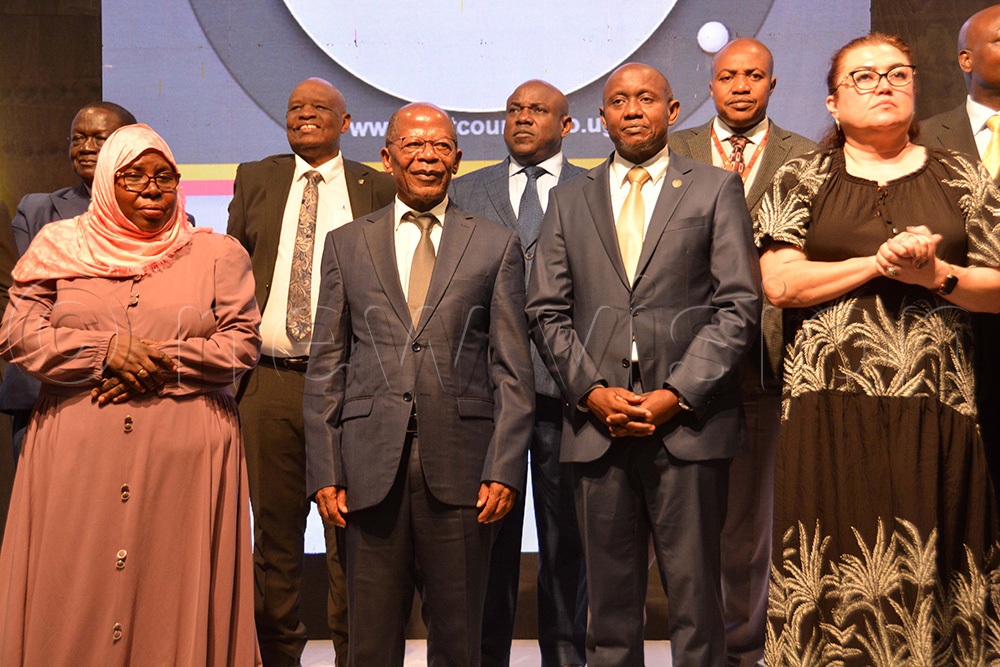
Front row, left to right: Commissioner Dr Safina Musenene, Acting Minister of Education Dr John Muyingo, Dr Tonny Tumwesigye and UNICEF official Barno Mukhamadieva posing for a photo after the launch. (Photo by Francis Emorut)
He said the framework was a product of collective effort, collaboration and shared commitment.
“I therefore call upon all stakeholders to embrace it, fulfil their respective responsibilities and work together to ensure that it delivers the intended outcomes for Uganda.”
Muyingo made the remarks during the launch of the framework at Kampala Serena Hotel on November 13, 2026.
Under the framework, a young person can start with a Primary Leaving Examination certificate, become a certified artisan, progress to craftsperson level and advance through the training system to attain a Bachelor of Technology, Master of Technology or even a Doctorate of Practice.
Opportunities under the framework
The framework provides opportunities for individuals to work while studying, acquire additional skills, progress to higher levels of training and return to education without losing qualifications and competencies they have already attained.
He encouraged girls and young women to embrace technical and vocational training, particularly in fields such as engineering, information and communication technology, construction, automotive technology and agro-processing.
“These are not exclusively men's trades. They are Uganda's trades, and our girls and women must be equally empowered to participate and excel in them,” he said.
He also urged stakeholders to ensure that persons with disabilities were not left behind.
Muyingo said the Ministry of Education and Sports would provide the policy guidance, institutional coordination, capacity-building support and resource mobilisation required for the effective implementation of the framework.
He added that the Government would promote the portability and international recognition of Ugandan skills and qualifications, noting that many young people seek employment within the East African Community, the Middle East and other international labour markets.

“It is important that their qualifications and competencies are recognised wherever they go to work,”.
He reminded the audience that, through the Tenfold Growth Strategy, the Government aspired to expand Uganda's economy from approximately $50b to $500b.
He said the transformation would be driven by strategic growth in agro-industrialisation, tourism, mineral-based industrialisation, oil and gas, and science, technology and innovation.
He also cited Section 28 of the Technical and Vocational Education and Training Act, 2025, under which the Government had approved the Uganda TVET Qualifications Framework as a binding and mandatory instrument for all actors in the TVET system.
Implications of the qualification framework
With effect from the date of approval, no TVET programme or qualification shall be accredited unless it complies with the requirements of the Uganda TVET Qualifications Framework.
Similarly, only qualifications duly recognised and recorded on the TVET Qualifications Register shall be considered.
“Any qualification that is not listed on the Register shall not have official recognition for purposes of employment, further education or professional recognition within the TVET system,” Muyingo stated.
Moses Kasakya, the executive director of the Technical and Vocational Education and Training Council (TVETC), said Uganda needed a skilling system that responded to market needs, describing the framework as a ray of hope for Ugandans, particularly young people.
“Its door opens to those who can demonstrate their skills and reflect on the need they are capable of doing,” Kasakya said.
The UNICEF chief of learning and skilling, Barno Mukhamadieva, said the framework should not discriminate or leave any child or person with disabilities behind.
Education ministry permanent secretary Dr Ketras Turyagenda, who was represented by commissioner Dr Safina Musenene, said the framework formed an integral part of the broader Uganda Qualifications Framework architecture, which seeks to bring coherence, transparency, comparability and progression across the entire education and training system.
She said qualifications at the national level were organised through interconnected sub-frameworks serving different sectors of education and professional practice.
She added that the Uganda TVET Qualifications Framework provided pathways for artisans, craftsmen, technicians, technologists and other skills-based occupations.