
Govt urged to review affirmative action policy
Rosette Nanyanzi, the Gender Technical Advisor at the Ministry of Education and Sports, emphasised the need for girls to learn life skills, which are critical for them as they grow.
(L-R) Alice Kagoda, an Executive Committee member with Getrude Ssekabira, the President Association of University Women Uganda, Sarah Bunoti, the Vice President and Rose Bwire, a member at the association during the policy dialogue workshop on October 6th 2026. (Credit: Nicholas Oneal)
KAMPALA - Experts have called on the Government to review policies on supporting the girl child in enrolling on university and climbing up the education ladder.
Gertrude Ssekabira, the President of the Association of University Women, Uganda (AUWU), which has lasted since 1956, said she witnessed the implementation of the initial affirmative action policies and called for a review of many of them.
“We are certain that when stakeholders come together, they will inform policy recommendations by providing evidence-based reforms. We shall evaluate them and come up with proposed changes for the future,” she remarked during a breakfast policy dialogue organised by AUWU at Fairway Hotel in Kampala today (October 6).
Affirmative action refers to policies designed to address systemic discrimination by improving access to education, employment, and other opportunities for historically marginalised groups.
At university level, the affirmative action policy grants female students an extra 1.5 points added to the points they get after sitting for Uganda Advanced Certificate of Education (A’ level) exams, which their male counterparts do not get.
She revealed that AUWU intends to support over 80 girls from rural districts in primary and secondary levels in the next four years.
She encouraged stakeholders to go to the grassroots and support girls because having many action points without implementation yields little results.
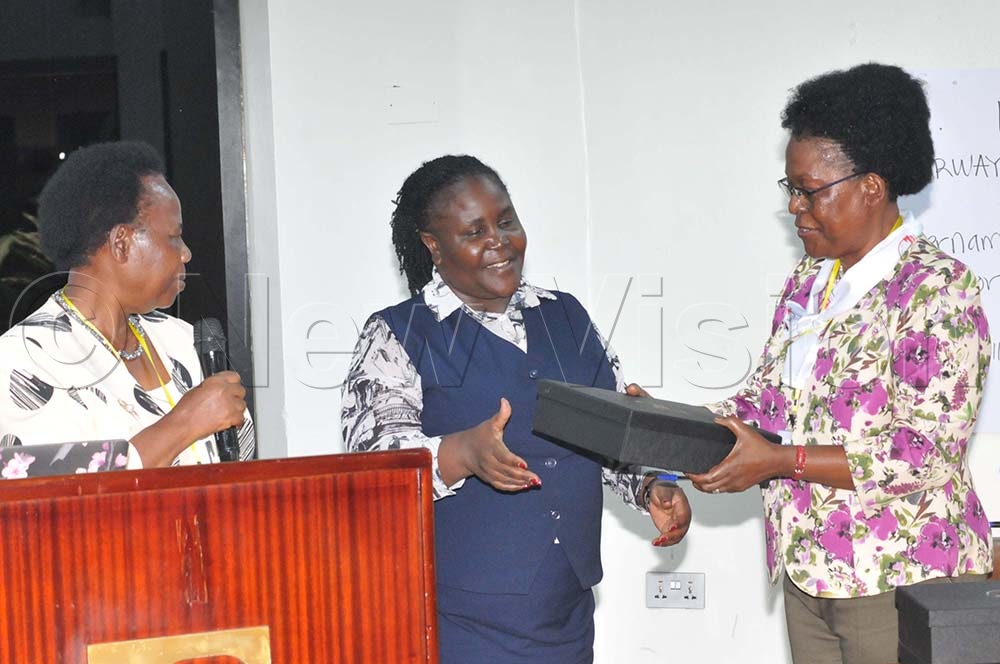
Sarah Bunoti (R), the Vice President Association of University Women Uganda hands over a gift to Rosette Nanyanzi, the Gender Technical Advisor at the education ministry as Getrude Ssekabira, association's president looks on. (Credit: Nicholas Oneal)
Rosette Nanyanzi, the Gender Technical Advisor at the Ministry of Education and Sports, emphasised the need for girls to learn life skills, which are critical for them as they grow.
She noted that teachers should embrace gender supportive means of learning to support girls in their learning.
“We have heard cases of girls being demoralised to take up STEM (Science, Technology, Engineering and Mathematics) subjects in class, and this psychologically deters them, hence opting out,” Nanyanzi said.
She called on schools to create conducive learning environments so that girls can be able to complete their studies.
Aramanzan Madanda, the Senior Gender Technical Advisor at Care International in Uganda, appealed to the Government to address the structural barriers hindering women, calling for social norms not to affect them.
He appealed to women to actively participate in business by investing in the production sector, where they can get returns in the long run other than merely investing in consumables.