
Govt moves to embed life skills in national curriculum
“Life skills are abilities that enable individuals to respond to demands, challenges, and opportunities in life in such a way that they remain happy and satisfied,” Dr Mugenyi said.
Eriya Kisambira (standing middle), the District Education Officer for Jinja City giving his comments about life skills during the two-day Life Skills Learning event at Civil Service College, Uganda in Jinja City which started on March 25. (Photos by Donald Kiirya)
________________
The Ministry of Education and Sports has announced a strategic shift towards fully integrating life skills into the national education system, moving away from short-term pilot projects to a sustainable, government-funded model.
The development was announced by Dr Cleophus Mugenyi, the commissioner of basic education, while representing the permanent secretary of the Ministry of Education and Sports, Kedrace Turyagyenda, at a two-day Life Skills Learning Event held at the Civil Service College in Jinja.
The event, which started on March 25 and ended on March 26, 2026, brought together ministry officials, district education officers, development partners including UNICEF and Irish Aid, teacher trainers, and other key players to reflect on achievements, challenges, and the way forward for the life skills programme.
He delivered a keynote address stressing that life skills are essential for learners to cope with academic pressures, punctuality, discipline, and broader life demands.
“Life skills are abilities that enable individuals to respond to demands, challenges, and opportunities in life in such a way that they remain happy and satisfied,” Dr Mugenyi said.
He cited the example of children living with HIV/AIDS who need support to adhere to medication, interact positively with peers, and maintain their health.
From pilots to policy
The life skills programme, which began five years ago as a small pilot, has now been scaled to over 65 districts in Uganda.
Dr. Tillmann Guenthes (right), the Adolescent Development Manager at UNICEF Uganda facilitating a topic about life skills during the two-day Life Skills Learning event at Civil Service College, Uganda in Jinja City which started on March 25. 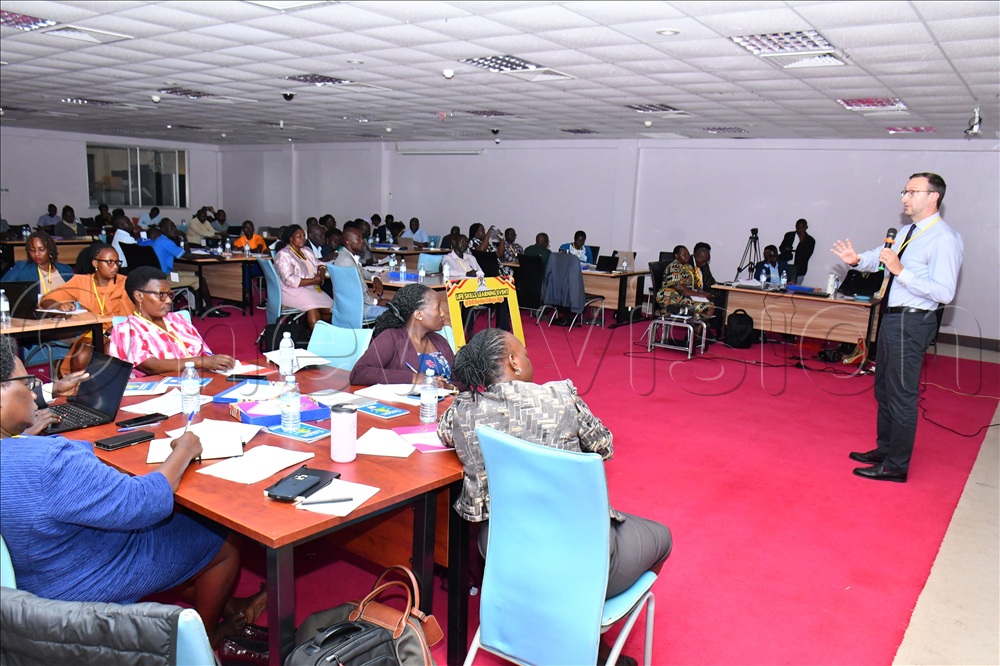
However, Dr Mugenyi warned that relying solely on donor support from partners like UNICEF and Irish Aid is a risk to long-term success.
"A stream that relies solely on rain will dry up—we must move from pilot projects to system financing where the Ministry takes over and plans for it. This ensures that even when donors leave, the program continues," Dr Mugenyi cautioned.
The Commissioner emphasised that life skills such as critical thinking, communication, and emotional intelligence are non-negotiable pillars for a workforce facing a volatile and complex future.
Digital literacy as a foundational skill
A major highlight of the summit was the push for a digital agenda, where Dr Mugenyi advocated for a transition from traditional textbooks to digital resources, suggesting that even early learners must be equipped with the skills to navigate Artificial Intelligence (AI) and the internet.
"The world has gone digital—we need to move to ICT so that children can access information online anywhere, anytime," he said.
He further challenged universities to embrace virtual lectures to reduce spending on physical infrastructure such as lecture theatres.
Addressing social challenges
The urgency for life skills is underscored by rising cases of mental health issues and social pressures among learners.
Rosette Nanyanzi, the gender technical advisor at the Ministry of Education and Sports, noted that these skills are vital tools in the fight against teenage pregnancy and youth suicide.
"Many graduates come out but cannot manage life. We see them committing suicide or entering unwanted marriages because they cannot manoeuvre through challenges," Nanyanzi stated.
She added that life skills empower girls to resist temptations and prevent boys from becoming child fathers, which often halts their educational journey.
Dr Tillmann Guenthes, an adolescent development manager at UNICEF Uganda, commended Uganda’s progress, noting the impressive scale-up from a small pilot to broader coverage in primary and secondary education.
He described Uganda as an advanced model in life skills education that other African countries seek to emulate.
The discussion focused on institutionalising the life skills toolkit across all schools and ensuring sustainable government funding.
The role of teachers and leadership
Eriya Kisambira, the district education officer for Jinja city, acknowledged that many teachers still lack effective methods to impart life skills, with schools often prioritising exam-oriented teaching.
In the Busoga region, the programme has trained 256 teachers and reached over 10,000 learners across 24 schools in Jinja and Kamuli districts.
He expressed hope that Jinja could serve as a case study for successful nationwide scaling.
Participant perspectives on sustainability
Participants proposed using continuous professional development programmes for faster integration of life skills into teaching practices, alongside establishing life skills clubs in training institutions for sustainability.
Another participant emphasised that life skills should not be taught in isolation but embedded through project-based learning, varied teaching methods, and teacher role modelling.
Effective assessment, she said, comes from observing learners’ hands-on problem-solving and engagement.
The workshop reflected a shared commitment to moving life skills from a peripheral project to a core, sustainable pillar of Uganda’s education system, preparing learners not just for examinations but for responsible citizenship and a complex future.