
EOC urges schools to expand opportunities for marginalised learners
The Commission has asked school administrators to consider providing at least one scholarship opportunity each year for a learner with a disability and to develop policies that promote the admission and retention of children from disadvantaged communities.
The Secretary to the Equal Opportunity Commission EOC), Dr. Shaft Nasser Mukwaya (left), speaks to head teachers as the Commissioner for Compliance and Enforcement at EOC, James Mugisha (second left), looks on during the Equal Opportunity Commission dialogue with Education stakeholders at the commission offices in Kampala. On the right are the headteacher of Namasagali College, Siminyu Benah, Canon Ssenkungu David (second right) and the Headteacher of Trinity College Nabbingo, Lwanga Immaculate Nassozi. (Photos by Ronnie Kijjambu)
________________
The Equal Opportunities Commission (EOC) has urged Government-aided secondary schools to deliberately create opportunities for learners from marginalised groups, including children with disabilities and ethnic minorities, amid concerns over the rising cost of education.
The Commission has asked school administrators to consider providing at least one scholarship opportunity each year for a learner with a disability and to develop policies that promote the admission and retention of children from disadvantaged communities.
Dr. Shaft Nasser Mukwaya, the secretary to the Commission, said schools should go beyond providing education to ensure that children facing social and economic disadvantages are not excluded from opportunities.
“We request you put in place a policy to admit at least one Person With Disability (PWD) or a child from an ethnic minority,” Mukwaya said.
He was speaking on Tuesday during a consultative dialogue on the cost of education and school fees in Government-aided schools organised by the EOC at the Commission's head offices at Kingdom Kampala.
The meeting brought together more than 14 head teachers from secondary schools in different parts of Uganda to discuss school fees, access to education and equality in the provision of education services.
Mukwaya said schools could play an important role in widening opportunities for communities that have historically had limited access to education.
He cited the Ik community in Karamoja, noting that until recently the community had not had a university graduate, before scholarship interventions opened up opportunities for learners.
The EOC also commended school heads for confirming that they do not interfere with learners' freedom of worship.
A group photograph of participants after the Equal Opportunities Commission dialogue with Education stakeholders at the commission offices in Kampala.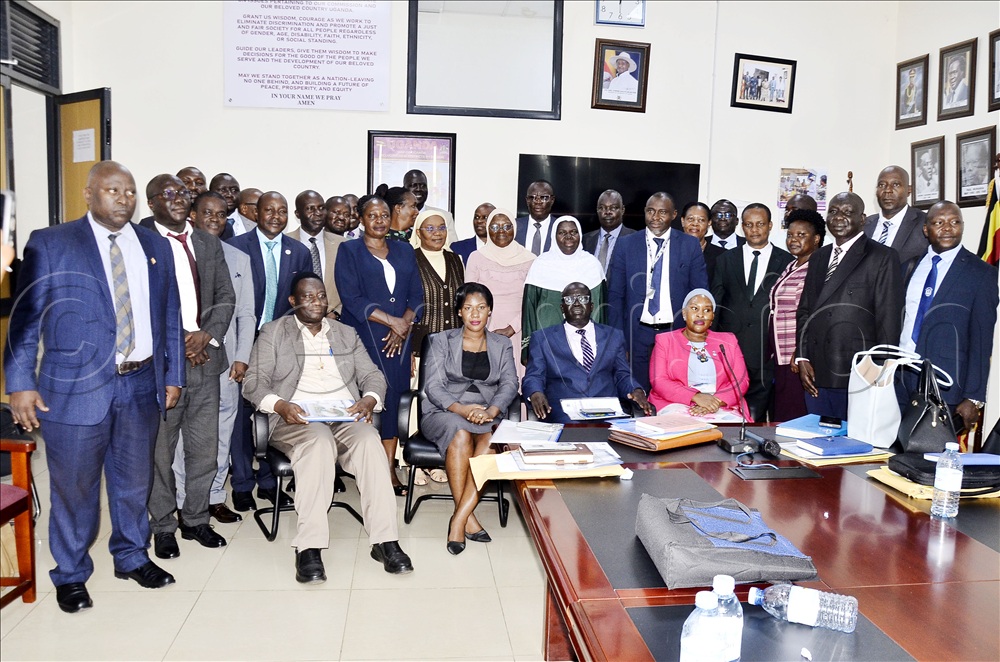
Mukwaya said this clarification was important because the Commission had previously received complaints from stakeholders alleging that some schools were interfering with learners' freedom of worship.
Fees and access
The EOC recommendations came against the backdrop of submissions from school heads that inadequate Government funding, staffing shortages and rising operational costs were making it difficult for schools to provide services without additional financial contributions from parents.
The school administrators argued that school fees should be considered in the context of the actual costs involved in running individual institutions.
Godfrey Kasamba, the head teacher of King's College Budo, said the school is entitled to 101 Government-paid teachers but currently has only 50, creating a staffing gap of 51 teachers.
The school is also supposed to have 13 Government-paid non-teaching staff, but only two are currently on the Government payroll, he said.
Kasamba said Budo has about 2,600 students occupying a compound of more than 200 acres, with a four-kilometre perimeter wall that also requires maintenance and security.
He said the school employs more than 40 security guards and about 115 other non-teaching workers, with much of the cost being met by the school and parents.
At Namasagali College, head teacher Benah Siminyu said the Government provides sh53,000 per learner per term, which she said becomes inadequate when distributed across the entire school term and the range of services it is expected to support.
“When you break that down to the number of days, that is about sh623 per child per day. That money is supposed to take care of everything to do with the studies of that child for the entire term,” she said.
Siminyu said Namasagali College has 21 teachers against an establishment of 39, leaving a shortage of 18 teachers.
The school also has 15 non-teaching staff, while it has to meet expenses for water, electricity, maintenance, scholastic materials and co-curricular activities.
EOC study
The dialogue was informed by an EOC study that was conducted in May this year, covering at least 85 secondary schools across Uganda, according to Susan Atukunda, a senior research officer at the Commission.
The discussions sought to examine the factors influencing school fees and whether the cost and conditions of accessing education could create inequalities among learners.
The EOC said its concern was not limited to the amount charged by schools but also whether children from disadvantaged backgrounds were able to access and benefit from education on equal terms.
The Commission's mandate includes eliminating discrimination and inequalities against individuals or groups and promoting affirmative action for marginalised communities.
The dialogue therefore brought together concerns from both sides: school heads highlighted the financial pressures created by inadequate staffing and operational costs, while the EOC emphasised the need for schools to ensure that such challenges do not further exclude disadvantaged learners.
The meeting was attended by EOC officials, including Commissioner for Compliance and Enforcement James Mugisha, senior research officer Atukunda, and principal communication and information officer Yusuf Muziransa.