
Chief Justice Zeija urges institutions to hire for skills, not certificates
“They now look for what skills you have or what you can offer,” Zeija said.The Chief Justice said education systems should therefore produce young people capable of questioning, imagining, creating and solving problems.
Zeija said academic qualifications remain important but should be complemented by practical competencies that enable graduates to respond to real-world challenges. (Credit: Aloysious Kasoma)
KAMPALA - Chief Justice Dr Flavia Zeija has urged institutions to focus on skills, competence and problem-solving abilities when recruiting professionals, rather than relying solely on academic qualifications.
Zeija made the call at the launch of Uganda’s One Million Books Fundraising campaign at Makerere University on Friday.
The Chief Justice pointed out that Uganda’s transformation will depend on the quality of its human resources, arguing that infrastructure and other investments cannot deliver sustainable development without competent people to manage and utilise them.
“Nations are not transformed by infrastructure alone. You can build roads, schools, hospitals, courts and universities, and every one of these eventually depends upon the quality of the human being who occupies them," Zeija said.
He was speaking during the launch of three books, where he challenged institutions, educators and professional bodies to rethink how they prepare people for the workplace and national development.
Real-world challenges
Zeija said academic qualifications remain important but should be complemented by practical competencies that enable graduates to respond to real-world challenges.
“A certificate can tell us what someone studied. It cannot always tell us who that person has become,” he said.
He added that employers are increasingly interested in what individuals can contribute through their skills, rather than simply the qualifications they possess.
“They now look for what skills you have or what you can offer,” Zeija said.
The Chief Justice said education systems should therefore produce young people capable of questioning, imagining, creating and solving problems.
He added that young people should move beyond asking where they can find jobs and instead develop the capacity to identify challenges and create solutions that can contribute to Uganda’s economic transformation.
Zeija also called on institutional leaders to pay greater attention to the welfare of professionals, warning that excessive pressure can undermine the very institutions they are expected to strengthen.
“Professional well-being, therefore, is not merely a private matter. It has institutional consequences,” he said.
He said the issue affects the judiciary as well as hospitals, universities, schools, businesses and public institutions.
“A healthy justice system requires healthy people, and the same is true of our hospitals, universities, schools, businesses, and public institutions,” Zeija said.
He also urged employers to create environments where professionals can achieve excellence while maintaining their health, family life, emotional well-being and ability to reflect.
Zeija said strong institutions should not be built on exhausted employees, but on professionals equipped with the right skills and supported to perform effectively.
His remarks form part of a broader call for Uganda to shift from measuring success through certificates alone to developing a workforce capable of applying knowledge, solving problems and driving national transformation.
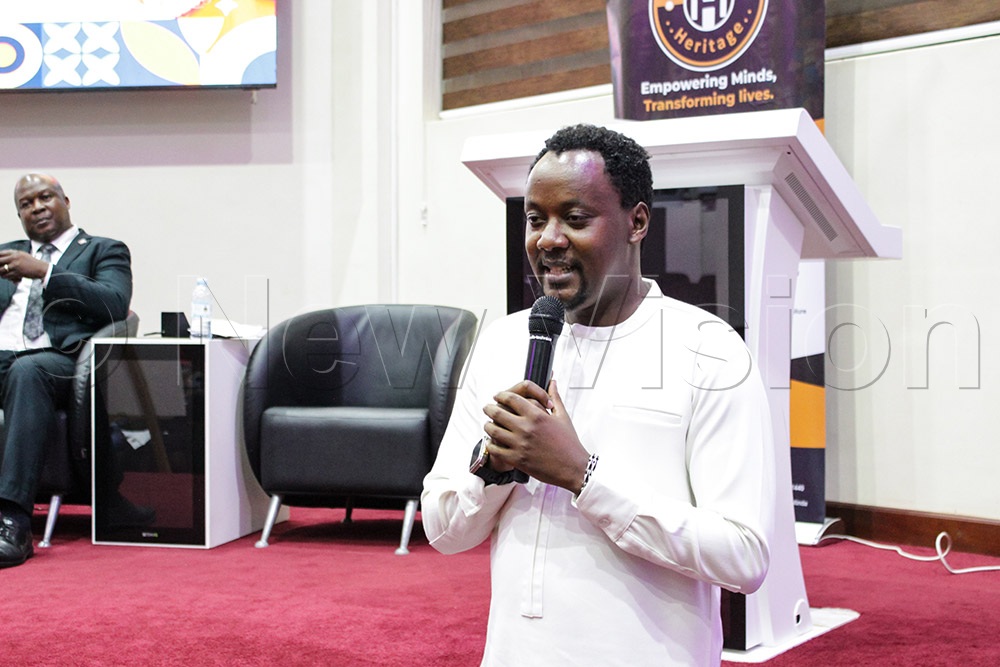
My Heritage (MH) African Foundation founder, Gardner Rwakiseta Herbert, said the initiative is not merely about putting books in schools, but creating opportunities for young people to develop their potential. (Credit: Aloysious Kasoma)
Creating opportunities for youth
My Heritage (MH) African Foundation founder, Gardner Rwakiseta Herbert, said the initiative is not merely about putting books in schools, but creating opportunities for young people to develop their potential.
“Our mission today is not all about delivering one million books in schools. It is about opening up one million opportunities,” Rwakiseta said.
The campaign will be anchored on three books, including Mind Reset, which focuses on identity, purpose and generational impact.
Rwakiseta said Mind Reset profiles 148 icons from East Africa, including 102 Ugandans who have made contributions in education, leadership, politics, innovation, music and sport. The book is intended to help young people understand their history and overcome self-limiting beliefs.
The foundation will first train teachers before distributing the books. Teachers will establish school clubs where learners will discuss the books through poetry, music, drama, quizzes and public speaking.
Influencing generations
Prof. Tersis Kabwegyere, who reviewed the books, said their content goes beyond conventional learning, with lessons capable of influencing generations.
“This is a generation impact. You cannot read these books and remain the same. I have also learned that people who make history are not many,” Kabwegyere said.
Educationist Victoria Kisarile said many young people are not short of intelligence, but lack the tools needed to discover and develop their potential.
She said Uganda’s education system has traditionally placed greater emphasis on remembering and understanding, while paying less attention to nurturing individual strengths and character.
“Most of us went through an education that determined remembering and understanding only at levels one and two. We celebrate marks, but education must embrace methods that nurture individual strength. Children must understand and develop their character,” Kisarile said.
She added that education should go beyond academic performance to equip learners with practical skills that enable them to understand themselves, identify their strengths and make meaningful contributions to society.
Her remarks reinforce the foundation’s argument that the books are intended to complement formal education by addressing areas such as identity, critical thinking, emotional intelligence and personal development.