
King Oyo in the face of conservation, tourism
On numerous occasions, King Oyo appealed to the central government plus the tourism ministry to restore wildlife corridors which used to connect one protected area to another.
Toro King Oyo Kabamba Iguru Rukidi IV (left) with his executive assistant, Jonathan Baguma, raising the Kingdom flag at Margherita peak on Mountain Rwenzori during his hiking expedition which started on July 28 to August 7, in a campaign to conserve biodiversity of Mountain Rwenzori. (Photos by Julisu Luwemba)
________________
Two years after Lilly Ajarova (then chief executive officer for Uganda Tourism Board) had descended the tallest mountain in Uganda, King Oyo Kabamba Iguru, of Toro, was inspired to take on the challenge, later conquering the Margherita peak of the Rwenzoris in August 2022.
The king's hiking expedition, which started on July 28, 2022, aimed at emphasising the importance of environmental conservation, climate action and inclusive growth as a core to Uganda's sustainable development journey.
King oyo of Tooro (standing infront) with other members of the Royal family catching a glimpse of two gorillas swinging by the trees inside Bwindi Impenetrable national park during the gorilla tracking expedition in April 2025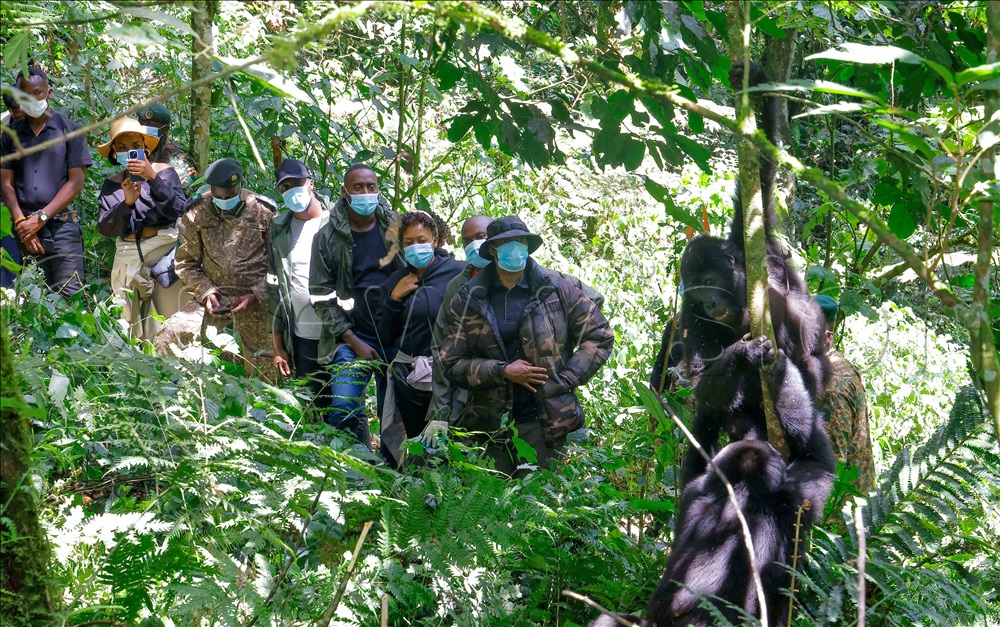
King Oyo's historic expedition was organised by the Uganda Tourism Board (UTB) in partnership with the United Nations Development Programme (UNDP) and Toro kingdom. Upon taking on the mystical challenge of summiting the highest point of the Rwenzori Mountains on August 3, 2022, King Oyo echoed the fact that Rwenzori Mountains are a source of life.
"Walking through ecosystems seemingly from another world where you can lose yourself among wildflowers of indescribable beauty shrouded by the mist of the mountains of the moon. Clouds that never stop dancing over sleeping giants mired in an eternal rest that only can be broken by those who are brave enough. It is a place where purity of the air drives you to keep climbing," the King describes in his oratory.
He also advocated for responsible tourism. "Tourism not only brings economic prosperity, but also plays a vital role in raising awareness about the importance of preserving our natural heritage. I believe that through responsible tourism, we can inspire visitors to become active participants to conservation efforts and sustainable practices," King Oyo remarked upon descending the highest pinnacle of Uganda.
King Oyo trudged from the grassland at the foot of the mountain, through the dense montane forests, up through the bamboo to the heather zone before summiting to the glacier-covered rocky peak of the block mountain. His hike up mountain Rwenzori further highlighted the resilience, endurance and a need to conserve nature as well as diversify Uganda's tourism products.
Upon taking on the mystical challenge of summiting the highest point of Uganda, King Oyo also kicked off his bucket list, the top-sought-after tourism expedition- gorilla tracking. The monarch, in company of ten (10) members from the Royal family, tracked the gorilla family of Binyindo in Buhoma sector, Bwindi Impenetrable national park on April 26, 2025. It was another journey in which the king stepped beyond the symbolism of his crown and into the heart of Uganda’s conservation story.
Best Kemigisha welcoming back her son King Oyo Kabamba Iguru (left) with his executive assistant prince Jonathan Baguma from their hiking expedition in 2022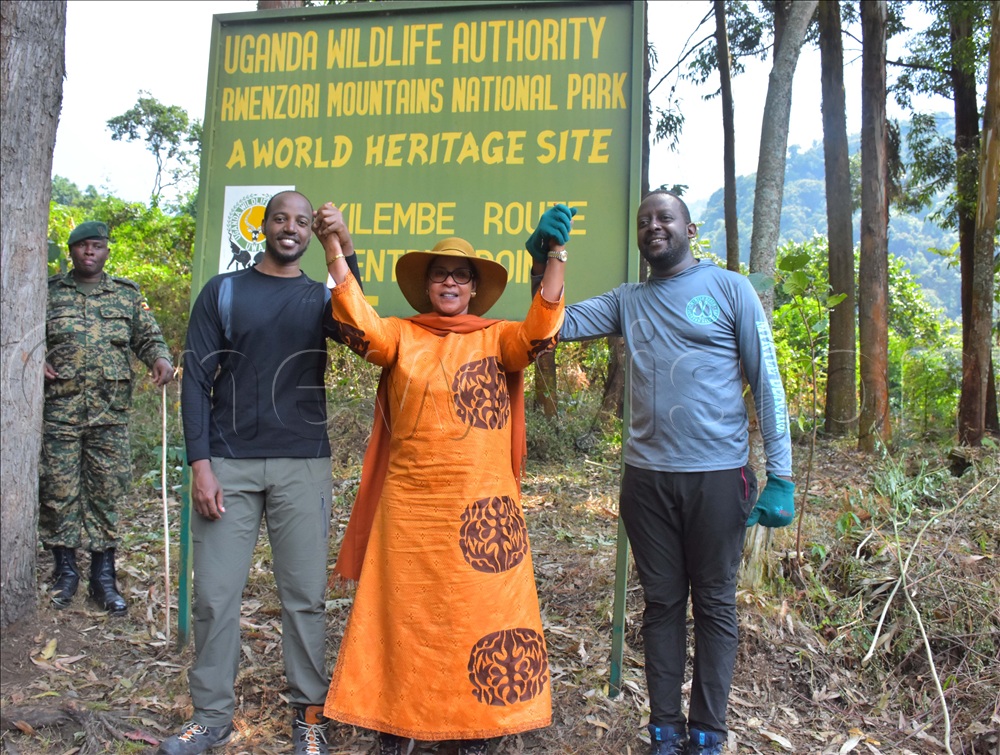
The tour was part of Oyo's deliberate efforts to drum up Uganda's sustainable tourism with an inclination to conservation.
"We are very pleased with what we saw today, especially the biodiversity and how the gorillas are formed in their family setting. We shall forever cherish this moment and never forget it," the King expressed.
He called upon all Ugandans to develop the curiosity of touring the gem in the Pearl of Africa.
"What we have here is truly spectacular and you cannot find it anywhere else in the world," the King added. Drumming up for conservation, Oyo stated that "Conservation is not just about awareness but also humans acknowledging what is enough for us. As a human race, we are too greedy that we encroach on the national parks which exerts a lot of pressure on the wildlife."
On numerous occasions, King Oyo appealed to the central government plus the tourism ministry to restore wildlife corridors which used to connect one protected area to another.
According to the monarch, wildlife corridors facilitate the easy movement of wild animals from one national park to another, thereby enhancing tourism.
Citing an example of Serengeti National Park in Tanzania and Masai Mara in Kenya, Oyo noted that their interconnectedness through a corridor enables the annual crossing of millions of wildebeests from one park to another, fostering tourism between the two countries.
He, however, recognised that apart from greed, some other Ugandans encroach on wildlife habitats and corridors out of ignorance about the importance of conserving biodiversity. "Therefore, if we promote local tourism where Ugandans are able to explore what is in their backyard, we shall have helped to cure that spirit of ignorance," the King observed.
Omukama Oyo giving out tree seedlings to pupils in Kasese district, in a campaign to conserve Rwenzori mountains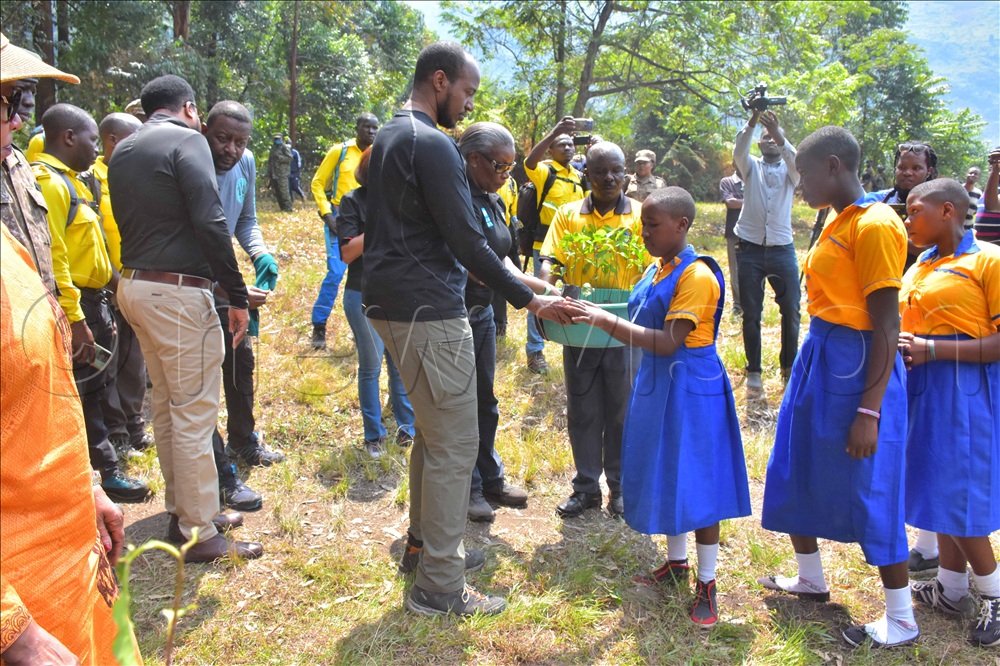
King Oyo inherited the ooro throne as a child in 1995 and spent much of his life growing into a role that placed him at the intersection of tradition, leadership and public service. Yet among the many images that will remain of him, is the walk through the mist of the Rwenzoris. Walking through ancient forests that are also the habitat of mountain gorillas. And using those journeys to remind his country that the wealth of Uganda is not only found in its cities, industries or farms; but also in its mountains, forests, rivers and wildlife.
Where as life was brief, his encounters with Uganda’s wild places carried a message larger than their destinations. That tourism can finance conservation. That conservation can sustain communities. That a country cannot afford to consume the natural heritage upon which its future depends. And that leadership sometimes means stepping away from the comfort of the throne to experience, appreciate and defend the land one has been entrusted to serve.
King Oyo may have left the throne, but the trails he walked remain. The Rwenzori still rises above the clouds. Bwindi still shelters its gorillas. Uganda’s wildlife still moves through its forests and savannahs. The challenge he championed therefore remains alive; to ensure that the Uganda he explored, admired and advocated for is still there for generations yet to discover.