
Why Uganda’s industrial sector has not grown faster despite reforms and investments
According to Ggoobi’s study, several factors explain why Uganda’s industrial sector has not grown faster, with corruption among the most significant.
Ramathan Ggoobi, the Permanent Secretary and Secretary to the Treasury (PSST) at the Ministry of Finance, Planning and Economic Development presenting his findings. (Photos by Maureen Nakatudde)
________________
Uganda’s Vision 2040 positions industrialisation as the primary catalyst for structural economic transformation. Yet, despite three decades of policy reform and deliberate public investment, industrial output has stagnated at roughly 25% of GDP.
This core challenge formed the basis of a public dialogue titled “Determinants of Industrial Sector Growth in Uganda,” held at the Uganda Management Institute (UMI) on October 22, 2026.
The event centered on the PhD thesis findings of Dr. Ramathan Ggoobi, the Permanent Secretary and Secretary to the Treasury (PSST) at the Ministry of Finance, Planning and Economic Development.
Officiating the dialogue, Dr. Silvester Kugonza remarked on the timeliness of the research.
“As a nation, Uganda is actively navigating its journey towards Vision 2040, with clear mandates under our National Development Plans to multiply the size of our economy, create sustainable jobs, and drive import substitution,” Kugonza said.
“Yet, for industry to truly become an engine of our growth, focus cannot rely on guesswork. It requires deep particularity on what drives and accelerates manufacturing, value addition, and agro-industrialisation.”
Empirical drivers and inhibitors of industrial growth
Dr Ggoobi’s study examined five core industrial subsectors over more than two decades (2000–2023). Using a Panel Autoregressive Distributed Lag (ARDL) framework across 115 observations sourced from the Uganda Bureau of Statistics (UBOS), the World Bank, and the International Monetary Fund (IMF), the research identifies institutional control over corruption as the single largest long-run driver of industrial growth.
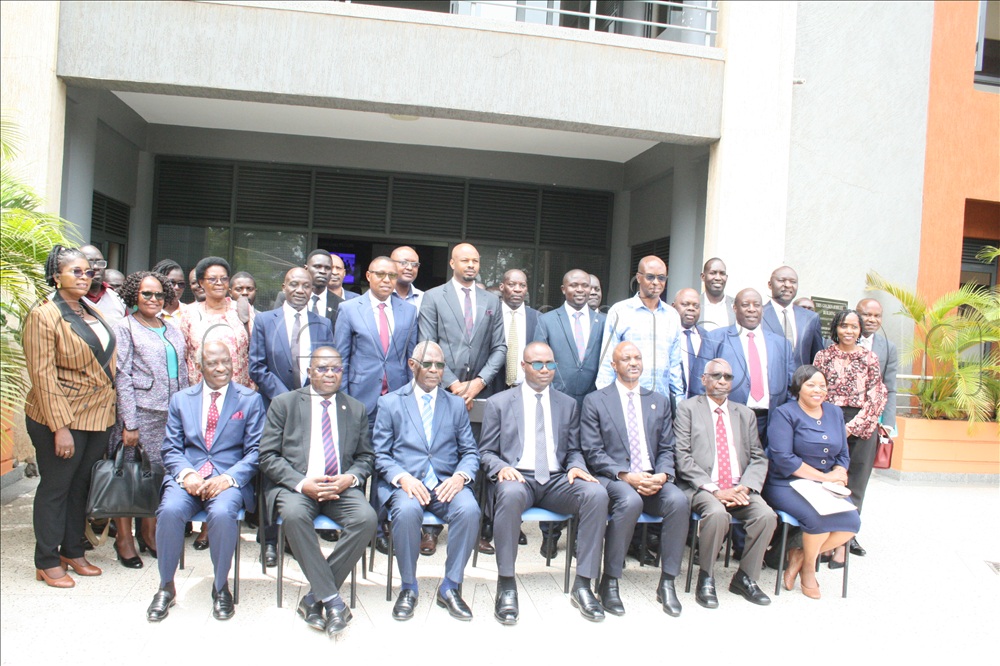
A group photo taken by some of the members present during the public dialogue
The study also found population growth and domestic credit to be significant long-run drivers of industrial growth.
Factors slowing industrial growth
According to Ggoobi’s study, several factors explain why Uganda’s industrial sector has not grown faster, with corruption among the most significant.
He said other key factors slowing industrial growth include regulatory friction (-4.42%), high lending rates (3.11%), and over-mature trade openness, or globalisation (1.92%).
To accelerate industrialisation and structural transformation under Vision 2040, Ggoobi recommended that the country prioritise affordable domestic financing, capital formation, and anti-corruption measures, and address regulatory and financing bottlenecks rather than rely blindly on trade liberalisation.
Expert discussions
To curb economic stagnation, Prof. Gerald Karyeija, the main discussant of the paper, urged that long-term, affordable financing is essential for businesses that struggle to secure standard funds, provided they have the ability to pay it back.
Support programs
Karyeija, a political analyst and head of Quality Assurance at UMI, said that if the government wants to realise its goal of economic growth, incentives such as tax breaks, cheaper loans, and government contracts must be monitored.
“If results or returns do not materialise, this support should be withdrawn or ended rather than sustained indefinitely,” he said. “Government should ensure transparency by publishing who receives support, how much they receive, and at what cost.”
Skills, training, and labour
Uganda’s economy will not escalate unless skills match the demands of the job market, Karyeija said. He pointed to a gap in matching practical skills to job requirements, such as training people to support industries like dairy or yoghurt production.
“The country faces a severe job deficit and demographic dividend, necessitating a strong push for long-lasting jobs, minimum wages, and safe working conditions,” he said.
He added that the quality of some Ugandan goods has been lacking. For the country to meet its economic development goals, he said, educational institutions need to emphasise foundational areas such as measurement, metrology, and standardisation to meet regional and international benchmarks.
Karyeija explained that true industrial progress requires a developmental state model in which the well-being of every citizen is a primary responsibility, combining robust infrastructure with active government participation in economic development.
Focus on the taxpayer
Taxation and employee thresholds
Kasozi noted that raising the tax-free income threshold to 235,000 shillings assumes employees can comfortably support their families. However, large households face severe financial strain under this limit.
He further argued that increasing the “pay as you earn” (PAYE) tax rate to 40% without allowances for dependents (such as children’s schooling) may undermine the purchasing power needed to buy industrial goods and support industrial growth.
Minister’s remarks
Henry Musasizi, the Minister of Finance, Planning and Economic Development, said Ggoobi’s research provides valuable, empirical insights into the factors shaping Uganda’s industrial growth and how policy interventions can be made more effective.
He highlighted that Ggoobi’s work aligns with the government’s ten-fold growth strategy, import substitution, and export promotion agenda.
He said collaborative efforts between academic institutions such as Makerere University Business School, the Bank of Uganda, and government ministries are essential for grounding policy decisions in robust evidence.
Capital costs and financing
Musasizi emphasised the critical need to lower lending rates and provide long-term, patient capital by reforming pensions and capital markets to support domestic enterprises.
Inflation and exchange rates
He said controlling inflation and stabilising the exchange rate remain top priorities for the Ministry, in collaboration with the Bank of Uganda.
Combating corruption
Musasizi recognized corruption as a major barrier to development and said it must be curbed for the country to develop. He said combating it is a critical enabler of the government’s ten-fold growth strategy, alongside providing tax holidays, lower electricity rates, and land support for investors.
Prof. Rose Namara, a Professor of Government Management and head of Research and Innovation at UMI, said the findings of the research can be used to drive industrialization, grow the country, create jobs, and secure its future.
James Nkanta, the Director General of the institute, said the dialogues are organized under the Uganda Policy Development Management Forum, a think-tank established to support evidence-based policy formulation through the Cabinet Secretariat. The forum also serves as a steering committee forum.