
Uganda woos Chinese investors with land, tax incentives and coffee opportunities
A statement shared by the ministry said the engagement reaffirmed the strong and growing economic partnership between Uganda and China, with a focus on unlocking value addition and industrialisation.
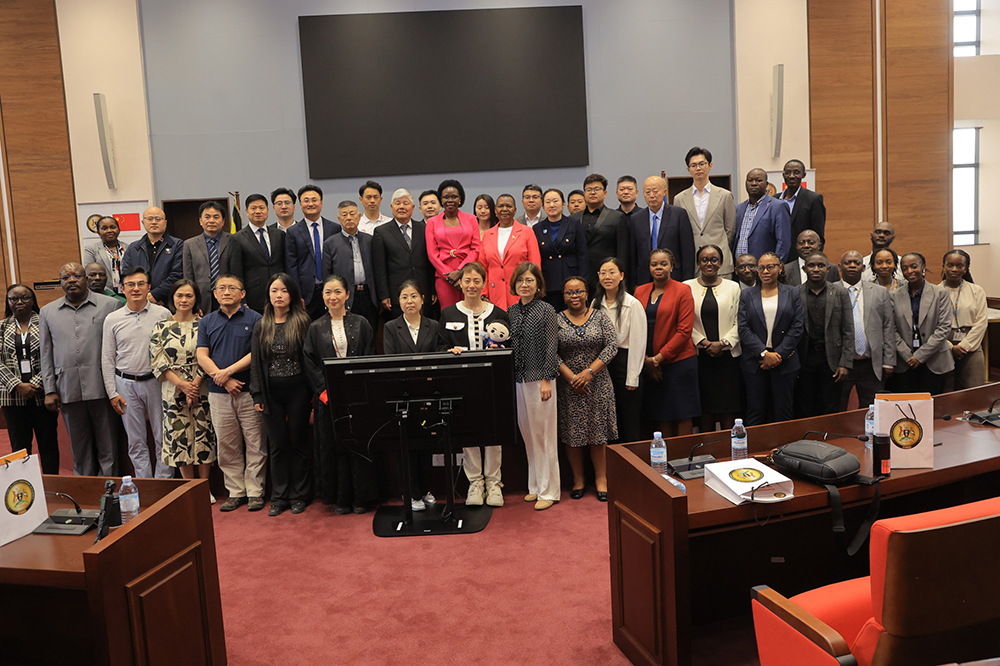
Uganda’s Ambassador to China, Oliver Wonekha ( 2nd left), investment and privatisation state minister Evelyn Anite (2nd right) with some of the Chinese delegation during the meeting. (Courtesy photo)
________________
The Government of Uganda has intensified efforts to attract Chinese investment, offering land, generous tax incentives, and vast opportunities in the coffee value chain and agro-industrial sector.
This was revealed during a high-level meeting hosted by the finance ministry under the Uganda–China Coffee Investment and Destination Tour 2026.
A statement shared by the ministry said the engagement reaffirmed the strong and growing economic partnership between Uganda and China, with a focus on unlocking value addition and industrialisation.
The meeting was presided over by the investment and privatisation state minister Evelyn Anite, who represented finance minister Matia Kasaija. She was joined by Uganda’s Ambassador to China, Oliver Wonekha, and the leader of the Chinese delegation, Diao Chunhe.
Welcoming the delegation, Anite applauded the longstanding Uganda–China relationship spanning over 60 years and called for deeper collaboration to maximise its economic potential. She highlighted successful Chinese investments in Uganda, including the Liaoshen Industrial Park and the Sino-Uganda Mbale Industrial Park.
She emphasised Uganda’s competitive investment climate, noting that business registration is fast, affordable, and can be completed within 45 minutes.
She outlined key incentives available to investors, including a 10-year tax holiday, exemptions on imported machinery, and access to land for strategic investments.
“The President has directed my office to mobilise and allocate land to serious investors. In return, we expect investments that create jobs for Ugandans,” said Anite.
She also underscored Uganda’s strong agricultural potential, describing the country as an ideal destination for large-scale farming and agro-processing, particularly in coffee. She encouraged investors to take advantage of Uganda’s fertile soils and favourable climate.
She further highlighted the government’s ATMS strategy: agro-industrialisation, tourism development, mineral development, and science and technology innovation.
The strategy is aimed at growing the economy tenfold to $500b.
On her part, Amb. Wonekha emphasised the importance of economic diplomacy in driving mutually beneficial investments. She welcomed the delegation’s interest in Uganda’s coffee sector, noting its critical role in export growth and job creation.
Speaking on behalf of the delegation, Chunhe expressed appreciation for the warm reception and reaffirmed interest in investing in Uganda’s coffee value chain, particularly in processing, value addition, and technology transfer, as well as expanding access to the Chinese market.
The meeting marks a significant step in strengthening Uganda–China economic cooperation and positioning Uganda as a leading investment destination in Africa.
China-Uganda relations
Uganda-China relations started in 1962 and are currently at a historical high level, characterised by strong economic partnership, major infrastructure development, and growing trade.
Since the establishment of diplomatic relations, economic, trade, and economic-technical cooperation between China and Uganda has progressed smoothly.
China has assisted Uganda in constructing complete projects, including the Kibimba Farm, Doho Farm, Kampala Ice Plant, biogas facilities, the Food and Ceramics Research Centre, the National Stadium, fishing wharves, and the Ministry of Foreign Affairs office building.
In 2024, bilateral trade reached $1.46 billion, a year-on-year increase of 12.1%.
China's exports to Uganda amounted to 1.46 billion,a year−on−year increase of 12%, while imports from Uganda totalled $79 million, up 13.8%. China primarily exports electromechanical products and vehicles to Uganda, while importing goods such as sesame, timber, and coffee.
Today, China is a major investor in Uganda's energy, manufacturing, and transportation sectors, including key projects like the Karuma Hydropower Station and the Kampala-Entebbe Expressway, among others.