
Uganda urged to harness IP to turn research into jobs and growth
The call was made by Uganda National Council for Science and Technology (UNCST) executive secretary Dr James Kisaale during the National Dialogue on Intellectual Property, Technology Transfer and Research Commercialisation at the Four Points by Sheraton Hotel in Kampala on August 5, 2026.
A team of experts poses for a photo during the national dialogue on intellectual property, technology transfer and research commercialisation held at Four Points by Sheraton on August 5. (Photos by Alfred Ochwo)
________________
Researchers have been urged to shift towards converting scientific discoveries into marketable products and services.
The call was made by Uganda National Council for Science and Technology (UNCST) executive secretary Dr James Kisaale during the National Dialogue on Intellectual Property, Technology Transfer and Research Commercialisation at the Four Points by Sheraton Hotel in Kampala on August 5, 2026.
Kisaale said Uganda must move beyond merely producing research.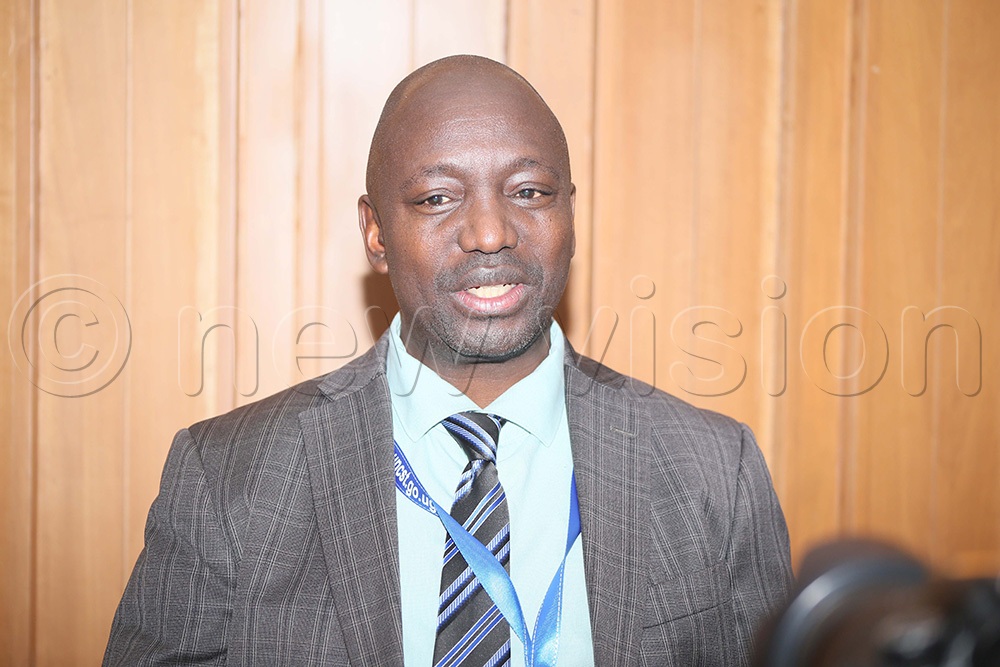
UNCST executive secretary James Kisaale, speaking during the national dialogue on intellectual property, technology transfer and research commercialisation held at Four Points by Sheraton on August 5. (Photos by Alfred Ochwo)
The focus, he argued, must shift towards converting scientific discoveries into marketable products and services.
"Research alone is not sufficient. Knowledge creates value only when it moves beyond publication and becomes usable by society," he said.
The event was intended, among other things, to raise awareness of the critical role of intellectual property in unlocking the country's potential in research and innovation to spur economic growth.
During his opening remarks, Kisaale stressed that intellectual property should no longer be viewed solely as a legal formality but rather as a critical driver of economic transformation and a key indicator of national competitiveness.
Kisaale challenged universities and research institutions to measure success not just by the volume of academic publications, but by the number of discoveries protected through patents, developed into viable products, adopted by industry and ultimately used to improve livelihoods.
He cited China's dominance in international Patent Cooperation Treaty (PCT) filings through the World Intellectual Property Organisation (WIPO), noting that robust IP systems are inextricably linked to global economic leadership.
"If Uganda is to earn a meaningful place in the global innovation economy, we must significantly strengthen our national intellectual property performance," he stated.
Reaffirming UNCST's mandate to coordinate and regulate science, technology and innovation (STI) in Uganda, he committed to building an ecosystem where research publication and commercialisation go hand in hand.
The $405b burden on STI
Robert Mugabe, commissioner for intellectual property at the Uganda Registration Services Bureau (URSB), stressed that prioritising innovation is essential to achieving the country's long-term targets.
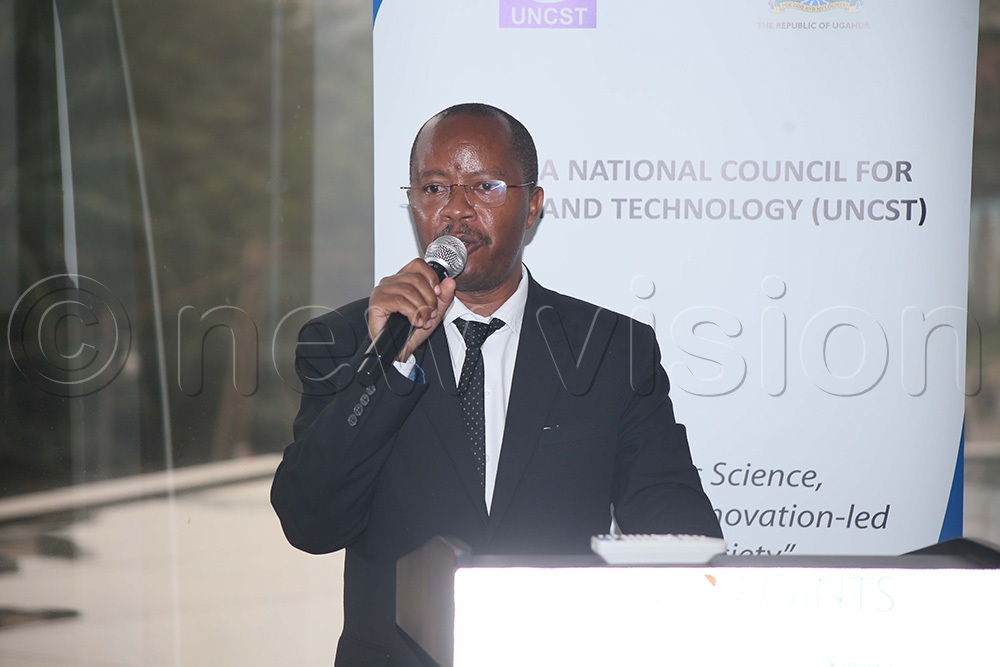
URSB commissioner for intellectual property Robert Mugabe during the national dialogue on intellectual property, technology transfer and research commercialisation held at Four Points by Sheraton on August 5. (Photos by Alfred Ochwo)
Representing URSB registrar general Mercy Kainobwisho at the event, Mugabe pointed to Uganda's ambitious tenfold growth strategy, which aims to expand the economy to $500 billion by 2040.
"If you could remember, Uganda's economy in 2010 was $25 billion," Mugabe noted.
"In 2025, after 15 years, it had doubled to $50 billion. But in the same time period, from 2025 to 2040, it should grow tenfold. It is only STI that can do that."
Mugabe emphasised that STI is projected to carry the heaviest burden of this rapid growth, contributing $405 billion, or 81%, of the targeted $500 billion economy.
By comparison, he outlined the projected contributions from other key sectors: Tourism ($50 billion), Oil, Gas and Minerals ($25 billion), and Agro-industrialisation ($20 billion).
"You can imagine all this oil we are waiting for is expected to contribute only $25 billion. So, the big chunk is basically STI," he said.
From lab to market
Alinaitwe explained that technology transfer should provide innovators with a clear pathway from the laboratory to the market. This includes navigating IP ownership, protection, funding, industry partnerships and market access.
"The biggest challenge is not that researchers are failing to innovate," he said.
"The real problem is that we are missing the operating system that guides innovations from the laboratory to the market."
He argued that in many institutions, technology transfer relies too heavily on personal relationships and goodwill rather than predictable, institutionalised systems.
"Goodwill is not a system," Alinaitwe warned.
"Researchers should not have to rely on who they know to access intellectual property services, funding, or industry connections. We need institutional systems that work consistently for everyone."
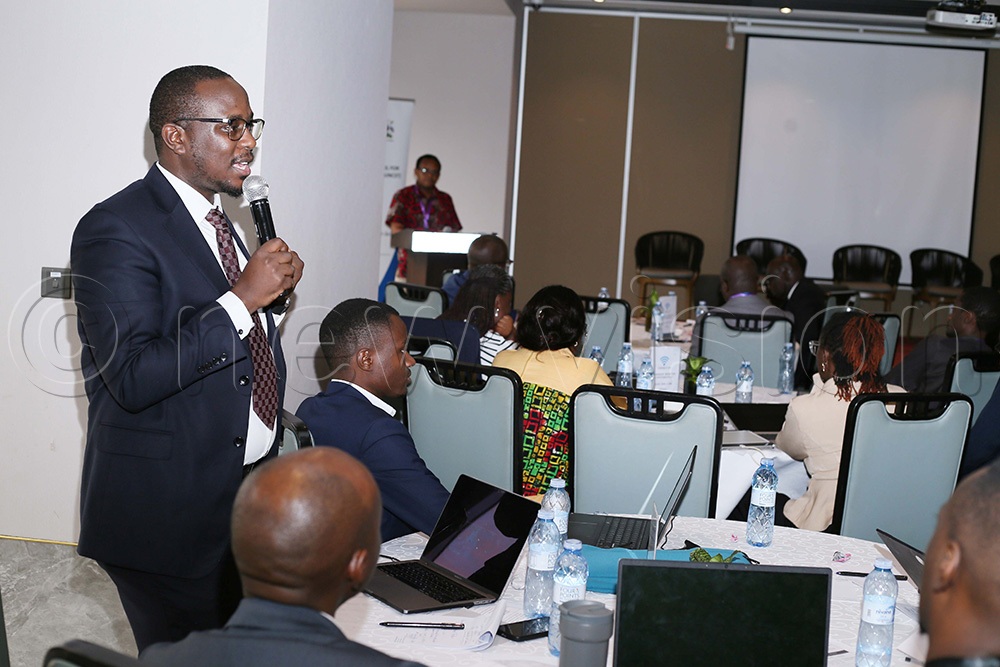
Marvin Alinaitwe, an IP expert, speaking during a national dialogue on intellectual property, technology transfer and research commercialisation held at Four Points by Sheraton on August 5. (Photos by Alfred Ochwo)
To address this, he called on universities and research institutions to establish clear entry points for innovators, guarantee timely decisions on IP matters and define concrete next steps for every innovation under review.
Alinaitwe also stressed that successful technology transfer is fundamentally a leadership issue.
He said institutional leaders must clearly define mandates, decision-making authority and accountability for their technology transfer offices to thrive.
Furthermore, he urged institutions to simplify their IP policies, making it easier for researchers to understand ownership rights, disclosure requirements, publication rules and benefit-sharing arrangements.
He advised that scarce public resources should only be invested in innovations after a rigorous assessment, ensuring they solve a critical problem, demonstrate technical proof, possess secure IP rights, attract commercial partners and justify further investment.