
Uganda sets sights on first oil as sector shifts to production phase
“Today, we are no longer asking if Uganda will produce oil; we are focused on when and how well we will do it,” said Nankabirwa.
Deputy Speaker of Parliament Thomas Tayebwa (Left) and Energy minister Ruth Nankabirwa (Right) arriving for the 11th International Oil and Gas Convention organised by the Uganda Chamber of Energy and Minerals (UCEM) at Speke Resort Munyonyo. (Photos by John Odyek)
________________
Uganda’s oil and gas sector is entering its most decisive phase, with the Government and industry leaders signalling a firm transition from infrastructure development to production, as the country targets first oil in the second half of 2026.
Speaking at the 11th International Oil and Gas Convention organised by the Uganda Chamber of Energy and Minerals at Speke Resort Munyonyo in Kampala city on April 28, 2026, Deputy Speaker of Parliament Thomas Tayebwa said oil production will be a key driver in unlocking Uganda’s economic potential.
Tayebwa said the petroleum sector is central to Uganda’s ambition to grow the economy tenfold from $50 billion to $500 billion by 2040, anchored on agro-industrialisation, tourism, mineral-based industrialisation and science and innovation.
“Parliament remains fully committed to providing the legislative support and oversight required to ensure this sector delivers real value to Ugandans,” he said.
He emphasised the need for transparency, strong local content participation and investment in high-value segments of the industry.
He added that as Uganda moves into the production phase, the focus must shift to sustained enterprise growth, technology transfer and positioning the country as a regional energy hub.
The convention marked the launch of the National Petroleum Policy 2025, which replaces the 2008 framework and provides a comprehensive guide across the petroleum value chain as Uganda prepares for commercial production.
Petroleum Authority of Uganda executive director Ernest Rubondo reaffirmed that efforts are on track to achieve first oil within 2026.
Tayebwa (Sixth Right) and Nankabirwa (Fourth Left) arriving for the 11th International Oil and Gas Convention organised by the Uganda Chamber of Energy and Minerals (UCEM) at Speke Resort Munyonyo. 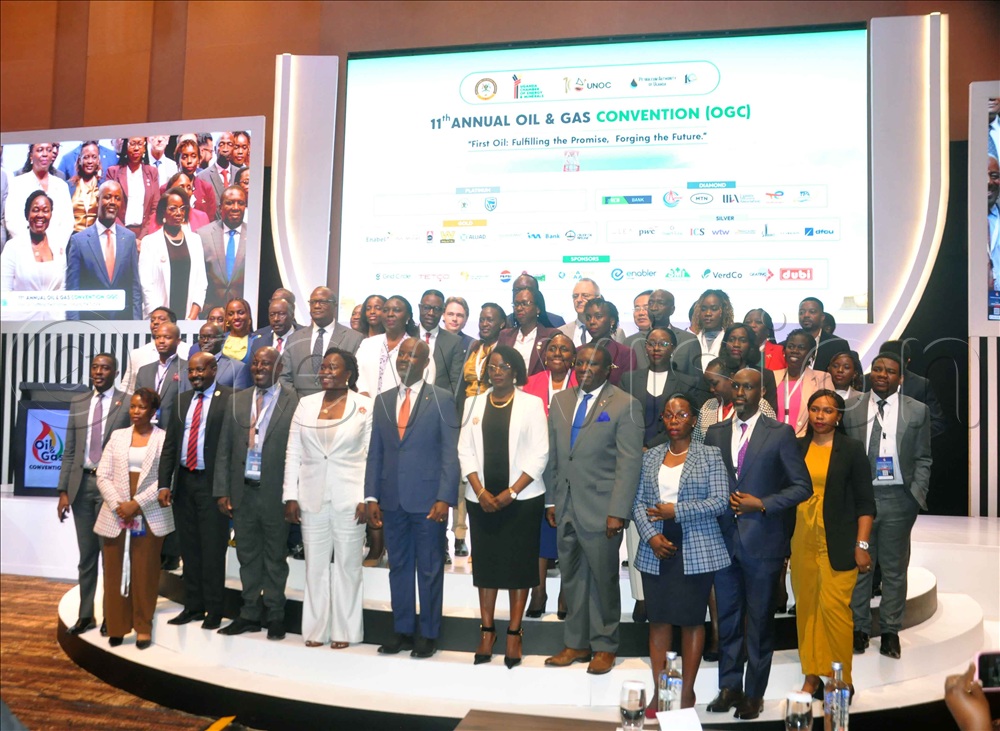
“This milestone will mark a defining moment in Uganda’s energy journey and the beginning of a new phase focused on production, operations, and value realisation,” Rubondo said.
He explained that the first oil will involve a sequence of operational milestones, including extraction from reservoirs, processing at central facilities, transportation to Kabaale in Hoima, export through Tanga in Tanzania, and eventual sale and revenue receipt from crude cargo.
Energy minister Ruth Nankabirwa said Uganda’s progress has been the result of more than two decades of deliberate planning and institutional development.
Nankabirwa highlighted local content as a key pillar of the sector, noting that policies are already driving employment of Ugandans, participation of local firms in supply chains, and skills development.
“Thousands of Ugandans are engaged in oil and gas activities, and this will grow significantly as we transition into production,” she said.
The Government has invested heavily in human capital development through training programmes, scholarships, and institutional partnerships aimed at ensuring Ugandans take leading roles in the sector.
On sustainability, Nankabirwa said strict environmental standards are being enforced to ensure responsible resource development, including biodiversity protection and emissions management.
She acknowledged that Uganda’s oil ambitions are unfolding amid a shifting global energy landscape shaped by climate concerns, energy transition pressures, and evolving investment trends.
“Uganda’s oil and gas story is one of patience, resilience, and determination. We have come a long way, but the most important phase lies ahead,” she said.
The convention, held under the theme “Fulfilling the Promise – Transitioning to Operations,” was addressed by key industry players, including Philippe Groueix of TotalEnergies EP Uganda, John-Bosco Habumugisha of East African Crude Oil Pipeline (EACOP) Ltd, and Hu Weijie of CNOOC Uganda Limited.
Chairperson of the UCEM Governing Council, Aggrey Ashaba, welcomed delegates, underscoring the convention’s role in shaping dialogue as Uganda moves closer to oil production.