
Uganda bets on cocoa to boost foreign exchange earnings
While ambitious production and export targets have been set, players in the cocoa industry say the country's ability to achieve them will depend on addressing persistent challenges facing farmers, including inadequate planting materials, limited extension services and insufficient financing to establish and maintain plantations.
Peter Ddamuzungu (left), Commissioner for Crop Production at the Ministry of Agriculture, chats with Maria Bisamaza, Manager of Quality and Standards at PACEID, during the launch of the National Cocoa Strategic Plan 2026–2036 on November 18, 2026. (Photo by Nicholas Oneal).
__________________ Peter Ddamuzungu, Commissioner for Crop Production at the Ministry of Agriculture, signs the commemorative board during the launch of the National Cocoa Strategic Plan 2026–2036 on November 18, 2026. (Photo by Nicholas Oneal).
Uganda is looking to cocoa to open a new chapter in its agricultural transformation, with the government seeking to turn the crop into a major source of export revenue, rural employment and industrial investment over the next decade.
While ambitious production and export targets have been set, players in the cocoa industry say the country's ability to achieve them will depend on addressing persistent challenges facing farmers, including inadequate planting materials, limited extension services and insufficient financing to establish and maintain plantations.
These concerns emerged during the launch of the Uganda Climate Resilient Cocoa Development Strategy (2026-2036) at Fairway Hotel in Kampala on Wednesday (November 18). Government officials, development partners and private sector players outlined plans to expand production and strengthen the country's position in the international cocoa market.
Under the strategy, Uganda wants to increase annual cocoa production from approximately 72,000 metric tonnes to 500,000 tonnes by 2036, while raising annual export earnings from about $620 million (about sh2.5 trillion) to $3 billion (about sh12.4 trillion).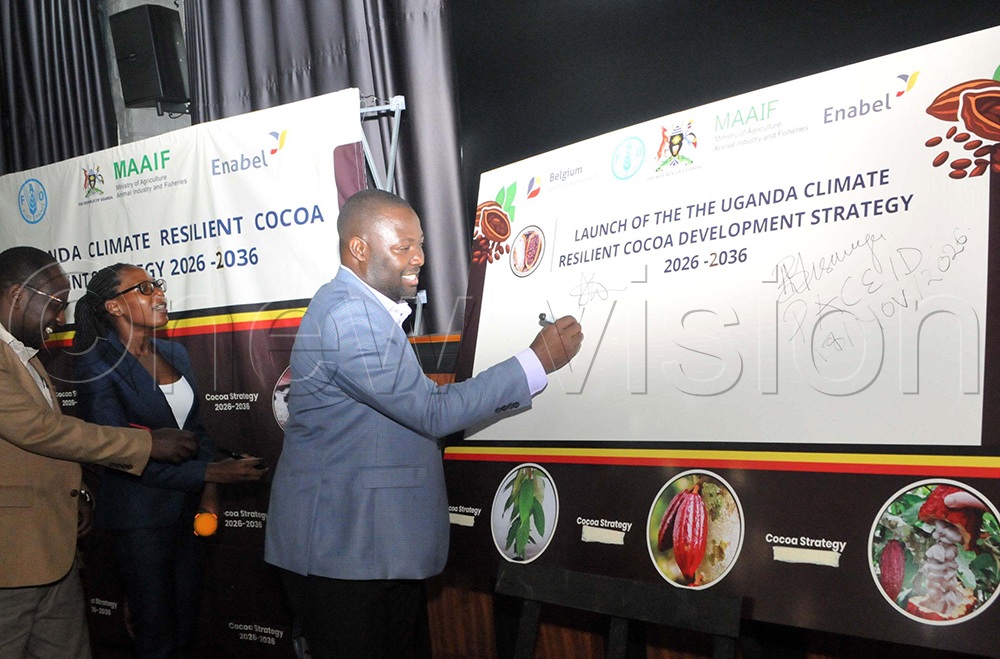
The 10-year roadmap, developed by the Ministry of Agriculture, Animal Industry and Fisheries (MAAIF), with support from the Food and Agriculture Organisation of the United Nations (FAO), the Belgian Agency for International Cooperation (Enabel) and other partners, also seeks to increase domestic processing, improve productivity and promote climate-resilient farming.
Peter Dhamuzungu, commissioner for crop production at MAAIF, said cocoa had demonstrated its potential as an important foreign exchange earner and a source of income for smallholder farmers.
“We can promote this crop without fear because it has demonstrated that it is a high foreign exchange earner for this country,” he said.
He added: “It is also a source of employment for our youth, and it is also a source of income for the smallholder farmers.”
Uganda's cocoa industry has expanded considerably over the past decade. Government figures indicate that export earnings increased from $70.59 million (about sh293.6 billion) in the 2015/2016 financial year to approximately $620.43 million (sh2.5 trillion) in 2024/2025.
Nevertheless, cocoa remains behind coffee, Uganda's leading agricultural export. Coffee exports generated approximately $2.21 billion (about sh9.2 trillion) in 2024/2025, more than three times the earnings from cocoa.
The government believes increased production, better farm management and domestic processing could substantially improve cocoa's contribution to the economy.
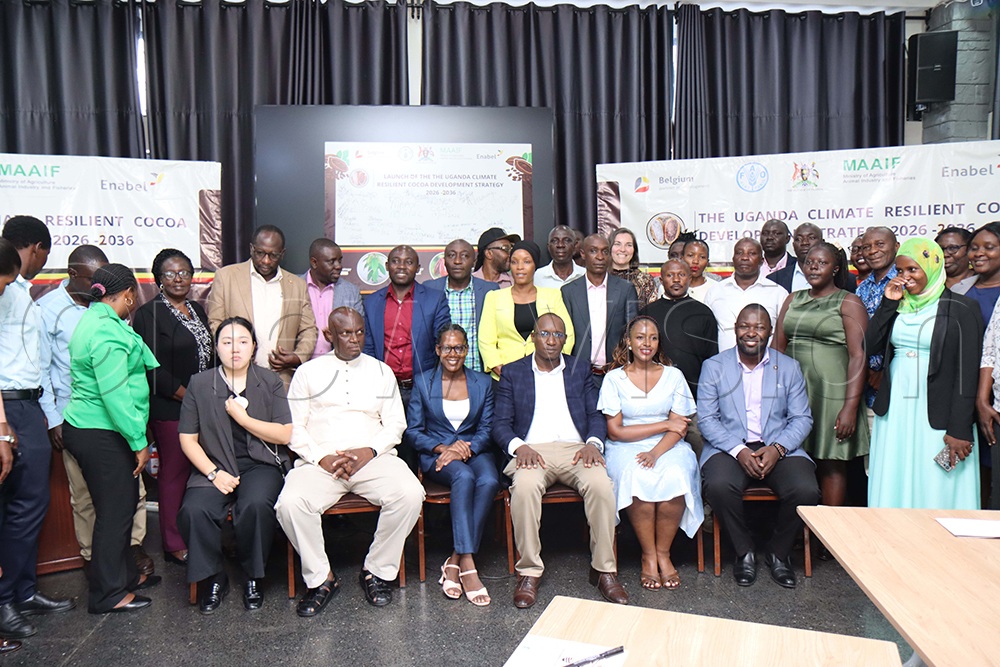
Peter Ddamuzungu (seated right), Commissioner for Crop Production at the Ministry of Agriculture, with other guests during the launch of the National Cocoa Strategic Plan 2026–2036 on November 18, 2026. (Photo by Nicholas Oneal).
Farmers at the centre of expansion
Bundibugyo district, at the foothills of the Rwenzori Mountains in western Uganda, remains the country's dominant cocoa-producing area, accounting for approximately 70 per cent of national output.
Other established growing areas include Mukono, Buikwe, Jinja, Kamuli, Mayuge, Iganga, Kayunga, Hoima, Masindi, Kibaale, Mubende, Mpigi and Luwero. The government is also exploring expansion into other regions where scientific assessments have established suitable growing conditions.
The industry is largely driven by smallholder farmers, with FAO officials estimating that more than 100,000 farmers are involved in cocoa production.
Dr Joseph Mudiope, a crop production specialist at FAO Uganda, said cocoa's contribution to household incomes and export earnings justified its recognition as a strategic agricultural commodity.
Industry demands practical support
The strategy estimates that approximately $221.19 million (about sh918 billion) in public and catalytic investment will be required over the next decade, with private investors expected to finance much of the expansion in production, aggregation, storage, transportation and processing.
A competitive global market
Uganda's ambitions are being pursued in a market where African countries already dominate global cocoa production.
Côte d'Ivoire and Ghana remain the continent's leading producers, followed by Nigeria and Cameroon. Other African producers include Sierra Leone, Guinea, Liberia, Togo, Tanzania and the Democratic Republic of Congo.
According to International Cocoa Organisation estimates for the 2024/2025 season, Côte d'Ivoire produced approximately 1.68 million tonnes, Ghana about 600,000 tonnes, Nigeria 330,000 tonnes and Cameroon approximately 310,000 tonnes.
Outside Africa, Ecuador is a major competitor, producing approximately 570,000 tonnes during the same season.
The International Cocoa Organisation estimates global production at approximately 4.7 million tonnes, with Africa contributing about 69 per cent.
Sylvia Natandula, an agribusiness expert at Enabel, said stakeholders should now concentrate on delivering the strategy's objectives.
“My plea to you is that we move from ambition to implementation of this strategy,” she said.
She argued that success should be measured not merely by production volumes but by the number of jobs created and improvements in farmers' incomes.
“It should be reflected in how many jobs, how much money people are earning out of cocoa, and how many more people are living decently,” she said.