
Business
SONA: What Ugandans are paying for basic commodities
UBOS data for the 12 months to May 2026 shows that beef (1kg) is up from sh17,185 to sh18,264 per kilo on average. The cost could be even more, depending on the market or region you shop in.
SONA: What Ugandans are paying for basic commodities
By: Ali Twaha, Journalist @New Vision
________________
As President Museveni addresses the country during the state of the nation address (SONA), a review of the fiscal year shows that many Ugandans are struggling to put food on the table as basic commodities now cost a little more than they did a year ago, according to data from the Uganda Bureau of Statistics (UBOS).
UBOS data for the 12 months to May 2026 shows that beef (1kg) is up from sh17,185 to sh18,264 per kilo on average. The cost could be even more, depending on the market or region you shop in.
Fresh tilapia (1kg) has climbed from sh16,353 to sh17,824. Onions (1kg) are pricier (sh3,312 to sh3,716), tomatoes have followed (sh2,733 to sh3,008), and even groundnuts have ticked up slightly to sh7,673.
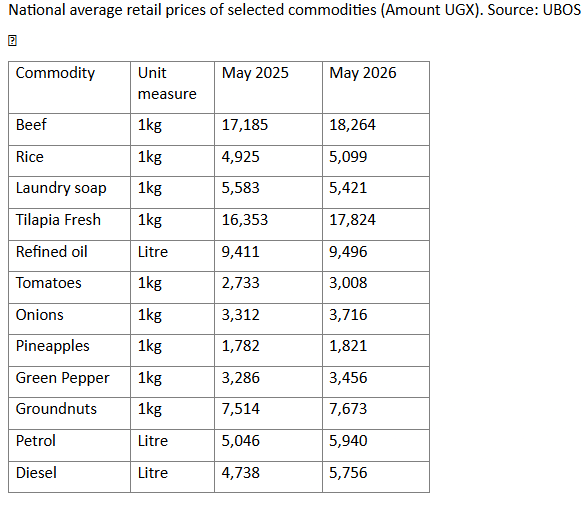
Rice, refined oil, green pepper, and pineapples are all a little more expensive than they were a year ago. The one exception is laundry soap, which has fallen marginally from sh5,583 to sh5,421.
Petrol has jumped from sh5,046 to sh5,940 per litre over the year, and diesel from sh4,738 to sh5,756. That is a roughly 18% and 21% rise respectively. These numbers are as end of May, but current market prices the commodities have ticked up to sh6,299 for petrol and sh6,500 for diesel.
Uganda imports fuel, largely through Mombasa. The Ministry of Energy has said tensions around the Strait of Hormuz, a critical global oil transit route, are a key driver of higher international crude prices, with rising freight charges, marine insurance premiums, and exchange rate movements adding to the cost.
“We expect a clear national pronouncement on what needs to be done in the short and medium term to respond to this shock,” Ezra Muhumuza, executive director at Uganda Manufacturing Association, said.
Higher fuel costs push up the cost of moving produce from farm to market, which partly explains why food prices are drifting upward even in a country that grows much of what it eats.
Annual headline inflation for the 12 months to May 2026 rose to 3.2%, up from 3.0% in April, driven largely by the fuel surge, according to UBOS. But that number remains well inside the Bank of Uganda's 5% target.
When President Museveni speaks this afternoon, he will likely point to that stability as evidence of a managed economy. The numbers support a cautious optimism, though ordinary Ugandans, particularly those who rely on boda bodas or buy charcoal by the sack, are feeling the squeeze in ways the headline figure does not fully capture.
“We want to make sure that the rate at which prices increase does not go over 5% in the medium term. Currently, they are rising at a rate of about 3.5%. They are increasing on a certain rate. SO yes, the prices are high, but the rate at which they are changing is not high,” Michael Atingi-Ego, Governor at the Bank of Uganda, said.
Higher fuel costs push up the cost of moving produce from farm to market, which partly explains why food prices are drifting upward even in a country that grows much of what it eats.
Annual headline inflation for the 12 months to May 2026 rose to 3.2%, up from 3.0% in April, driven largely by the fuel surge, according to UBOS. But that number remains well inside the Bank of Uganda's 5% target.
When President Museveni speaks this afternoon, he will likely point to that stability as evidence of a managed economy. The numbers support a cautious optimism, though ordinary Ugandans, particularly those who rely on boda bodas or buy charcoal by the sack, are feeling the squeeze in ways the headline figure does not fully capture.
“We want to make sure that the rate at which prices increase does not go over 5% in the medium term. Currently, they are rising at a rate of about 3.5%. They are increasing on a certain rate. SO yes, the prices are high, but the rate at which they are changing is not high,” Michael Atingi-Ego, Governor at the Bank of Uganda, said.