
SEATINI marks 30 years of fighting for Africa’s place in global trade
Kadaga thanked SEATINI for advocating for favourable trade policies for the continent.
SEATINI commemorates 30 years of championing Africa's interests in global trade. (Courtesy)
________________ Kadaga (centre), joined by SEATINI staff, poses for a photo moment during the organisation’s 30th anniversary celebrations at Kampala Serena Hotel. (Courtesy)
The Southern and Eastern Africa Trade Information and Negotiations Institute (SEATINI) marked its 30th anniversary on July 29, with government officials, board members and staff looking back at an organisation that has grown from a modest idea into one of the continent’s most persistent voices on trade justice.
The celebration, held at Kampala Serena Hotel, brought together current and former SEATINI leadership, government representatives and partners for an evening that mixed reflection with a renewed push for the institute’s next chapter, among them a common African currency and deeper regional integration.
Speaking on behalf of government, the minister for East African Community Affairs, Rebecca Kadaga, thanked SEATINI for advocating for favourable trade policies for the continent.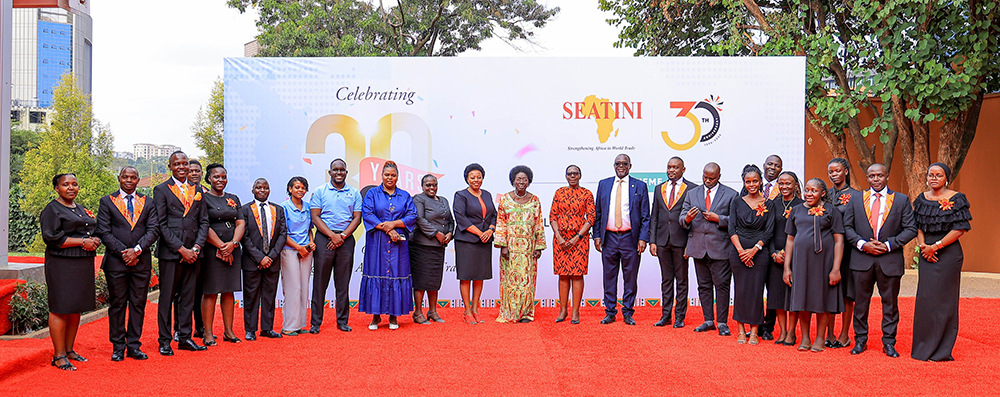
She used the occasion to press SEATINI on an issue close to government's regional agenda, a single currency for the East African Community. Kadaga said Uganda treats regional integration as an urgent priority, not a distant ambition.
She asked SEATINI to throw its weight behind the campaign for a common currency, pointing to how Europe managed the transition.
“I would like to ask SEATINI to bend her backwards in the campaign for a common currency. I would like us to go the way the European Union did, by having a common currency running alongside our national currencies until such time as we can exit national currencies. Our traders have a lot of difficulties with currency fluctuations,” Kadaga said.
“Let us leave this celebration with renewed determination to build an Africa where trade drives industrialisation, where investment creates opportunities for all, where regional integration translates into tangible benefits for our citizens,” she said.
Vincent Mayiga, SEATINI Board Chairperson, said the founding idea behind SEATINI was straightforward and that Africa’s development thinking did not need to be imported.
"That conviction was simple, but it was radical for its time, that Africa does not need to borrow its understanding of development from elsewhere. Our knowledge systems, our histories and our realities are legitimate foundations for shaping policy and refining our development pathways," he said.
Mayiga credited the institute with taking dense, technical trade debates and putting them within reach of ordinary people affected by the decisions.
Jane Nalunga, executive director, said the anniversary is more than a mark of longevity. She said it is proof of an idea that has held up over 30 years of shifting global trade politics.
“Today is more than an anniversary, it is a celebration of an idea, a celebration of a vision and a collective commitment that Africa must have the knowledge, must have the confidence and must have the institutional capacity to define its own development pathways," Nalunga said.
She traced that vision back to SEATINI’s founding conviction, that Africa's role in the global economy should not stop at participation.
“The establishment of SEATINI was based on a very powerful conviction, that Africa must not only participate in global economic systems but must also have the capacity to shape the rules, institutions and ideas that govern those systems,” she said.
“Our future priorities will include advancing equitable trade policies, strengthening fiscal justice and responsible development financing, supporting green industrialisation, promoting Africa's knowledge production, advancing digital transformation and investing in the next generation of African policy leaders,” she said.
“Africa's future must be shaped by Africa's priorities, African knowledge and African solutions. The next 30 years will require courage, innovation, collaboration and a continued belief that Africa can, and must, shape its own future.”