
Business
Regulators meet in Nairobi to unlock Africa’s $4 trillion
About 2.7% of institutional assets across the continent are currently invested in infrastructure and other productive sectors.
Mark Napier CEO FSD Africa, Hikmet Abdalla CEO FSD Ethiopia, Jemima Gathumi Lead Capital Markets FSD Africa, Dr. Evans Osano Chief Financial Markets Officer FSD Africa, Greta Bull Board Member FSD Africa, launch the “Making Financial Markets Work” report that looks at state of play and recent capital markets case studies in Africa.
By: Ali Twaha, Journalist @New Vision
NAIROBI - More than 300 policymakers, regulators, institutional investors and market practitioners from over 20 African countries, including Uganda, are in Nairobi this week for the third Sustainable Capital Markets Conference.
According to a statement, the conference is organised by FSD Africa and partners. The gathering to explore ways to unlock nearly $4 trillion in pension, insurance and sovereign wealth assets to fund the continent's own infrastructure and climate projects.
About 2.7% of institutional assets across the continent are currently invested in infrastructure and other productive sectors.
Confirmed speakers include Mark Napier, CEO of FSD Africa, Daniel Mainda, CEO of the Nairobi International Financial Centre Authority, and Yodit Kassa, CEO of the Ethiopia Stock Exchange, alongside regulators, debt managers and investment executives from across the region, among them Chris Olobo of Dhamana Guarantee, Jonathan Stichbury of SanlamAllianz Investments and Japhet Justine, Commissioner for Public Debt Management at Kenya's Ministry of Finance.
Confirmed speakers include Mark Napier, CEO of FSD Africa, Daniel Mainda, CEO of the Nairobi International Financial Centre Authority, and Yodit Kassa, CEO of the Ethiopia Stock Exchange, alongside regulators, debt managers and investment executives from across the region, among them Chris Olobo of Dhamana Guarantee, Jonathan Stichbury of SanlamAllianz Investments and Japhet Justine, Commissioner for Public Debt Management at Kenya's Ministry of Finance.
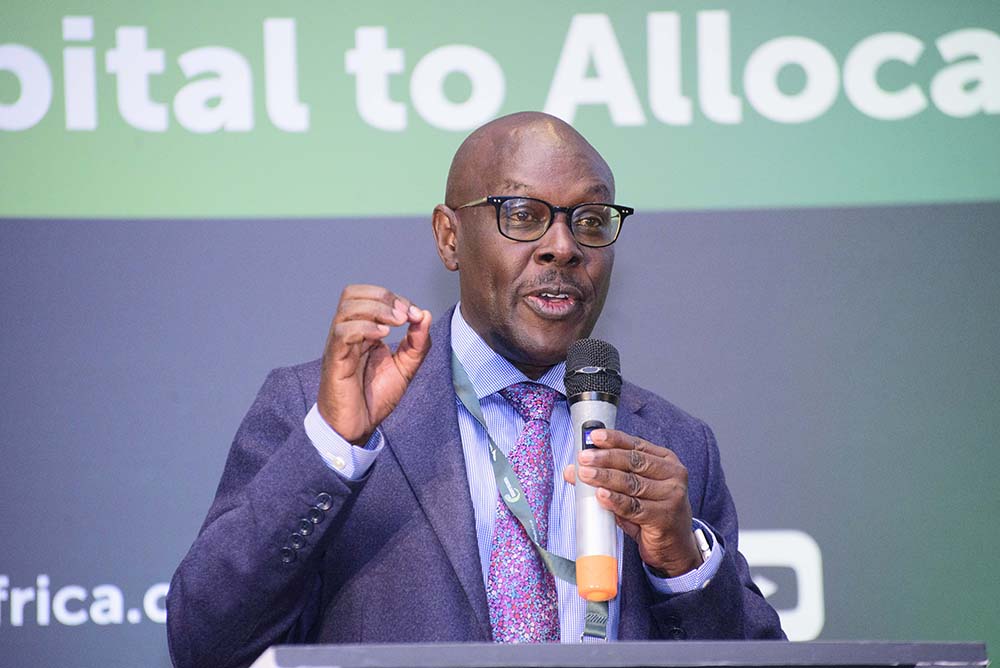
Evans Osano making remarks during the 3rd Sustainable Capital Markets Conference that opened in Nairobi on September 15.
Speaking during the Africa Pension Summit at Speke Resort Munyonyo last year, Patrick Ayota, managing director at National Social Security Fund (NSSF), said that while Africa has one of the lowest default rates globally, it pays the highest interest on borrowed funds.
Ayota said the mismatch between perceived and actual risk has made it difficult for African countries to rely on external borrowing.
“The average weighted cost of capital in Sub-Saharan Africa is 8 to 9%, compared to 4 to 5% in Asia. Yet, the default rate in Africa is just 1.4%, lower than Asia’s 3% and Europe’s 4%. So why are we paying the highest cost for money?” he said.
“We cannot continue to depend on aid and foreign debt. External aid is failing, and global capital is costly. Africa is not short of resources; we are short of mobilisation. NSSF portfolio is around $7.5b, and 80% of that is invested in government securities. It is safe, yes, but perhaps too safe. We need to be deliberate about investing in areas that can drive real economic growth.”
Ayota said the mismatch between perceived and actual risk has made it difficult for African countries to rely on external borrowing.
“The average weighted cost of capital in Sub-Saharan Africa is 8 to 9%, compared to 4 to 5% in Asia. Yet, the default rate in Africa is just 1.4%, lower than Asia’s 3% and Europe’s 4%. So why are we paying the highest cost for money?” he said.
“We cannot continue to depend on aid and foreign debt. External aid is failing, and global capital is costly. Africa is not short of resources; we are short of mobilisation. NSSF portfolio is around $7.5b, and 80% of that is invested in government securities. It is safe, yes, but perhaps too safe. We need to be deliberate about investing in areas that can drive real economic growth.”