
Opportunities are for those who stand out – Maurice Mugisha
Mugisha was speaking to Rotaractors during an engagement on how young professionals can turn the connections they make through Rotary and Rotaract into meaningful career opportunities.
Maurice Mugisha, the Deputy Managing Director, Uganda Broadcasting Service, addressing Rotaract of Kampala South during the Rotary partnership campaign on August 20, 2026. (Photo by Nancy Nanyonga)
__________________
A room full of young professionals at Hotel Africana fell silent on Thursday when Uganda Broadcasting Corporation (UBC) Deputy Managing Director Maurice Mugisha posed a blunt question: “How do you remain unemployed with all the spectacular networks you have made?”
Mugisha was speaking to Rotaractors during an engagement on how young professionals can turn the connections they make through Rotary and Rotaract into meaningful career opportunities.
But he cautioned that networking is not about collecting phone numbers or business cards. It is about building genuine relationships, demonstrating value and making yourself memorable.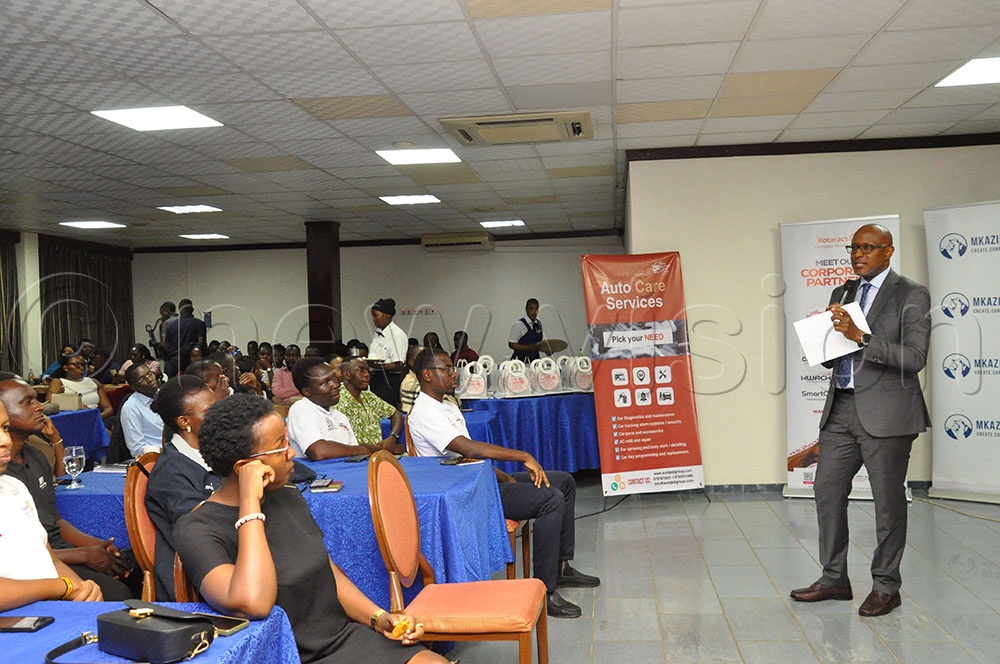
Maurice Mugisha, the Deputy Managing Director, Uganda Broadcasting Service, addressing Rotaract of Kampala South during the Rotary partnership campaign on August 20, 2026. (Photo by Nancy Nanyonga)
“You must start building your network from day one,” he said.
Having someone's contact, Mugisha said, does not guarantee that person will help you. What matters is the impression you make when you first meet.
“It’s not enough to have the cards and the contacts in your phone. You must have sold yourself in the first engagement you had with that individual,” he said.
For young professionals, he said, this means knowing what they want to be known for and deliberately building a reputation around it.
“You must identify your space. The sooner you identify your space and begin to chart that map, the sooner you will understand what your career is really about,” he said.
Stand out
Mugisha also challenged young professionals to match their ambitions with effort.
He urged them to volunteer, take on difficult assignments and become people others can depend on, warning that career advancement requires more than simply demanding opportunities.
“It's not enough to stand up, but you must stand out.”
For Mugisha, standing out means becoming known for something valuable and consistently delivering on it.
Turn social media into an opportunity
Mugisha also challenged young people to rethink how they use social media.
He said platforms such as Facebook, LinkedIn, X, Instagram and TikTok can provide opportunities to showcase talent, ideas and professional work to large audiences.
However, he warned against spending too much time consuming content without creating anything of value.
“Evaluate your interests. What is it you want? Is it your growth? Or do you want to support telecom companies and some influencers somewhere?” he asked, drawing laughter from the audience.
He urged young professionals to treat social media as a professional tool rather than merely entertainment.
“Stop seeing social media merely as entertainment and begin treating it as a professional tool,” he said.

Employers and clients, he added, increasingly value meaningful engagement, specialised skills and impact rather than simply large follower numbers.
Learn to say no
Mugisha also cautioned young professionals against trying to pursue every opportunity that comes their way.
“You can't do everything,” he said.
He shared how he stopped wedding emceeing after taking on greater responsibilities at UBC, allowing him to focus more fully on his career and family.
“Learn to say no to what does not serve your bigger goal,” he said.
He also warned that having many acquaintances does not necessarily mean having a strong support system.
Reflecting on the COVID-19 pandemic, Mugisha said the crisis exposed the weakness of relationships built mainly around workplaces, social events and institutions.
“Get broke, and you will see your real friends. Or get sick and see your real friends,” he said.
He encouraged Rotaractors to build smaller, genuine circles of people who can support one another during difficult times.
Putting networks to work
Some young professionals at the engagement said they were already trying to turn their networks into opportunities.
Eric Mathew Luse, a climate change activist, said he builds relationships by sharing knowledge, identifying potential collaborations and connecting people to business, career and project opportunities.
Zahara Manyeshi, founder and managing director of Afrio Hair, said she is also becoming more intentional about her networks by building genuine relationships, adding value and being open about her goals.