
How digital skills are opening doors for young people
In Koboko, in the West Nile region, Leila Zamititu had never used a computer before joining the programme at Koboko Resource Centre. She learnt how to create folders, attend online lectures, search for jobs and market products through digital platforms.
Grace Muombamungu, one of the beneficiaries of the digital skills training programme, speaks during a dissemination meeting at UNICEF Uganda's headquarters in Mbuya, Kampala. (Courtesy photo)
__________________
When Grace Muombamungu joined a digital skills training programme, he had little experience navigating the online world. For the Congolese refugee living in Nakivale refugee settlement in Isingiro District, learning to use a computer would eventually open a door to employment.
During the training, Muombamungu learnt how to enter data, complete online applications and navigate digital platforms. Armed with those skills, he began searching and applying for jobs online.
He eventually found work at a library, where he now handles data entry and photocopying.
“Currently, I'm working on someone's library as a data entrant,” he said.
His experience offers a glimpse of what digital literacy can mean for young people whose access to education, technology and employment remains limited. In a country where many opportunities increasingly require basic computer knowledge, the ability to navigate a keyboard, create an email account or submit an online application can make a significant difference.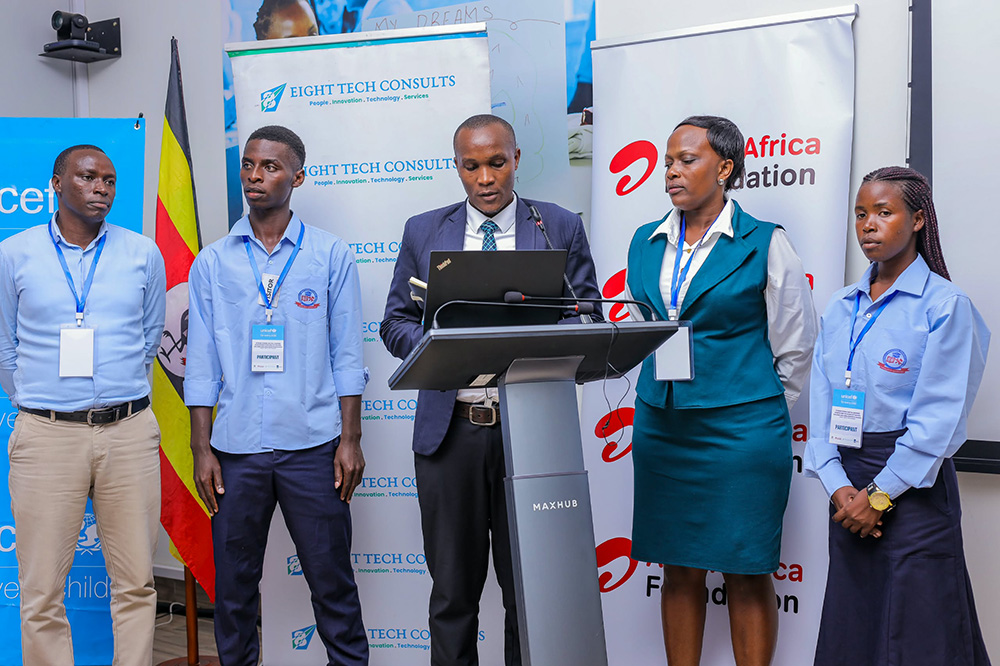
Muombamungu is among 7,300 adolescents who have completed digital skills training under an initiative supported by UNICEF, Airtel Uganda and Eighttech.
The programme seeks to extend digital learning opportunities to adolescents both in and out of school, equipping them with practical information and communication technology skills that can be applied in education, employment and business.
For some participants, the training has provided a first encounter with a computer. For others, it has offered a way to explore income-generating activities.
In Koboko, in the West Nile region, Leila Zamititu had never used a computer before joining the programme at Koboko Resource Centre.
She learnt how to create folders, attend online lectures, search for jobs and market products through digital platforms.
She has since started promoting products online and earning commissions from the sales. But while the skills have given her a way to generate some income, she says a lack of capital limits her ability to grow the activity.
“We are getting some bit of commissions,” she said.
At Nakivale Vocational Training Centre, Mackline Namagara has also found practical uses for the skills she acquired.
The training introduced her to basic computer operations, including using a keyboard and mouse and creating email accounts. She also learnt how to obtain a tax identification number, a process she had previously struggled to navigate because she could not afford the cost involved.
Although she has not yet secured employment, Namagara has begun helping colleagues create email accounts and obtain their own tax identification numbers.
Her experience suggests that the benefits of digital training can extend beyond the individual participant, particularly in communities where access to technology and digital knowledge is limited.
The programme was designed with such communities in mind.
UNICEF Education Officer Janet Akao Abaneka said the initiative recognised that adolescents outside formal education also need opportunities to acquire skills that can help them navigate everyday life and earn a living.
To identify suitable training locations, UNICEF worked with local governments, community organisations and youth centres. It assessed 25 youth centres, examining their infrastructure, access to computers and internet connectivity, as well as the capacity of facilitators to deliver the training.
The initiative targeted young people in underserved communities, including refugee-hosting districts such as Terego, Madi-Okollo and Isingiro, as well as urban refugee communities in Kampala.
Eighttech project manager Baker Ssekitto said the programme had initially targeted 7,500 young people across Uganda. Of those trained, 94 per cent were able to independently demonstrate the skills they had acquired.
He added that about 1,000 participants had found activities following the training, including work in secretarial services, internet hubs and other small-scale enterprises.
The training covered practical skills such as typing, photocopying, scanning, creating email accounts, online marketing, social media management and cybersecurity.
Female participants accounted for 48 per cent of those trained, compared with 52 per cent male participants, according to Ssekitto.
For participants in remote and underserved communities, the very technology they are learning to use can remain difficult to access.
Muombamungu said slow internet connections sometimes interfere with his ability to practise the skills he acquired.
Ssekitto identified inadequate computers, unreliable electricity and limited connectivity as some of the major challenges encountered during implementation.
For Zamititu, the obstacle is not simply access to technology. Although she can now market products online, she needs capital to expand the activity and increase her earnings.
These experiences point to a wider challenge facing digital education programmes: training can equip young people with useful competencies, but without devices, affordable internet, electricity and access to finance, the opportunities may remain limited.
Airtel Uganda says it is working to address some of these barriers by extending internet connectivity to schools, community centres and public libraries.
Charity Brenda Rwabutomize Bukenya, the company's corporate social responsibility manager, said Airtel had connected more than 400 schools, providing each supported institution with 300GB of internet data monthly.
She said community centres and public libraries also offer spaces where young people without personal devices can access online resources, practise their skills and apply for jobs.
The company is also making smartphones available on credit through its shops.
UNICEF, meanwhile, plans to extend some of the digital learning models through its Leaders in Teaching programme, which is expected to reach 2,091 secondary schools and involve 15 higher education institutions. Strengthening teachers' digital skills will also be part of the initiative.
For Muombamungu, the value of the training is already reflected in the work he has secured at the library. For Zamititu, it is in the commissions she earns from online marketing. Namagara, who is still looking for employment, has begun using her knowledge to help others navigate digital services.
Their experiences reveal both the promise and the limitations of digital skills training. Learning to use technology can make opportunities more accessible, but it does not remove the economic and infrastructure barriers that prevent many young people from taking advantage of them.
The measure of success, therefore, may lie less in the number of adolescents who complete a course than in what happens afterwards: whether they can find work, earn a dependable income or build businesses that can support them beyond the training programme.