
Gold buyers to undergo biometric registration under new govt reforms
Under the proposed regulations, every licensed gold buyer, trader, exporter and refiner will undergo biometric verification and background checks, while authorities introduce a digital traceability system to monitor minerals from mine sites to authorised trading centres in real time.
(L-R) Elizabeth Byarugaba, a gold miner, Saidah Sanyu of Woodcross Smelting, Benard Mungu Feni, Director of EuroGold and David Iremera Manneh, a gemstone dealer, during the stakeholders’ consultation workshop. (Credit: John Musenze)
The government, through the Ministry of Energy and Mineral Development, has unveiled a new biometric registration system that will require fingerprinting of all gold and mineral buyers in Uganda as part of sweeping reforms aimed at cracking down on fraud, fake gold dealers and illegal mineral trade networks operating across the country.
Under the proposed regulations, every licensed gold buyer, trader, exporter and refiner will undergo biometric verification and background checks, while authorities introduce a digital traceability system to monitor minerals from mine sites to authorised trading centres in real time.
The energy ministry said the reforms are intended to clean up Uganda’s rapidly growing gold industry, which has increasingly attracted international attention over fake gold scams, smuggling, tax evasion and organised criminal syndicates targeting foreign investors.
Speaking during a stakeholders’ consultation workshop in Munyonyo on May 15, 2026, assistant commissioner in the mineral sector Agnes Alaba said the government wants to fully identify every player involved in the mineral trade.
“We are going to ensure that we know the buyers, the players, the key actors in the mineral sector. We will connect fingerprinting data with systems like Interpol so that we know whether an investor has been involved in criminal activity or scams,” Alaba said.
She explained that the new digital system will capture mineral information directly from mining sites before tracking movement to buying centres, refineries and export points.
“At the mine site, we expect digital capture of all relevant information regarding that gold, where it is coming from, and a traceability system that tracks the mineral from the mine site as it moves to the market,” she said.
The reforms come at a time when gold has become Uganda’s leading export commodity and one of the country’s biggest foreign exchange earners.
According to official trade data, gold contributes more than 45 percent of Uganda’s export revenues and, in some years, has generated more than $2 billion (about sh7.5 trillion) annually, overtaking traditional exports such as coffee.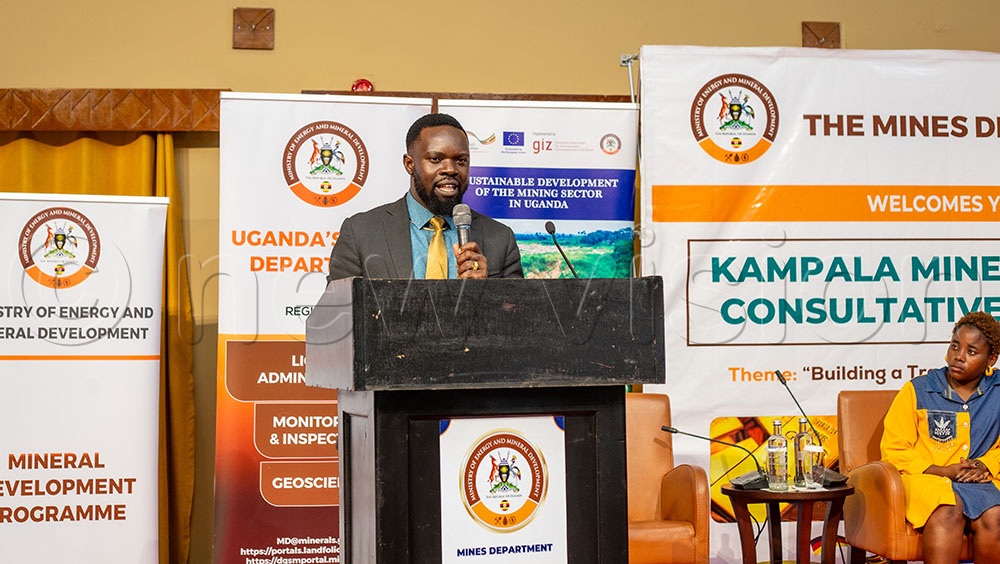
Benard Mungu Feni, Director of EuroGold, addressing stakeholders during the consultation meeting held in Munyonyo. (Credit: John Musenze)
Security agencies estimate that fraudulent gold transactions and illegal mineral trade cost Uganda billions of shillings annually through lost taxes, unregulated exports and criminal scams.
In recent years, several foreign investors have reportedly lost millions of dollars to fraudsters posing as genuine gold dealers in Kampala and neighbouring border districts.
Assistant commissioner of police Julius Caesar Tusingwire, commandant of the Police Minerals Protection Unit, said the lack of organised trading systems has allowed scammers to thrive.
“The establishment of organised mineral markets is going to address many security concerns, especially fraud and scams that we have been dealing with. Many victims lose money because they do not know the right people to deal with,” Tusingwire said.
He added that gold trading requires tighter security controls because of the mineral’s high value.
“Gold is a high-value mineral and must be kept in strong rooms, not displayed openly. We also advise traders to use banks and trusted security providers,” he said.
Under the proposed regulations, all mineral trade will only take place within licensed and government-regulated mineral buying centres, while unlicensed buyers and dealers will face tougher penalties.
Government also plans to restrict trading hours, requiring mineral markets to close by 5:00 pm due to security concerns linked to nighttime gold transactions.

Gold and Minerals representatives at stakeholders’ consultation workshop in Munyonyo on May 15. (Credit: John Musenze)
According to the minerals sector, the government is setting up buying centres in areas with gold minerals, while Kampala will have an office where traders can conduct gold business. The new regulations will also require all traders to undergo fingerprint registration.
“We have noted that there are investors who order gold and minerals without licenses. Every operation must take place within the market, and every trader must have a license granted by the ministry,” she added.
The reforms are also expected to strengthen Uganda’s new policy of building national gold reserves through the Bank of Uganda.
Earlier this year, the government announced plans allowing the central bank to purchase locally refined gold as part of efforts to boost foreign exchange reserves and strengthen economic stability.
Minerals officials said stricter regulation and improved traceability are critical if Uganda is to fully benefit from its mineral wealth while reducing illicit financial flows linked to the regional gold trade.
Government is also pushing for mandatory value addition before mineral exports. Under the proposed rules, gold exports will only be allowed after refining to at least 99.9 percent purity, while gemstones will have to undergo processing into finished jewellery-ready products before export.
“No mineral will be exported without meeting prescribed value addition standards. Value addition is the key catchword,” Alaba said.
Uganda is estimated to host more than 50 mineral types, including gold, copper, iron ore, tin, cobalt and rare earth minerals, making the sector one of the country’s biggest long-term economic opportunities.
Benard Mungu Feni, director of EuroGold Refinery, said organised mineral markets would help genuine investors avoid fraud and improve confidence in Uganda’s mineral industry.
“When foreign investors come into the country, they sometimes end up in the wrong places because they do not know where the recognised market centres are,” Feni said.
“This is good for refineries, miners, and the entire country because there will now be a recognised place where gold trade is conducted,” he added.
Alaba said the new biometric system is intended to formalise the sector, improve revenue collection, eliminate illegal mineral networks and restore trust in Uganda’s growing gold trade.