
Fewer Ugandans to live in poverty, World Bank says
Qimiao Fan, World Bank division director for Uganda, Kenya, Rwanda, and Somalia said economic growth has to translate into better, more formal, and more inclusive jobs for Ugandans. (Courtesy photos)
________________
The World Bank has projected that poverty in Uganda will fall to 47.7% by the 2027/28 financial year, from 51.5% in the 2024/25 financial year, driven largely by growth in the non-oil economy and the anticipated start of commercial oil production.
The projection is contained in the World Bank’s 27th edition of the Uganda Economic Update, which credits the expected decline to accelerating non-oil GDP growth, projected at 6% in FY26, rising to 8.5% in FY27 and 8.1% in FY28.
“The risks to the outlook on the domestic front could affect the outlook that we have presented. The share of Ugandans living below the $3 per day line is estimated to have fallen to 51.5% in FY25, down from 52.9% in FY24,” Liz Mukasa, senior economist at the World Bank, said while presenting the report at their headquarters in Kampala.
However, the Bank cautioned that the pace at which poverty falls will depend heavily on whether ordinary, poorer households actually get to share in the benefits of oil revenues, and not just the wealthy or those directly connected to the oil sector.
“Managing these risks while investing in human capital and productive sectors will shape Uganda’s sustainable development path,” Qimiao Fan, World Bank division director for Uganda, Kenya, Rwanda, and Somalia, said.
Kaggwa (2nd right) during the launch of the report by World Bank in Kampala.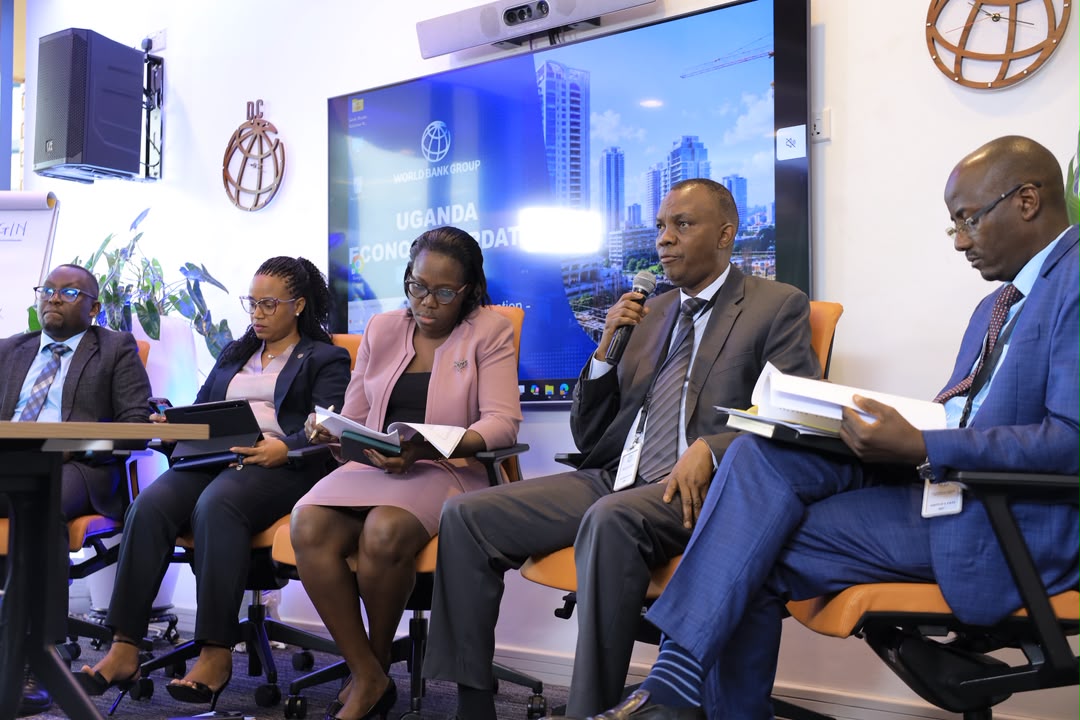
While the poverty numbers point in the right direction, Uganda’s fiscal deficit is projected to widen to 6.5% of GDP in FY26, up from 6.0% in FY25, a development the Bank attributes to election-related spending, budget overruns and rising interest costs.
Tax revenue growth has also slowed sharply, coming in at 5.1%, well below the three-year average of 13.4%.
Moses Kaggwa, director of economic monitoring affairs, at the ministry of finance, said that oil cash will be put to productive use.
“The first oil will be coming in this financial year, but we don't expect that we are going to use a lot of the oil money. We already have a fiscal rule on how we are going to use oil revenues. The revenues are going to be used for infrastructure and development projects, not for increasing salaries,” he said.
“We have looked at areas that will drive jobs, and that is agro-industrialisation, tourism development, mineral development, including oil and gas, and science, technology, and innovation, including ICT and the creatives.
“We have put in the last four years sh4.4 trillion in the parish development model for the smallholder farmers to be able to supply to the market so that industry can produce the manufactured goods which they can sell.“