
FDC faults sh84.39 trillion budget over spending priorities
Speaking at the party headquarters in Najjanankumbi, Kampala, on Monday (June 15), FDC vice-chairperson for the western region, Robert Centenary, said the budget favours those in power while neglecting key sectors that directly affect citizens' livelihoods.
The FDC vice chairperson Western Region, Robert Centenary, speaking to the press at FDC Headquarters Najjanankumbi, Entebbe Road in Kampala on Monday June 15, 2026 (Photo by Isaac Nuwagaba)
_________________
The Forum for Democratic Change (FDC) has criticised the government's sh84.39 trillion budget for the 2026/27 financial year, arguing that it fails to address the needs of ordinary Ugandans and does little to promote wealth creation, job growth and improved public services.
The budget, presented to Parliament by finance minister Henry Musasizi on June 11, 2026, outlines government spending priorities for the financial year beginning July 1.
Speaking at the party headquarters in Najjanankumbi, Kampala, on Monday (June 15), FDC vice-chairperson for the western region, Robert Centenary, said the budget favours those in power while neglecting key sectors that directly affect citizens' livelihoods.
“A budget that does not reduce poverty is not a development budget but a political document,” FDC reacted.
Centenary said the party was concerned that, despite significant growth in government expenditure over the past five years, many Ugandans continue to struggle economically.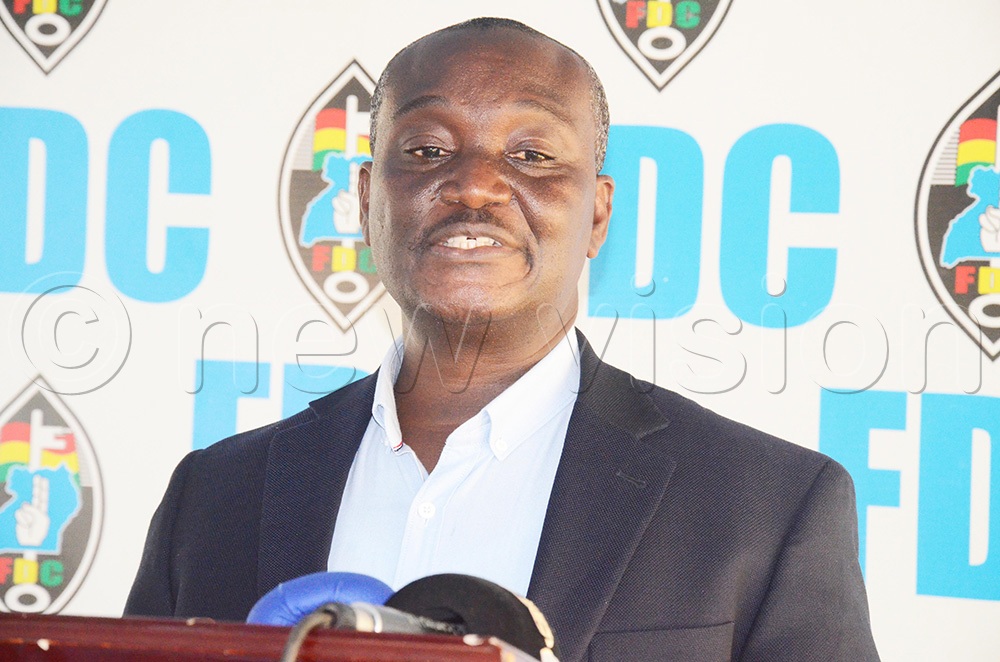
The FDC vice chairperson Western Region, Robert Centenary, speaking to the press at FDC Headquarters Najjanankumbi, Entebbe Road in Kampala on Monday June 15, 2026 (Photo by Isaac Nuwagaba)
“FDC notes that despite a 70% budget growth over the past five years, ordinary citizens have not seen a matching improvement in their lives. The party highlights Uganda's public debt, now standing at sh126.19 trillion, equivalent to 53% of Growth Development Product (GDP), with much of it accumulated through inflated contracts and corruption,” Centenary said.
The party questioned the allocation of sh10.21 trillion to security, governance and the rule of law, including sh5.03 trillion for the Ministry of Defence, arguing that more resources should have been directed towards social services and debt reduction.
“FDC questions the prioritisation of security over essential services like healthcare and education, especially given Uganda's peaceful relations with neighbouring countries. We are not at war with any external aggression, and big chunks of money should have been considered for health, education and paying the public debt,” he proposed.
FDC also criticised the State House budget of sh470.6 billion, describing some expenditure on travel, meals and entertainment as excessive.
The party further argued that the country's budgeting framework should be reviewed to allow an incoming government to prepare and implement its own budget.
“If FDC was in power, we would have amended the Finance Administration Act under which the current law tasks the outgoing government to be responsible for preparing the national budget,” Centenary said.
“This has created a challenge because if a different political party wins an election, the incoming government may be required to implement a budget that was designed by the predecessor rather than one that reflects its own policies and priorities.”
Centenary said an FDC-led government would allocate at least 15% of the national budget to healthcare in line with the Abuja Declaration and fully fund the National Medical Stores to eliminate medicine shortages.
“Fully fund the National Medical Stores (NMS) to eliminate drug stockouts in public health facilities and recruit and deploy at least 10,000 additional health workers to under-staffed facilities.”
The party also proposed ensuring that every health centre III has a functional maternity ward and at least one trained midwife.
On education, FDC said it would allocate 15% of the national budget to the sector and increase teachers' starting salaries to at least sh1.5 million per month.
“In the field of education, FDC would dedicate 15% of the budget allocation and ensure tripling school teachers’ salaries to at least sh1.5m per month as starting salary,” Centenary noted.
The party also called for the removal of UCE and UACE examination fees for students from households living below the poverty line.
“FDC wants the government to fund a national school feeding program and increase per capita funding to Universal Primary Education (UPE) and Universal Secondary Education (USE) schools to reflect the actual cost of running a school,” he said.
“We demand a revised budget that prioritises citizens' welfare and addresses pressing issues like healthcare, education, and poverty. FDC would have established a national agricultural bank to provide affordable credit to farmers rather than depending on moneylenders.”
He added that the government should allocate at least 10% of the national budget to agriculture in line with the Maputo Declaration.
“We want the government to dedicate a 10% budget to agriculture as required by the Maputo declaration,” Nandala insisted.
On fiscal management, Nandala said FDC would cut the State House non-security budget by at least half and redirect some of the savings to health services.
“FDC would eliminate sh196b in presidential donations and redirect to ambulances and drug procurement, as well as paying medical interns. We would reduce the defence budget to a level commensurate with genuine security needs, not political control,” he suggested.
The party also called for the reversal of excise duty increases on cooking oil, fuel and sugar, as well as higher motorcycle registration fees.
Citing the Auditor General's 2025 report, Centenary said corruption continues to undermine public spending.
“According to the auditor general’s report 2025, it is estimated that 20% to 30% of Uganda’s budget does not reach the intended destination.”
“This means out of sh84.39 trillion in this year’s budget, between sh16 trillion to sh25 trillion will disappear into corruption, ghost projects and inflated procurements,” Centenary said.
According to the budget, the largest allocations include sh33.6 trillion for debt servicing, sh10.21 trillion for security, sh8.79 trillion for transport infrastructure and sh6.66 trillion for education.
FDC also cited findings from the 2025 Uganda Bureau of Statistics census indicating that 1,208 of Uganda's 2,209 sub-counties and town councils do not have a secondary school, which it said highlights the need for greater investment in education infrastructure.