
Budget reading: CSOs raise concern over Uganda’s rising debt
According to the organisations, Uganda’s public debt is projected to reach sh130 trillion in the 2026/27 financial year, while debt servicing obligations are expected to exceed sh18.2 trillion, accounting for nearly 22% of the national budget and about 40% of projected domestic revenue.
(L-R): Peninah Naiga, a research Associate at the Uganda Debt Network, with Henry Magala, the Country Program Manager AIDS Healthcare Foundation and Julius Mukunda, the Executive Director Civil Society Budget Advocacy Group (CSBAG), during a media launch for the Freedom from Debt Campaign on June 10, 2026. (Photo by Nicholas Oneal)
_________________
As the country prepares for the reading of the national budget for the 2026/27 financial year at Kololo Ceremonial Grounds on Thursday (June 11), Civil Society Organisations (CSOs) have raised concerns over the country’s growing debt burden.
They have warned that escalating debt servicing costs are increasingly squeezing funding for critical public services.
The concerns were raised during the launch of the Freedom from Debt Campaign in Uganda, a joint initiative spearheaded by the Civil Society Budget Advocacy Group (CSBAG), AHF Uganda Cares, Uganda Debt Network and Southern and Eastern Africa Trade Information and Negotiations Institute (SEATINI)-Uganda.
The campaign launched at CSBAG offices in Ntinda, Kampala, is part of a wider global movement advocating for debt justice, fiscal accountability, and sustainable public financing.
According to the organizations, Uganda’s public debt is projected to reach sh130 trillion in the 2026/27 financial year, while debt servicing obligations are expected to exceed sh18.2 trillion, accounting for nearly 22% of the national budget and about 40% of projected domestic revenue.
Speaking at the launch, Uganda Debt Network representative Peninah Nayiga said the country’s debt trajectory should concern every Ugandan because of its implications for future generations and government spending priorities.
She noted that while borrowing remains an important tool for development, it must be undertaken responsibly and with clear accountability mechanisms to ensure that loans translate into tangible improvements in people's lives.
“The question is not whether government should borrow, but whether borrowed resources are generating value for citizens. Debt should support development outcomes in sectors such as health, education, agriculture and social protection rather than becoming a burden that limits future opportunities,” Nayiga said.
The Executive Director of CSBAG, Julius Mukunda, emphasised the need for greater transparency and stronger oversight in public debt management.
Mukunda argued that citizens often bear the consequences of public borrowing decisions despite having limited access to information regarding loan agreements, borrowing terms and the performance of debt-financed projects.
“We have seen improvements in budget transparency over the years, but citizen participation in debt governance remains inadequate. Parliament must exercise stronger oversight over borrowing proposals, while government should proactively publish accessible information on debt and the projects financed through loans,” he said.
According to Mukunda, accountability in debt management is particularly important as government seeks additional financing to fund infrastructure and development priorities.
He called for rigorous value-for-money assessments before new loans are contracted, saying every borrowed shilling must contribute directly to Uganda's development agenda.
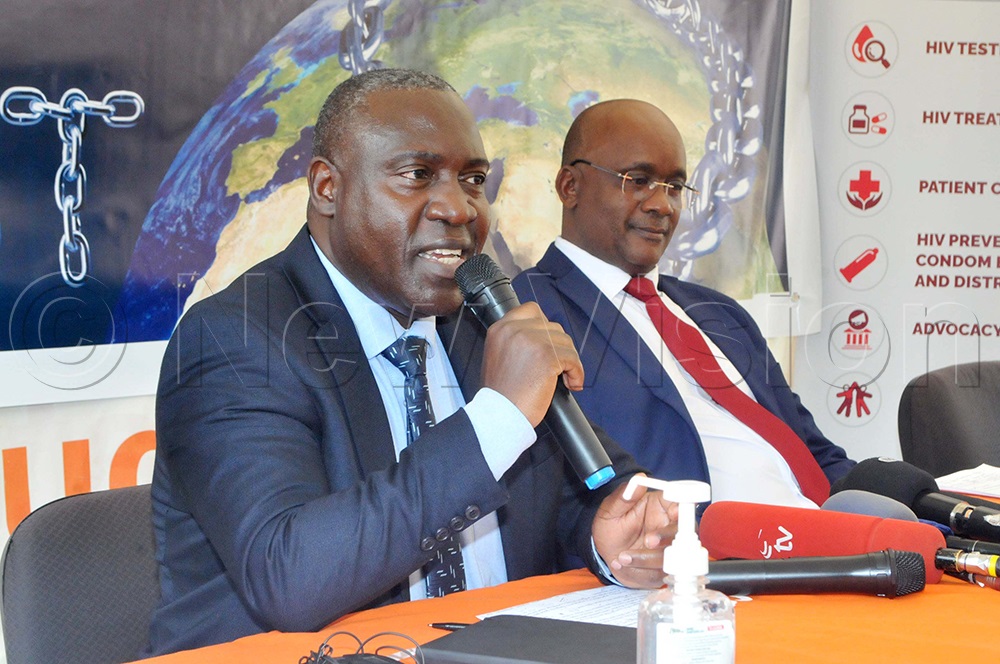
Henry Magala (left) the Country Program Manager AIDS Healthcare Foundation speaks as Julius Mukunda the Executive Director Civil Society Budget Advocacy Group (CSBAG) looks on during a media launch for the Freedom from Debt Campaign on June 10, 2026. (Photo by Nicholas Oneal)
From the health sector perspective, Dr Henry Magala, the Country Director of AHF Uganda Cares, expressed concern about the impact of rising debt repayments on healthcare financing.
He noted that many developing countries are increasingly allocating more resources to debt servicing than to health and education, a trend that threatens progress in improving public health outcomes.
“When countries spend more on debt repayment than on healthcare, citizens pay the price through underfunded hospitals, shortages of essential medicines and inadequate health services,” Magala said.
Magala further supported calls for automatic debt-servicing pauses during public health emergencies, saying such measures would enable governments to respond more effectively to crises without sacrificing essential services.
Meanwhile, Hilda Tumuhe, the Programme Officer for Debt and Aid at SEATINI-Uganda, placed Uganda’s debt challenge within the broader context of the global financial system.
She argued that developing countries often face structural disadvantages in international finance, resulting in debt arrangements that disproportionately benefit creditors while limiting the policy space of borrowing nations.
“The current global financial architecture places a heavier burden on developing countries and contributes to a reverse flow of wealth from poorer nations to wealthier economies through debt repayments,” Tumuhe said.
She called for reforms that would give borrowing countries greater bargaining power. She also advocated for the establishment of a global Borrowers’ Forum to strengthen cooperation among developing nations.
Tumuhe further backed proposals for debt-for-development swaps, arguing that this would allow countries to redirect resources towards investments in healthcare, education, climate resilience and infrastructure.
The civil society organisations further called for a 1 percent global levy on artificial intelligence capital to support debt relief efforts and finance essential public goods, including vaccines, food security initiatives and infrastructure development.
Collectively, the organisations urged government to ensure that increasing debt servicing costs do not crowd out investments in healthcare, education, agriculture and social protection programmes.
They emphasised that debt should remain a tool for development rather than becoming a long-term obstacle to economic growth and social progress.