
BOU Governor tips bankers on risk management
The Finance Minister, Henry Musasizi, who was the chief guest, urged researchers and academic institutions to work more closely with banks, SACCOs (Savings and Credit Cooperative Organisations) and insurance companies to ensure that research responds to practical challenges facing the financial sector.
BOU Governor tips bankers on risk management
The Governor of the Bank of Uganda (BOU), Dr Michael Atingi-Ego, has called for a more innovative and resilient financial sector capable of managing risks while supporting Uganda’s ambition to transform its economy ten-fold.
Atingi-Ego said Uganda’s financial sector must move beyond simply avoiding risk and instead develop the knowledge, systems and capacity to understand, assess and manage emerging risks as businesses, technologies and financial products evolve.
He made the remarks on August 21 during the second day of the 2026 Annual Research Conference held at Protea Hotel, Kampala, under the theme: “Financial Sector Research as a Catalyst for Uganda’s ten-fold Economic Growth Agenda.”
The two-day conference was organised by the Uganda Institute of Banking and Financial Services (UIBFS), in partnership with the Uganda Bankers’ Association and Makerere University’s College of Business and Management Studies.
Atingi-Ego said a financial sector that is expected to support businesses, innovation and economic growth must be equipped to manage, rather than shy away from risks.
He called for deepening of Uganda’s financial market architecture to create a stronger and more responsive financial system capable of supporting investment and economic activity.
The Governor further stressed the importance of constructive engagement between the regulator and financial sector players, calling for “a regulator that listens first” as the industry responds to new technologies, products and changing market realities.
His remarks placed research and evidence at the heart of efforts to build a financial sector capable of supporting Uganda’s ten-fold Economic Growth Agenda.
Research-industry partnerships
The Finance Minister, Henry Musasizi, who was the chief guest, urged researchers and academic institutions to work more closely with banks, SACCOs (Savings and Credit Cooperative Organisations) and insurance companies to ensure that research responds to practical challenges facing the financial sector.
“The best investment you can make is understanding your customers and your market,” Musasizi said.
He urged regulators to remain open to evidence and innovation and to pilot, test and scale interventions that work.
The Minister also called on development partners to align their support with Uganda’s research priorities rather than expecting national priorities to follow donor interests.
“Align your support to Uganda’s research priorities, not the other way round,” he cautioned.
Musasizi said Uganda’s ambition to achieve the ten-fold economic growth would require more than borrowing.
“Uganda’s ten-fold growth will not be delivered by debt alone, but by knowledge, innovation and capital working together,” he said.
He challenged stakeholders to make the conference a turning point by moving financial sector research from the periphery to the centre of Uganda’s economic strategy.
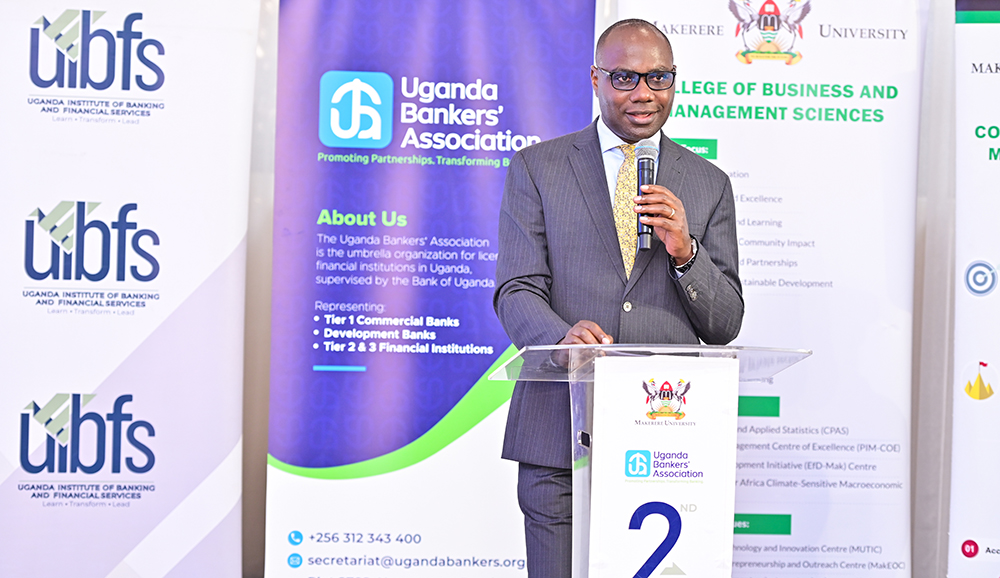
Musasizi said Uganda’s ambition to achieve the ten-fold economic growth would require more than borrowing.
The Secretary to the Treasury and Finance Ministry Permanent Secretary, Ramathan Ggoobi, said financial sector research was critical to understanding emerging opportunities, identifying financing gaps and developing evidence-based approaches to mobilising and deploying capital into productive sectors.
Ggoobi, who was represented by Bob Munene, an assistant commissioner in the ministry's financial services department, commended the organisers for choosing a theme he described as a matter of national importance.
He challenged stakeholders to look beyond the conventional role of finance as an intermediary between savers and borrowers and instead examine how knowledge, evidence, capital and innovation can combine to transform the economy.
The UIBFS Board Chairperson, Godfrey Ssebaana, called for a stronger culture of evidence-based decision-making within the financial sector.
Ssebaana, who is also the Chief Executive Officer of Diamond Trust Bank, said the financial sector would play a critical role in mobilising savings, financing businesses, facilitating investment and supporting economic activity as Uganda pursues economic transformation.
However, he said stakeholders needed evidence to determine whether the sector was evolving fast enough to support the transformation the country seeks. “To answer that question, we need evidence,” he said.
Ssebaana called for stronger partnerships among financial institutions, researchers, universities, regulators and policymakers.
He said financial institutions should not merely consume research, but should also help shape the research agenda by identifying practical challenges requiring investigation.
He reaffirmed UIBFS’ commitment to strengthening its role as a link between industry, research and professional practice.
UIBFS Chief Executive Officer Goretti Masadde said the financial sector was changing rapidly due to technology, evolving customer expectations and emerging risks, making research and continuous learning increasingly important.
Masadde said research should not end with reports, academic publications or conference presentations, but should generate evidence that informs decisions, supports innovation and provides practical solutions.
She called for stronger collaboration between financial institutions as well as academic and research institutions so that industry challenges can be translated into relevant research questions.
Masadde said UIBFS would continue providing platforms that bring together industry, academia, regulators, researchers and policymakers to share knowledge and develop evidence-based solutions.
The conference brought together government officials, financial sector leaders, regulators, researchers and academics to examine how research can strengthen Uganda’s financial sector and contribute to inclusive and sustainable economic growth.
The two-day discussions focused on the need to invest in research, strengthen industry-academia collaboration, understand customers and markets, master emerging risks, and ensure that financial policies and regulations are informed by evidence.