
Ugandan literature thrived in 2025
The biggest literature event was unarguably the second edition of the Kampala Writes LitFest, held on August 15-17 at the Yusuf Lule Auditorium, Makerere University.
Goretti Kyomuhendo and Nick Makoha during the launch of their books at the Kampala Writes LitFest in August. (File)
__________________
The year also saw major international recognition for Ugandan writers, including Joshua Lubwama winning the African Regional Commonwealth Short Story Prize, Zabu Wamara’s debut novel Night Dancer claiming the Island Prize for Fiction and poet Jedidiah Mugarura receiving the Sillerman First Book Prize, writes Kalungi Kabuye.
Goretti Kyomuhendo was the curator of the 2025 Kampala Writes Literature Festival (LitFest), possibly the largest ever literature gathering Uganda has ever seen. For over three days at the Yusuf Lule Auditorium, Makerere University, thousands of people turned up for panel discussions on major literature issues, attended masterclasses and were entertained with spoken word poetry, contemporary dance and drama.
When we asked Kyomuhendo to describe literature in 2025, she said: “It thrived!” And indeed, literature in 2025 thrived. While the LitFest was the cherry on the literature cake, there were others that showed that the book industry in Uganda is indeed thriving. There was Joshua Lubwama, a Kampala-based software engineer who won the African Regional Prize in the Commonwealth Short Story Prize, the first Ugandan to do so since Jennifer Makumbi Nansubuga in 2014. He was not the only one, too. Zabu Wamara, though largely unsung, was the joint winner of the Island Prize for a Debut Novel from Africa 2025 for her novel, Night Dancer.
Spoken word poetry continued to make its mark on Uganda’s entertainment scene; the Jinja International Poetry Festival happened in September, the Uganda Poetry Society was formed, and Femrite (the Uganda Women Writers’ Association) held its annual Week of Literary Activities, continuing its ‘lantern bearer’ role for Uganda’s literature. There were also several book launches.
The second Kampala literature festival
The biggest literature event was unarguably the second edition of the Kampala Writes LitFest, held on August 15-17 at the Yusuf Lule Auditorium, Makerere University. Sponsored by the Ugandan German Cultural Society, in partnership with the British Council and Makerere University, it was only the second time a literature festival was held in Uganda; there had been conferences, yes, but not a festival, which was strange.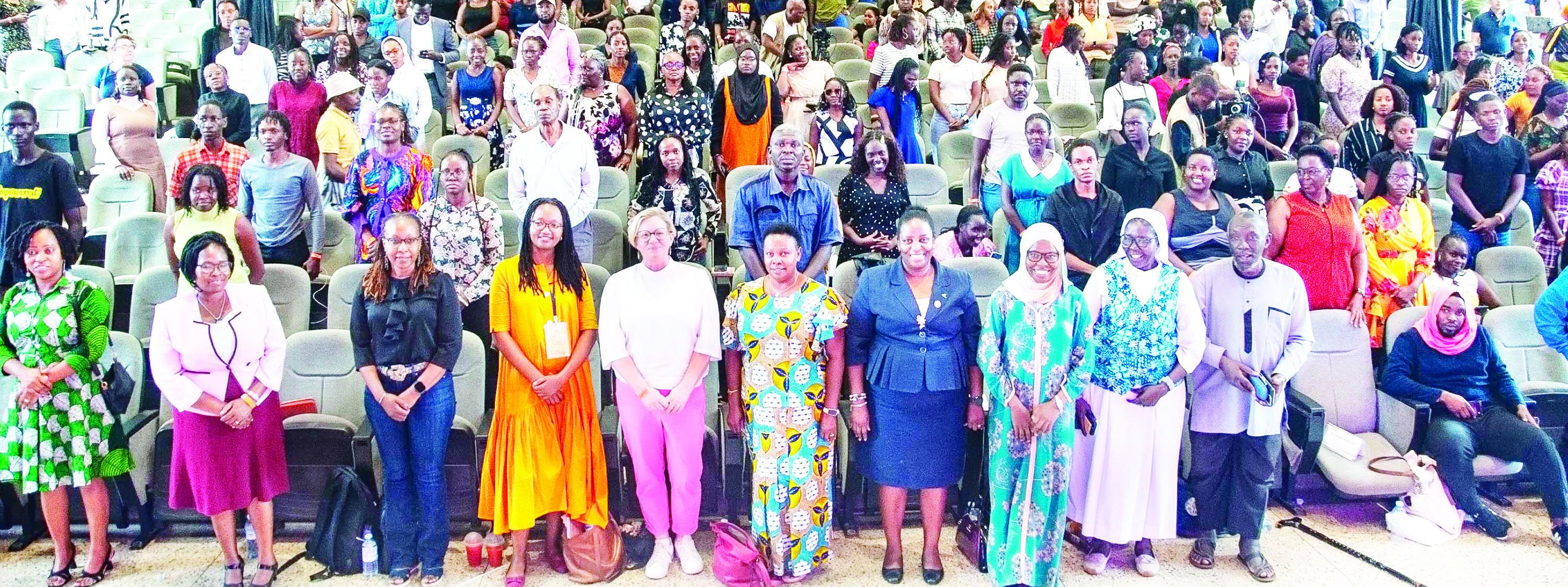
Participants at the 2025 Kampala Writes Literature Festival held on August 15-17 at the Yusuf Lule Auditorium, Makerere University. (Credit: Kalungi Kabuye)
But all that was forgotten, and forgiven, when it kicked off on a rainy Friday morning. It was the biggest opportunity Ugandan writers had to showcase their work, gain recognition and connect with literary agents and publishers.
The theme of the LitFest was Belonging, and it was explored in various ways by several panel discussions that featured diverse writers and authors from both Uganda and abroad.
The existence or not of a ready market for writers is one of the largest handicaps in Uganda, and one of the panel discussions explored publishing strategies and ways to navigate through them. And for the first time, we had international literary agents, one from Nigeria and one from Kenya.
There were panel discussions on different aspects of the writing industry, including perspectives from academia, and a very animated discussion on funding for the arts, especially literature.
The highlight of the festival came on its first day, with Makumbi giving the keynote address. Since becoming the overall winner of the 2014 Commonwealth Short Story Prize, she has been fêted as the country’s top writer, but Ugandans had not seen much of her, since she lived and worked in the UK. So, Makumbi treated the occasion, and indeed the three-day workshop was a homecoming of sorts.
In the address, she described her journey as a writer, starting from an avid reader as a child, to a search for belonging that led her to become a full-time writer.
“I walk tall, unafraid, and I have a spring in my step because being welcomed like that back at home is huge,” Makumbi said.
And everyone there loved her right back, especially since she stayed for all three days of the festival, and was open for talks and interviews. At the end, Kenyan literary agent Mercy Kiruiwas impressed.
“The Kampala Writes LitFest has quickly carved out its space within Africa’s growing literary calendar,” Kirui said, afterwards.
“It may still be young, but its blend of cultural support, institutional involvement and genuine inclusivity sets it apart. More than an event, it was a celebration of African voices and a reminder that literature remains one of the most powerful tools for shaping identity, community and the future.”
Joshua Lubwama
He is unassuming to a fault, but the 25-year-old, quiet-spoken software engineer (I won’t give up my day job) did what no Ugandan writer had done in over 10 years – becoming the African Region winner of the Commonwealth Short Story Prize. While the debate goes on whether the proliferation of winners of the prize reflects the quality of the writers in a particular country, Ugandans were happy to finally celebrate one of their own.
In an interview, Lubwama admitted to writing because he had ‘nothing better to do’. He also confessed to how writing can be very difficult, and at times writes to overcome anxiety. On what he likes to write about, he declared not ‘getting behind any particular agendas’.
“I just like to tell stories,” he said.
“My underlying principle is truth and accuracy, and then I hope that the reader can learn more about what people are like.”
The chairperson of the judges, Dr Vilsoni Hereniko, said Lubwama’s winning story, Mothers Not Appearing in Search, “illuminates many aspects of human nature and demonstrates true mastery of the short story form”. He won £2,500 (about sh12m).
Zabu Wamara and Jedidiah Mugarura
Also known as Yvonne Zabu, Wamara’s accomplishment went strangely unfêted by many. A therapist by profession — but holding an master of arts in creative writing from the University of East Anglia — Zabu’s novel, Night Dancer, was declared the joint winner of the 2025 Island Prize for Fiction, together with South African writer Kristien Potgieter.
Declaring the winner of the fourth edition of the prize, the judges said while “these are two very different novels, each with an original story and important themes, told in distinctive voices, both are more than worthy of publication and recognition”. Named after Karen Kenning’s novel, The Island, the prize was launched in 2022 to “address the underrepresentation of African voices in global literature by providing aspiring writers with a platform to showcase their work”.
Night Dancer explores how mental health intersects with community and belief in modern African society. She won £500 (about sh2.4m).
Jedidiah Mugarura, a Canada-based Ugandan poet, won the 2025 Sillerman First Book Prize for his book Nyamuteza. The prize is awarded annually to an African who has not yet published a full collection of poetry. The book was lauded for its “... intellectual brilliance, capaciousness and assured narrative sensibility”. Mugarura received $1,000 (about sh3.6m).
Spoken word poetry
When Carolyne ‘Afroetry’ Acen took to the stage on the afternoon of the opening day of the LitFest, it marked the acceptance of spoken word poetry as literature. While some purists are still reluctant to recognise it as an art form, its popularity has grown in leaps and bounds.
The Jinja International Poetry Festival, a brainchild of Keith Muganza, was held over three days in September. This was the second time the festival was held.
Later in the year, Philip Matogo led efforts to launch the Uganda Poetry Society. There will be a $1,200 (about sh4.5m) Dr Ivan Edwards Poetry Award, which will recognise emerging poetic voices in East and Central Africa.
Notable publications and launched
Goretti Kyomuhendo’s novel, Promises (Catalyst Press) was launched at the LitFest, together with The New Carthaginians (Oxford Press) by UK-based Ugandan poet Nick Makoha. Kyomuhendo said it had taken her 15 years to write and get her fifth novel published.
Promises would later be chosen among the top five books by African writers by The Continent, an African weekly magazine; and Makoha would also be announced among the poets shortlisted for the T.S. Eliot Prize for best new poetry collection in the UK.
Justice Mike Chibita of the Supreme Court launched his second book, Leaders Grieve Last, a book about dealing with grief and the loss of loved ones.
Feeling, a poetry anthology celebrating Ugandan women, was launched in July at the British Council offices.
Edited by Beverley Nambozo Nsengiyunva, the founder and editor of the Babishai Niwe Poetry Foundation, the anthology celebrated iconic Ugandan women like Rhoda Kalema, Dr Lydia Mungerera, Yvonne Namaganda (who rescued 19 girls from a school dormitory fire but perished doing so) and Betty Mugoya, Nambozo’s mother.