
From Rabat’s playbook to the Pamoja promise: How East Africa can match, surpass Morocco for AFCON 2027
Morocco showed that when infrastructure, digital identity, and payment acceptance work together, Africa’s flagship tournament looks and feels world-class.
Chad Pollock is the vice-president and general manager of Visa East Africa. (Courtesy photos)
________________
Two months ago, Morocco concluded a superb Africa Cup of Nations, capped by a final in Rabat where Senegal edged the hosts to lift the trophy.
The tournament ran from December 21, 2025, to January 18, 2026, across nine venues and six cities, an organisational feat that set a new benchmark for African mega events.
For Kenya, Uganda and Tanzania, the Pamoja hosts of AFCON 2027, the handover could not be more symbolic. CAF formally confirmed our region as the next host, and the Pamoja delegation received the CAF flag in Rabat. CAF President Dr Patrice Motsepe also underlined that Morocco “raised the bar,” while backing East Africa to deliver a successful edition in 2027.
As the official and exclusive payment partner for CAF competitions through 2026, we at Visa see firsthand how great tournaments are built: on top of solid infrastructure, yes, but also on a digital-first fan journey, ubiquitous payment acceptance, and a seamless blend of physical and cyber security.
What Morocco did right and what we should emulate
1) Integrated, world-class venues and city infrastructure.
Morocco staged AFCON across nine modernised stadiums and upgraded transport nodes, reflecting investments that dovetail with the country’s 2030 FIFA World Cup co-hosting ambitions. The result was consistent match-day quality and reliable fan flows across cities.
2) A digital fan journey from end to end.
CAF and the Local Organising Committee (LOC) launched an app and a Fan ID system that integrates ticketing, security, and even e-visa flows. The ticketing program included phased releases and a Visa pre-sale window, showing how payments partners can manage demand orderly and protect fans from fraud.
3) Payments embedded in the experience.
As CAF’s exclusive payment partner, Visa enabled digital payments for AFCON ticketing and on-site purchases in recent editions, reducing cash-handling risk and speeding up queues. That consistency of acceptance is part of what makes fans describe events as “world-class."
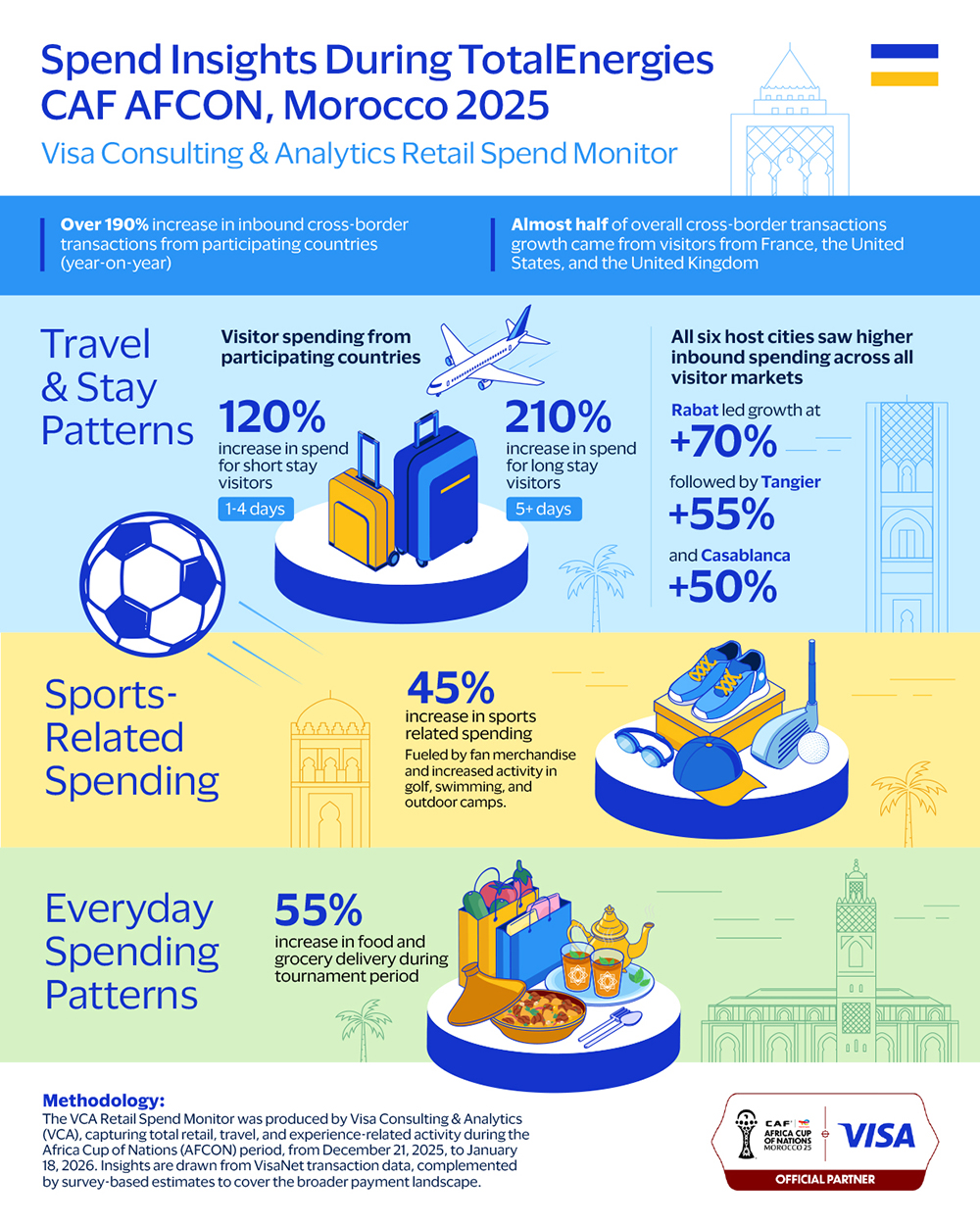
Visa’s data for the tournament period (21 December 2025–18 January 2026) showed that cross‑border transactions from participating countries rose over 190% year‑on‑year, driven largely by visitors from Côte d’Ivoire, Senegal, and the DRC.
This increase was reflected across all six host cities, with Rabat, Tangier, and Casablanca seeing the largest gains as short-stay visitor spending rose by 120% and long-stay spending by 210%. Beyond travel, spending patterns shifted elsewhere: Sports-related purchases rose 45%, and food and groceries delivery rose 55% during the tournament.
Our CAF partnership has gone far beyond logos. We’ve supported cashless acceptance at venues, delivered cardholder benefits such as exclusive ticket presales, and run programs that bring communities closer to the game, such as Player Escort initiatives for children. These are practical levers to improve the fan journey, while advancing inclusion and safety.
East Africa’s roadmap to match Morocco
1) Lock in CAF compliant venues.
CAF expects six suitable venues for a 24-team AFCON, with capacity thresholds that typically include two 40,000-plus stadiums and additional grounds for knock-out and group stages, alongside strict requirements for pitch quality, lights, media zones, medical facilities, and training sites. Beyond construction, CAF requires exclusive stadium control on the days leading up to kickoff, an operational detail that can make or break opening night.
2) Make 2027 the most contactless AFCON yet.
Fans expect to pay with ease on transit, at entrances, and at tills. Visa will help extend acceptance beyond stadiums into fan zones, hotels, restaurants and MSMEs. A major catalyst is Tap to Phone, which turns any NFC-enabled Android smartphone into a secure payment terminal without extra hardware. With Visa already launching Tap to Phone with several banks in the region, we aim to scale this across host corridors so even micro vendors can accept cards and wallets.
3) Border, safety, and cyber readiness.
CAF’s venue exclusivity rules and pitch management protocols are now rigorous and rightly so. We should mirror Morocco’s tightened security layers around stadiums and digital identities, and extend that mindset to cyber risk across ticketing, payments, and Wi-Fi networks. Early joint exercises between LOCs, federations, ICT authorities, and private partners will close gaps well before kickoff.
Morocco showed that when infrastructure, digital identity, and payment acceptance work together, Africa’s flagship tournament looks and feels world-class. With government resolve, a federation focus, and private-sector execution, Pamoja 2027 can set a new standard and leave a real economic and digital legacy for our cities, SMEs and fans.
The writer is vice-president and general manager of Visa East Africa