
Uganda’s refugees call for shared food storage facilities
The study showed that agriculture remains the main livelihood for refugees and host communities, with maize, beans, cassava and Irish potatoes being the main crops grown. Refugees, however, cultivate on very small plots averaging between 15 by 20 metres and 20 by 15 metres per household.
Karubanga, a lecturer in the Department of Extension and Innovation Studies at Makerere University and principal investigator of the study talking to refugees as one of the refugees looks on at Farmers Lounge, Kikuube District. (Courtesy photo)
_________________
Refugees living in western Uganda have called for the establishment of shared food storage facilities to help them preserve harvests and avoid selling produce at low prices during bumper seasons.
A study by Makerere University and the University of Cambridge under the Communities of Hosts and Refugees Transitioning to Climate Resilience (CHART-CR) project found that poor food storage is one of the main causes of food insecurity in Kyangwali Refugee Settlement in Kikuube District.
The study showed that agriculture remains the main livelihood for refugees and host communities, with maize, beans, cassava and Irish potatoes being the main crops grown. Refugees, however, cultivate on very small plots averaging between 15 by 20 metres and 20 by 15 metres per household.
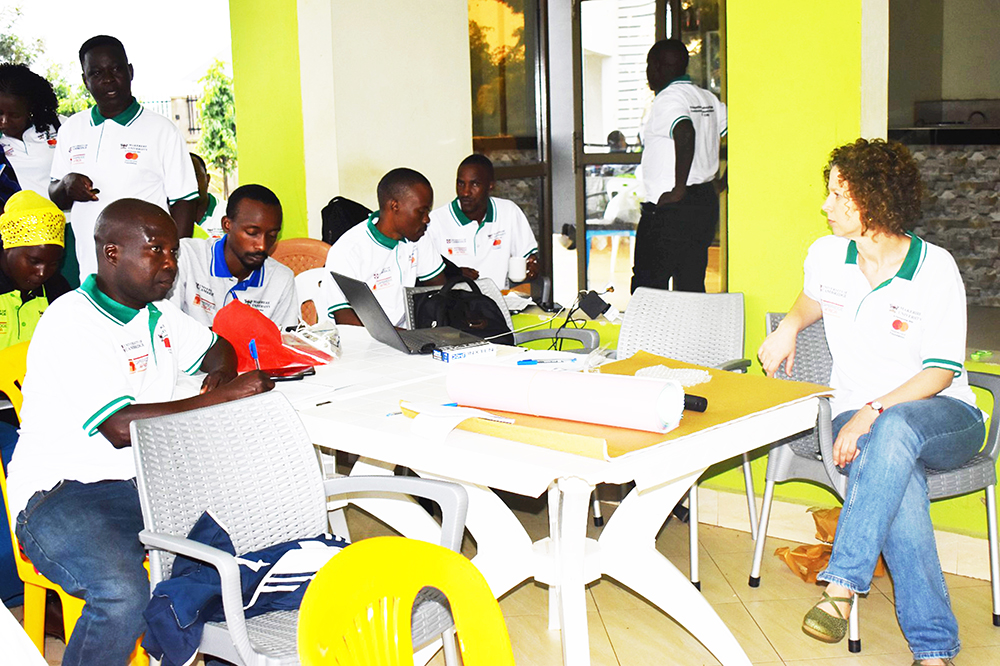
Dr Irit Katz from Cambridge University discussing with refugees at Farmers Lounge, Kikuube District. (Courtesy photo)
The host community, mainly the Banyoro, shares resources with refugees under Uganda’s refugee policy. Dr Gabriel Karubanga, a lecturer in the Department of Extension and Innovation Studies at Makerere University and principal investigator of the study, said food insecurity in Kyangwali is closely linked to the absence of proper storage facilities.
“The key problem that was found specifically in Kyangwali Refugee Settlement, which is a large, diverse humanitarian haven in Kikuube District, western Uganda, was food insecurity, which is attributed to lack of where to store their excess produce,” Karubanga said on Friday, May 29, 2026.
“They recommended that there is need for a more collective storage facility in place, because refugees stay in a smaller household where they cannot easily store the produce that they are given,” he said.
Karubanga said both refugees and host farmers face the same challenge. “So, with this, it is a common problem for the host farmers and the refugees. So, they prefer that the centralized storage facility be provided, but this requires more lobbying from the Office of the Prime Minister to provide space where this can be constructed,” he said.
“And to avoid the conflicts, the host communities and the refugees, they will need to be trained on how to manage the conflicts, because this is going to be the first time the host communities and the refugees are interacting using one storage facility,” Karubanga said.
“So, trainings, capacity building on how to establish the management committees of those storage facilities will be very, very paramount to ensure that these refugees and the host communities co-exist.”
Karubanga said maize and beans are among the crops most affected because farmers are forced to sell immediately after harvest when prices are low.
“There are diverse kinds of products. One of it could be maize and beans, because this is where they normally produce to get income and to get food,” he said.
“But they indicated that there is an excess surplus sometimes they get and they feel they don't want to sell it when the prices are very low. They want to first keep it and then later sell when the prices maybe have risen or maybe when they become food insecure.”
He said farmers could preserve produce for three to four months if proper storage systems were available. The CHART-CR project is a collaboration between Makerere University and the University of Cambridge funded by the Mastercard Foundation and Cambridge-Africa.
In December 2025 and January 2026, researchers led by Dr Irit Katz from Cambridge University and Dr Karubanga conducted workshops in Hoima, Kasese and Kikuube districts to examine climate-related vulnerabilities in refugee-hosting communities.
The workshops identified common challenges affecting refugees and host communities, including water scarcity, poor food storage facilities, weak market access, limited agricultural training and environmental degradation.
Participants said population growth and climate change have worsened food insecurity in Kyangwali. One participant explained: “When I arrived, we had enough land to grow many crops. As more people came, our plots became smaller, people started cutting trees, and the soil lost its fertility”.
Another participant said: “In the past, we used to farm on larger plots, sometimes as large as one acre. However, as the number of refugees increased, the plot sizes were reduced, and now most of us are farming on plots about 20m by 20m”.
Residents reported falling crop yields due to poor soils, erratic rainfall, pests and poor seed quality. “You plant with the expectation of getting 10 sacks, but you end up with just 3 sacks of maize. Then, you have to sell one and keep only one,” one participant said.
The study found that poor storage facilities force many farmers to sell produce quickly after harvest. “When I arrived last year, there was a bumper harvest, and many people made a lot of money. But they spent it on alcohol, and sold all the food they had stored,” one participant said.
Refugees complained of exploitation by middlemen who offer low prices and sometimes use faulty weighing scales. “In the past, vehicles came from as far as Kenya, but now we only have a few middlemen offering low prices,” the camp commander said.
Host community members said refugees sometimes receive better prices through organisations that buy produce directly from them.
“Refugees have organisations that buy their crops at better prices compared to what we get,” one host community member said. The report recommends establishing a one-stop Livelihood Training Centre to serve both refugees and host communities.
The centre would provide practical training in climate-smart agriculture, food preservation, irrigation, water management, market access and alternative income activities such as fish farming and small-scale trade.
Researchers said a community bulk storage facility would help families preserve food during lean seasons and reduce losses caused by distress sales after bumper harvests. Kyangwali Refugee Settlement was established in the 1960s to host Rwandan refugees fleeing conflict. Over the years, it has expanded as refugees arrived from neighbouring countries.
As of December 2025, the settlement hosted 155,134 people in 46,402 households, with refugees making up 99.7 per cent of the population. About 97 per cent are from the Democratic Republic of Congo, while smaller numbers come from South Sudan, Rwanda and Burundi. Women and children account for 80 per cent of the population.