
Stakeholders in Fort Portal unite to protect shrinking River Mpanga
The initiative was intended to create awareness among different stakeholders in the Mpanga catchment on how best to conserve the river’s catchment area.
Participants of the 5km run of the Save River Mpanga marathon setting off at the Boma grounds of Fort- Portal city. (Credit: Samuel Amanyire)
________________
Human activities, including reckless dumping of garbage such as polythene, plastics, medical and industrial waste into River Mpanga, as well as settlement and agriculture, have caused the shallowing of the river bed. This has led to flash floods, loss of its course, and a drastic reduction in water volumes during the dry season.
Furthermore, the riverbanks have been encroached upon for brick laying and several car-washing sites, causing both physical and chemical water pollution.
To address the situation, the Ministry of Water and Environment, together with several partners, on March 22, 2026, conducted the second edition of the Save River Mpanga Marathon. The event attracted locals, organisations and security teams and was hosted at Boma Grounds in Fort Portal city.
Speaking to the New Vision shortly after the marathon, Dr Brian Emmanuel Guma, the team leader of the Albert Water Management Zone, revealed that the initiative was intended to create awareness among different stakeholders in the Mpanga catchment on how best to conserve the river’s catchment area.
"The river stretches for about 220 km and provides water to more than six districts, serves as a habitat for some aquatic life, 250 bird species, but also ends up in Lake Albert," Guma said.
"Over 500 people have participated in the marathon, and to me, these are ambassadors that will champion the awareness campaign of saving the river," he added.
Guma also disclosed that over the years, they have achieved progress in implementing the River Mpanga catchment plans to increase water volume, including restoring the banks and demarcating wetlands, among other efforts.
"Before, the volume of the water was completely low, yet the river serves over two million people," he said.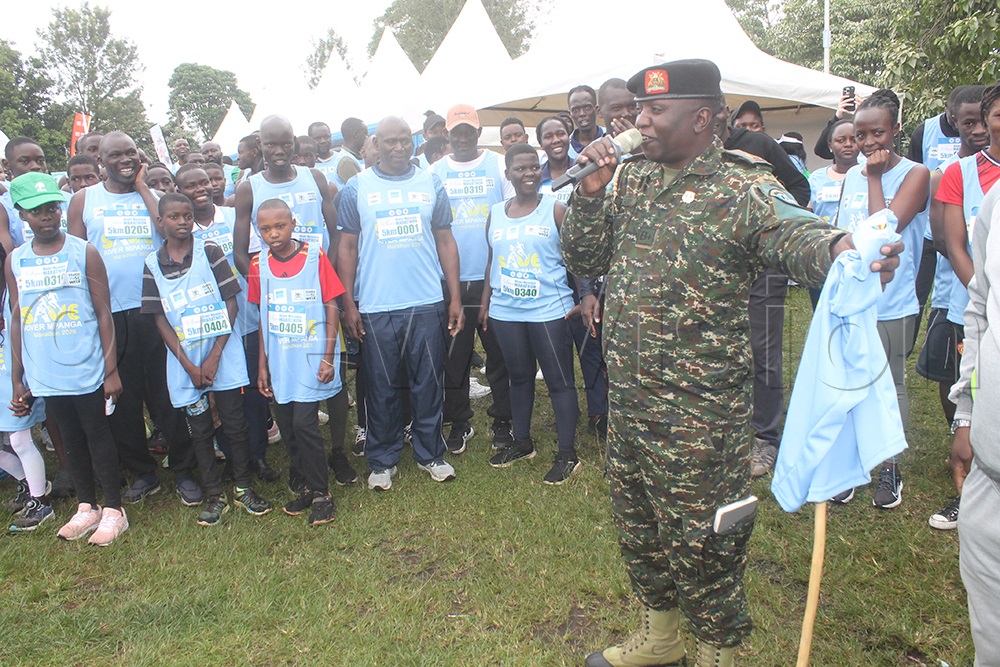
An army officer attached to the Mountain division based in Fort-Portal city flagging of runners of the 5km run of the Save River Mpanga marathon. (Credit: Samuel Amanyire)
Environmental officer speaks out
Herbert Fred Muhanuzi, the district environment officer for Kabarole, said that the declining status of River Mpanga is a major concern due to its crucial role in sustaining trees that help keep Fort Portal city and neighbouring areas cool.
"Some of the causing factors cannot easily be avoided, especially the ever-increasing population, but we are in the struggle of restoring our status as the coolest and cleanest city," Muhanuzi said.
Fears that the river could dry
Irene Linda Mugisa, the Fort Portal city woman Member of Parliament, revealed growing fears that the river could completely dry up, prompting plans to tap water from Lake Albert to support the supply in the area.
"There is a serious need to sensitise our people to observe the meters reserved for the river to flow," Mugisa said.
SSP Joab Wabwire, the regional police commander for Rwenzori West, warned that anyone found culpable for poor waste disposal or encroachment on environmental features, including water channels, wetlands and reserved forests, will face the law.
He also said there is a need to integrate environmental lessons into curricula at both primary and secondary levels so that children grow up understanding the issues and can contribute to long-term solutions.
"Imagine your children growing up and they don't find the flowing waters of River Mpanga only to be told stories about it," Wabwire said.
By 6:00 am on Sunday, March 22, 2026, hundreds had already gathered at Boma Grounds to participate in the second edition of the Save River Mpanga Marathon, which featured three routes, including 10km and 5km courses across Fort Portal city.