
Over 300 arrested, 31 Vehicles impounded in Bugoma Forest crackdown
According to Hangi, the 336 suspects arrested were linked to offences ranging from charcoal production and illegal timber harvesting to cultivation inside the reserve, transportation of illegal forest products, destruction of protected vegetation and unauthorised entry.
The Prime Minister Robinah Nabbanja staring in disbelief at the fresh charcoal burning kiln inside the degraded Bugoma central forest reserve. This was during the official handover of Bugoma to UWA recently. (Credit: Julius Luwemba)
The Uganda Wildlife Authority (UWA) has dealt a major blow to organised environmental crime in Bugoma Central Forest Reserve, arresting 336 suspects, seizing 3,721 bags of charcoal, seizing 697 pieces of illegally harvested timber, impounding 31 motor vehicles and 14 motorcycles used to transport the illegally harvested forest products.
Other confiscated items include 7 power-saws, 2 hand-saws, 11 axes, 97 pangas, 68 hoes, 67 spades and 15 forked hoes, all impounded in 3 months.
This was confirmed on Tuesday (August 18) by Bashir Hangi, the UWA spokesperson. He noted that the crackdown, conducted between May and July 2026, involved 114 intelligence-led operations targeting illegal activities that had contributed to widespread destruction of the 41,144-hectare forest reserve.
UWA formally assumed the responsibility of protecting and managing Bugoma forest on May 9, 2026, following a directive by President Yoweri Museveni.
The forest was officially handed over to UWA by Prime Minister Robinah Nabbanja during a ceremony held in Kikuube District.
The takeover followed reports of extensive forest degradation caused by illegal charcoal production, commercial timber harvesting, agricultural encroachment, sugarcane cultivation and other unlawful activities.
Immediately after the handover, UWA deployed a team, which brought together law enforcement personnel, intelligence officers and field support staff.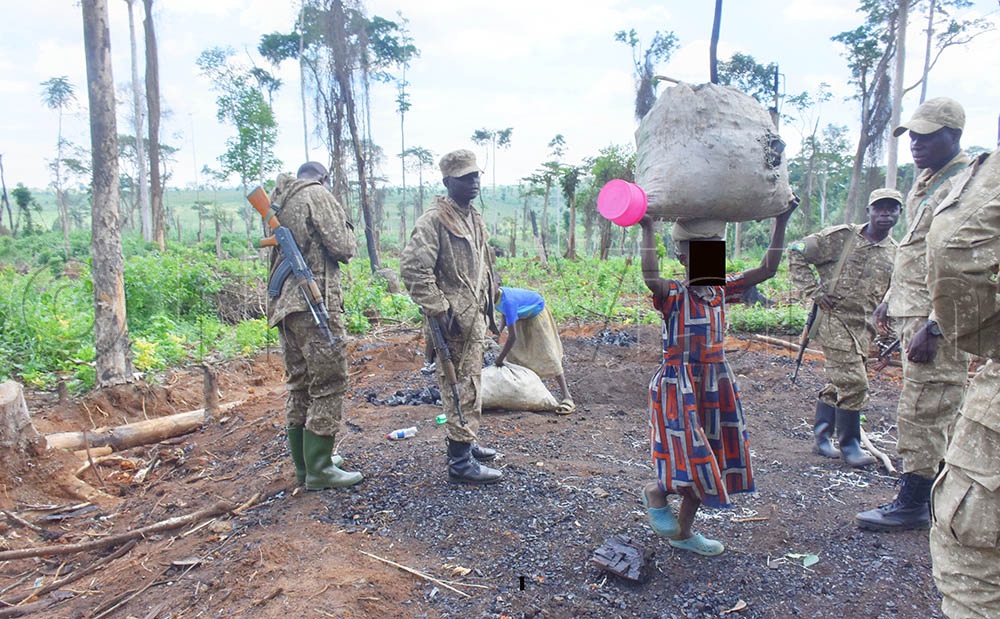
UWA rangers looking perplexed to a girl found carrying a sack of charcoal inside Bugoma forest. (All Photos by Julius Luwemba)
The operations covered major hotspots including Nsozi, Nyairongo, Nyakabale, Kaseeta, Ngogoli, Nyampindu, Wairagaza, Kisindi, Maratatu and Kabale, in Kikuube, Hoima and Masindi districts.
"Several suspects have since been arraigned before courts of law, and their cases are progressing through the criminal justice system," Hangi noted.
A source within the management of Murchison Falls conservation area, which manages Bugoma, said charcoal production emerged as the leading driver of forest degradation before UWA's intervention.
This was confirmed by Hangi, who noted that UWA recovered 630 bags of charcoal in May, 1,462 bags in June, and 1,629 bags in July, bringing the three-month total of recovered bags of charcoal to 3,721.
The seized timber included 283 pieces in May, 54 in June and 360 in July, disrupting the commercial exploitation of indigenous tree species and protecting the remaining natural forest stands.
UWA executive director Dr. James Musinguzi said the results demonstrate the importance of sustained government presence and intelligence-led enforcement in protecting the forest.
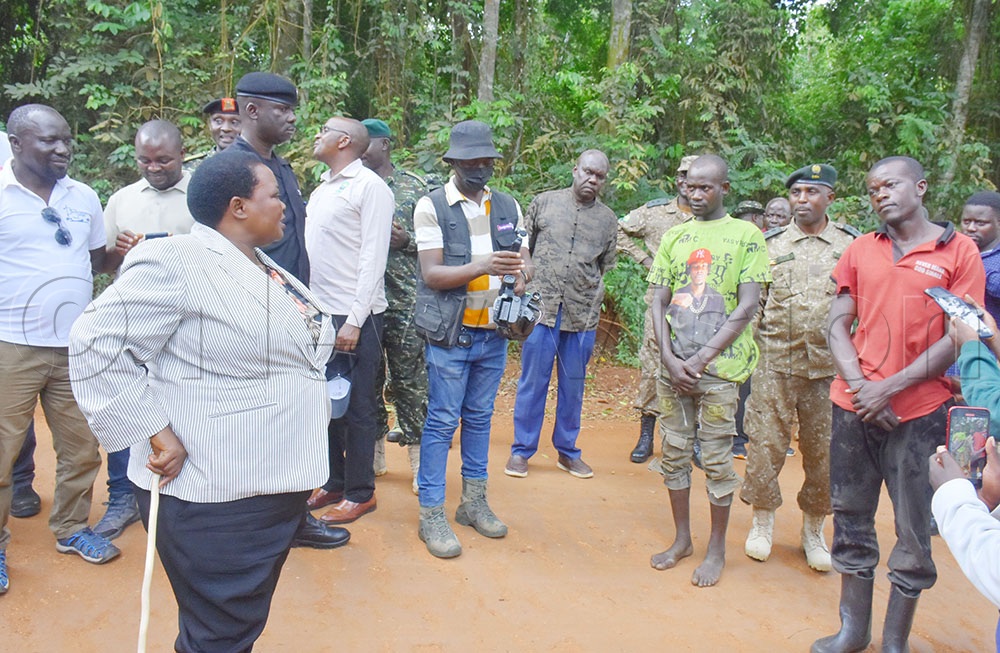
Nabbanja interrogating men who were nabbed burning charcoal from within Bugoma Central Forest on the day UWA took charge of Bugoma forest in May 2026.
"The progress registered within this short period shows that Bugoma can be protected and restored," Musinguzi remarked, adding that the authority would maintain its presence while working with other government agencies and surrounding communities to secure the forest.
Although illegal activities have not been completely eliminated, UWA said enforcement has significantly reduced charcoal burning, timber harvesting and other destructive activities in several previously affected areas.
Beyond enforcement, UWA has started putting in place systems for the long-term management of Bugoma.
Fred Kiiza, the chief warden for Murchison Falls Conservation area, said the Kisindi operational headquarters has been connected to piped water and equipped with solar power, while staff have received training in statement recording, investigations and exhibit handling.
Meanwhile, UWA reported that tourism activities have progressively continued during the enforcement campaign, with records indicating 87 visitors received in Bugoma in June and July. The tourists are reported to have participated in chimpanzee tracking, chimpanzee habituation experiences, mangabey monkey tracking and guided nature walks.
"The continued tourism activity highlights the forest's potential as an ecotourism destination capable of generating benefits for conservation and neighbouring communities," Hangi noted.
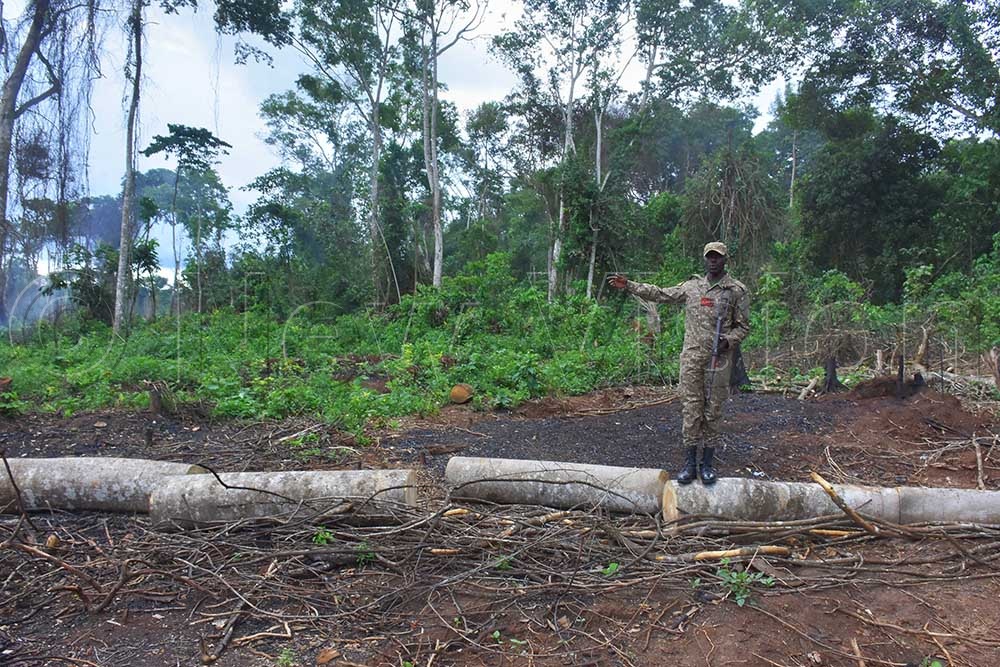
A ranger from the Uganda Wildlife Authority showing the magnitude of tree cover lost to encroachment and deforestation in Bugoma Central Forest Reserve.
Once a thriving sanctuary echoing with birdsong and wildlife, the Bugoma Central Forest Reserve had fallen silent under the roar of chainsaws and the smoke of charcoal kilns. Hundreds of hectares had been stripped bare for logging, farming and sugarcane growing, leaving behind scars on one of Uganda's vital ecosystems.
Upon the takeover of the management of Bugoma, Tom Butime, the Minister of Tourism, Wildlife and Antiquities, has since issued temporary management measures for Bugoma under General Notice Number 1430 of 2026.
The measures provide an interim framework for protecting and managing the forest pending its declaration as a Wildlife Conservation Area.
Bugoma provides critical habitat for chimpanzees, elephants, mangabey monkeys and numerous bird, butterfly and indigenous tree species.
It also plays an important role in watershed protection, climate regulation, carbon sequestration and ecological connectivity within the Albertine Rift Valley.
According to UWA, the next phase will focus on consolidating the enforcement gains, verifying and demarcating the forest boundary, restoring degraded areas, strengthening cooperation with neighbouring communities and supporting the Government process for stronger and permanent legal protection of Bugoma.