
Nwoya farmers count losses as changing rains threaten food security
“I planted maize and groundnuts on six acres, but I never harvested anything because of the high temperatures and changes in the weather,” Ochan said. He is now planting fruit trees and rearing goats, pigs and poultry to diversify his sources of livelihood and reduce his dependence on crops that are increasingly vulnerable to erratic weather.
Omara said Nwoya had about 59,000 hectares of natural forest before 2010, but an estimated 15,000 hectares were lost between 2020 and 2025. (Credit: Viola Nuwaha)
NWOYA - Farmers in Nwoya district are facing growing food insecurity as prolonged dry spells and unpredictable rainfall disrupt planting seasons, leaving maize and groundnut crops drying up.
Maurice Ochan invested about sh2 million to plant maize and groundnuts on six acres in Peya Village, Nwoya district, hoping for a good harvest.
Instead, prolonged dry weather and high temperatures left his crops withered, wiping out his entire investment.
“I planted maize and groundnuts on six acres, but I never harvested anything because of the high temperatures and changes in the weather,” Ochan said.
He is now planting fruit trees and rearing goats, pigs and poultry to diversify his sources of livelihood and reduce his dependence on crops that are increasingly vulnerable to erratic weather.
Ochan said he would also consider irrigation if the technology became accessible to farmers in his area, particularly through farmer groups.
His experience reflects growing uncertainty among farmers in Nwoya, where changing rainfall patterns and prolonged dry spells are disrupting planting seasons and threatening household food security.
Emmanuel Omara, the Nwoya district forestry officer, said a prolonged dry spell that started around June had left large parts of the district dry, with crops drying up and farmers struggling to produce staple foods.
He was speaking during a two-day community engagement in Nwoya district as part of a week-long campaign aimed at promoting climate justice and strengthening community-led responses to the effects of climate change.
The campaign is being held as part of the Global Week of Climate Action, observed every September under the theme Our Communities. Our Climate. Our Future: Young People Leading Climate Justice.
“Crops have dried out, and this is posing a risk of hunger to people in the community,” Omara said.
He said the changing rainfall pattern had made it difficult for farmers to determine when to plant, particularly maize and groundnuts. Farmers who planted early, when rains came in February, managed to harvest, while those who waited until the traditional March and April planting period recorded poor production.
“This shows the continuous change in the rainfall patterns and unpredictable weather,” he said.
The disruption is being compounded by the loss of the district’s natural forests, which officials say has weakened the environment on which rural livelihoods depend.
Omara said Nwoya had about 59,000 hectares of natural forest before 2010, but an estimated 15,000 hectares were lost between 2020 and 2025.
He said the loss had left some areas bare, with grassland replacing sections that previously had natural forest, while changes in the ecosystem had also been associated with the emergence of crop diseases and weeds.
“This is a huge loss that is also contributing to the challenges that we are facing at the moment,” Omara said.
The impact extends beyond crop production, with Omara warning that prolonged food shortages could force families to struggle to meet basic needs, potentially affecting children’s education.
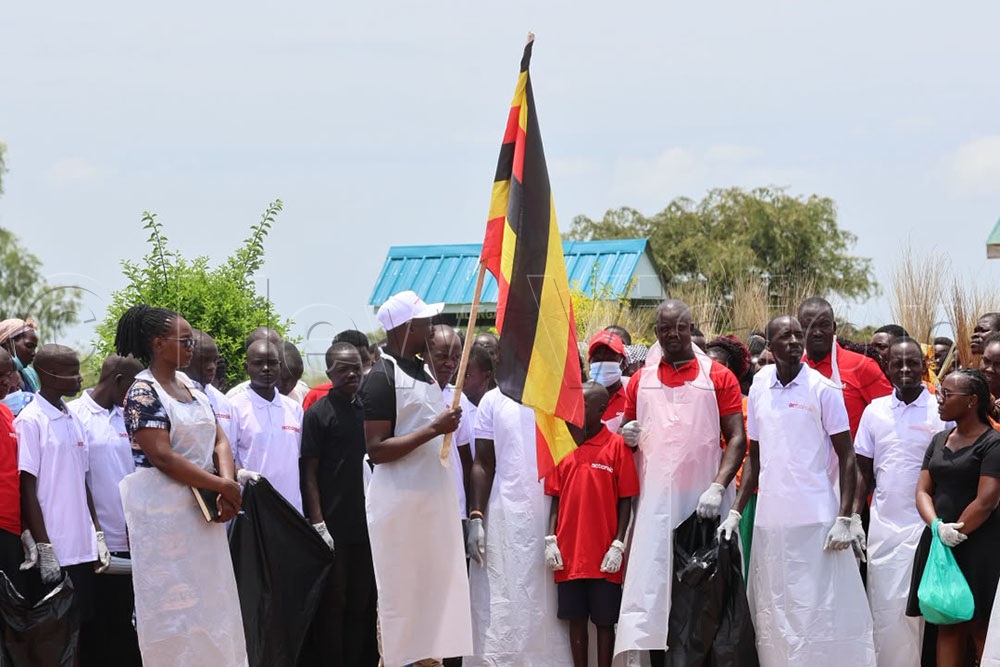
Asimwe said climate change should not be treated as an abstract issue because its effects are already visible through drying crops, water shortages for livestock and disruptions to access to schools and other services. (Credit: Viola Nuwaha)
Robert Asimwe, the ActionAid International Uganda programme officer for Northern Uganda, said rural communities were particularly vulnerable because they depend heavily on land, natural resources and rainfall.
“Currently, we cannot tell whether we are in a rainy season or we are in a dry season,” Asimwe said.
He said unpredictable rainfall was affecting planting seasons and household food security as farmers struggled to determine when to put seed in the ground.
Asimwe said climate change should not be treated as an abstract issue because its effects are already visible through drying crops, water shortages for livestock and disruptions to access to schools and other services.
“Local and traditional knowledge should also be combined with scientific research to develop climate solutions suited to communities such as those in Anaka,” he said.
District officials blamed environmental degradation for worsening pressure on the district’s natural resources.
Evelyn Acan, the Nwoya district senior environment officer, said tree cutting, charcoal burning, wetland encroachment and poor waste management were contributing to environmental degradation.
She said commercial farmers clearing large tracts of land and charcoal dealers stripping forests for fuel were among the drivers of forest loss.
She added that herbicides and pesticides used in wetlands can drain into water systems, further threatening ecosystems and communities that depend on them.
“Some people are cultivating deep inside wetlands without respecting the required buffer zones,” Acan said.
The district has introduced several measures to reduce pressure on natural resources, although officials say inadequate resources remain a major constraint.
The Department of Natural Resources has installed energy-saving cookstoves at Anaka, Koch Goma Secondary School and Purongo Hill Secondary School to reduce dependence on firewood.
The district has also demarcated four kilometres of sensitive ecosystems and planted bamboo along catchments to reduce soil erosion into rivers.
Acan urged residents to complement government efforts by protecting natural resources and planting trees.
“Your personal initiative of buying and planting trees can go a long way in mitigating the impact of climate change,” she said.
The interventions are being supported by ActionAid International Uganda, which is engaging communities in Nwoya and the neighbouring Amuru district as part of the Global Week of Climate Action.
The campaign aims to bring climate-change discussions closer to communities and encourage local action on environmental conservation, climate adaptation and sustainable management of natural resources.