
Nuwagaba calls for tree planting to shield economy from climate shocks
Bank of Uganda (BoU) Deputy Governor Prof. Augustus Nuwagaba says tree planting is vital to protecting agricultural supply chains and helping keep inflation in check.
Prof. Augustus Nuwagaba, the Deputy Governor of the Bank of Uganda (holding a hoe), Prof. Pauline Byakika, the Vice Chancellor of Mbarara University of Science and Technology (with a watering can) planting a green heart tree locally known as Abaki from Eastern Uganda for Viral infection treatment as others look on during the commemorative tree planting at Pharm-Biotechnology and Traditional Medicine Centre (PHARMBIOTRAC) Botanical Garden into a living gene bank for medicinal plants at the University campus, Kihumuro, on Thursday, 19 November, 2026. (Photos by Fred Turyakira)
________________
Environmental degradation is emerging as a threat to Uganda’s food prices, export earnings and currency stability, with drought and erratic weather disrupting agricultural production and putting pressure on food supplies.
Bank of Uganda (BoU) Deputy Governor Prof. Augustus Nuwagaba says tree planting is vital to protecting agricultural supply chains and helping keep inflation in check.
Speaking at Mbarara University of Science and Technology’s (MUST) Kihumuro Campus on November 19, 2026, Nuwagaba said poor weather conditions affect food production, pushing up prices and contributing to headline inflation.
"When you have very low food supply due to poor weather, prices of matooke, maize, and beans go up," he said, noting that poor weather in coffee-growing hubs such as Masaka had recently affected yields.
This is a major concern because Uganda relies on roughly 7.9 million 60-kilogram bags of coffee annually to generate $2.5b in export revenue.
Nuwagaba also linked environmental degradation to pressures on the Uganda shilling, attributing its depreciation to the country's $4.7b trade deficit.
"Nobody should lie to you; the problem we are having with the Shilling is because of a negative trade balance," he emphasised, urging Ugandans to boost exports and curb lavish spending on imported lifestyle goods for events such as weddings.
While the country earns foreign exchange from coffee, which generates $2.5b, gold and about $900m in diaspora remittances, it spends far more on importing petroleum, pharmaceuticals, vehicles, spare parts and machinery.
He also called for the upskilling of Ugandan migrant workers in Gulf states such as Qatar, from domestic workers to professional "house managers", to increase remittances.
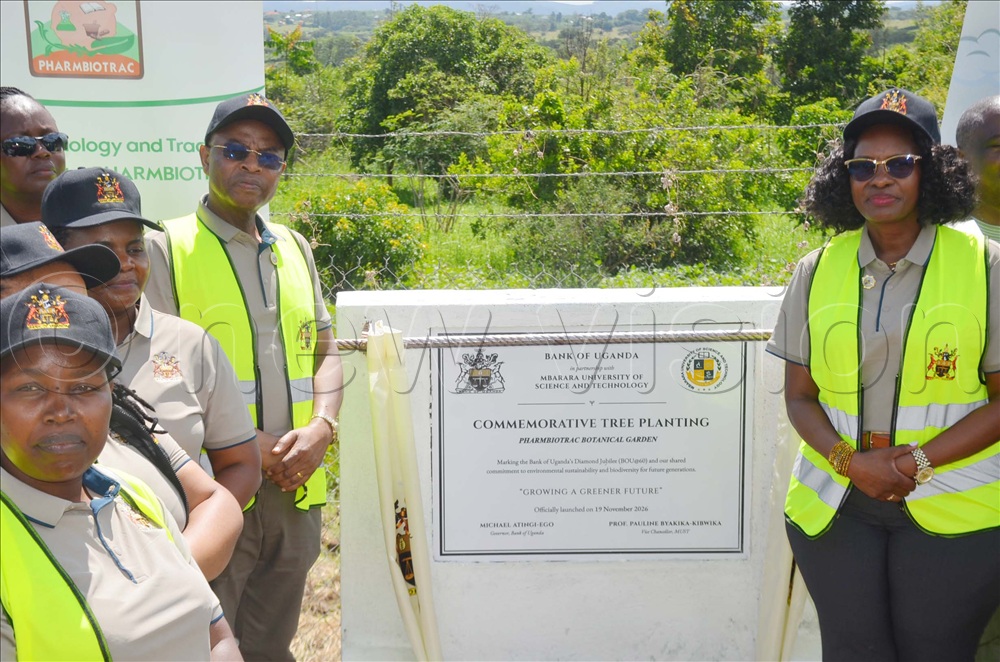
Nuwagaba made the remarks during the launch of a 1,500-tree planting drive at MUST, held under the theme, "Greening a Green Future."
Representing Bank of Uganda Governor Michael Atingi-Ego, he officiated at the launch, which forms part of the central bank’s Diamond Jubilee (BoU@60) celebrations.
The initiative, supported by a combined sh210m commitment from BoU and MUST, will also help upgrade the Pharm-Biotechnology and Traditional Medicine Centre (PHARMBIOTRAC) Botanical Garden into a living gene bank for medicinal plants.
Nuwagaba urged citizens to embrace generational stewardship by replacing trees that are cut down.
"A tree never eats its own fruit," he added.
He noted that MUST is the starting point for a nationwide university greening drive covering Soroti University, Makerere University Business School (MUBS) and other institutions ahead of the Bank of Uganda’s 60th-anniversary celebrations, which will climax on December 3, 2026.
Nuwagaba commended MUST and the National Agricultural Research Organisation (NARO) for driving scientific innovation and urged higher education institutions to ensure that research translates into practical community uptake.
Beyond environmental conservation, he highlighted the central bank’s broader corporate social responsibility initiatives, particularly in maternal and child health.
He noted that BoU has constructed 16 Health Centre IV facilities across the country, including in Mbarara, Arua, Mbale, Kabarole, Masaka, Jinja city, Rubanda, Kabale, Mitooma, Katakwi, Hoima, Moroto, Kasese and Kitgum, among others.
MUST vice-chancellor Prof. Pauline Byakika-Kibwika said the Bank of Uganda contributed sh60m towards the project, while the university added sh150m, alongside seedling donations from NARO-Mbarara ZARDI.
She said the initiative aligns with the newly approved master plan for the 467.2-acre Kihumuro Campus and supports Uganda’s Clinical Science of Natural Therapeutics programme, which she co-directs.
In collaboration with Makerere University’s COVAB and the Uganda Virus Research Institute (UVRI), MUST is putting local herbs through rigorous clinical trials.
"We have already taken three products through the pathway and are now testing remedies for malaria, diabetes, and pain," Prof. Byakika-Kibwika said, urging students and staff to nurture the seedlings to ensure they survive.
She also appealed to BoU to offer student internships ahead of MUST’s transition to a competence-based curriculum in the 2027/2028 academic year.
Deputy vice-chancellor Prof. Robert Bitariho noted that the project builds on a conservation legacy dating back to 1991, during which MUST has planted more than 20,000 trees across its campuses.
PHARMBIOTRAC director Assoc. Prof. Casim Umba Tolo added that the Living Gene Bank will safeguard endangered medicinal flora, boost botanical tourism and preserve indigenous plant names for younger generations.