
New sh148.5m sweet potato processing facility to boost Teso farmers' incomes
Joseph Okalebo, the SOSPPA coordinator, said the facility will focus on processing orange-fleshed sweetpotato varieties, including Ejumula, Naspot 8, Naspot 10, Naspot 13, Narospot 7 and Tanzania, into products such as puree, pasta and spaghetti.
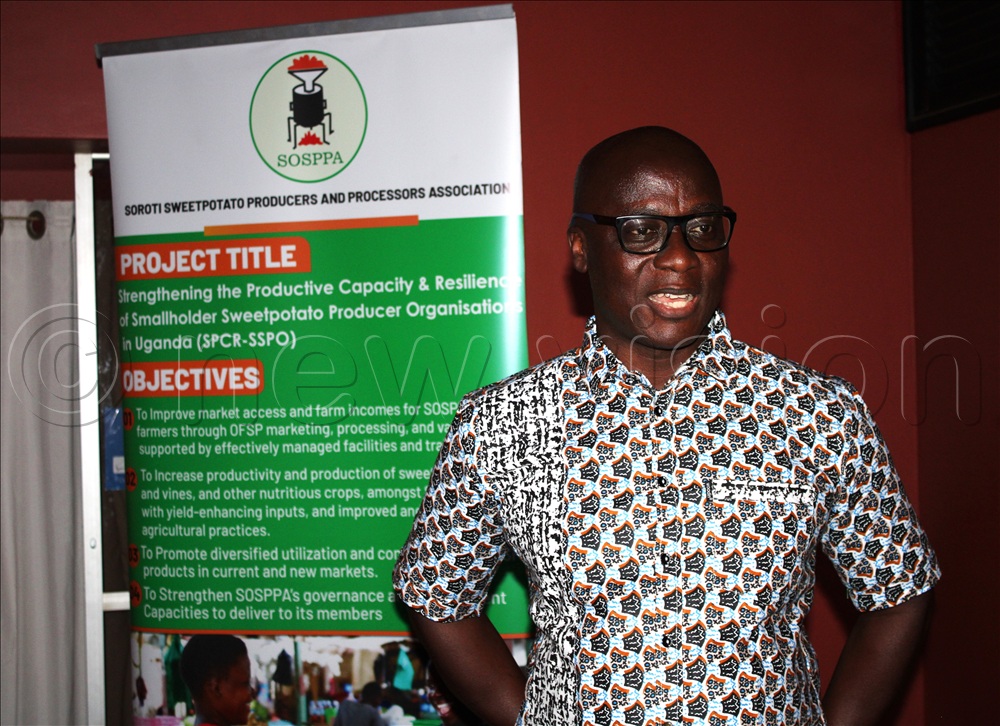
Joseph Okalebo, the coordinator of Soroti sweet potato producers and processors association (SOSPPA) speaking to journalists during a meeting in Soroti City on August 14th, 2026. (Photos by Delux Emmy Alomu)
________________
A new sweet potato processing facility valued at $40,000 (about sh148.5 million), is set to be built in Kyere town council in Serere district, in a move aimed at helping sweet potato farmers in the Teso sub-region add value to their produce and access commercial markets.
Sweet potato is a staple food and an important source of income for communities in Teso.
The project will be spearheaded by the Soroti Sweet Potato Producers and Processors Association (SOSPPA), with financing from the Global Agriculture and Food Security Program (GAFSP). It will receive technical support from the International Potato Centre (CIP) and the Ministry of Agriculture, Animal Industry and Fisheries, and will be overseen by the World Bank.
Joseph Okalebo, the SOSPPA coordinator, said the facility will focus on processing orange-fleshed sweetpotato varieties, including Ejumula, Naspot 8, Naspot 10, Naspot 13, Narospot 7 and Tanzania, into products such as puree, pasta and spaghetti.
He said the development is expected to improve market access for farmers and address challenges associated with transporting and marketing fresh sweet potato roots.
Sweet potato puree, pasta and spaghetti can be used in a variety of dishes. Puree can serve as a thickener or base for soups and baked goods, while sweet potato pasta incorporates the root vegetable into dough. Sweet potato spaghetti can also provide a low-carb, gluten-free alternative to conventional noodles.
Currently, Teso sweet potato farmers process their produce on a small scale, often without significant value addition or reliable market access. The new facility is expected to process one tonne of fresh roots into puree every hour, helping to address some of these challenges.
The announcement was made during the inaugural steering committee meeting for SOSPPA and GAFSP, held at Soroti Hotel from August 14 to 15, 2026.
Dr Fredrick Kobina, the country manager and nutrition scientist at the International Potato Centre (CIP) speaking to some of the sweet potato farmers in Teso at Soroti City
The facility will be developed as part of a four-year project aimed at strengthening the production capacity and resilience of smallholder sweet potato producer organisations in Uganda.
It is expected to benefit about 20,000 farmers organised in 100 groups, as well as 3,000 schoolchildren in six districts of Teso: Serere, Ngora, Amuria, Katakwi, Soroti and Bukedea.
“We will also work with farmers to diversify beyond the monotonous cycle of sweet potato cultivation,” Okalebo noted.
Dr Fredrick Kobina Ebo Grant, the Uganda country manager and nutrition scientist at the International Potato Centre (CIP), said they expect to establish the facility by the end of the year, with advertisements for contractors expected to be published soon.
He said local farmers would receive training on accessing clean planting materials and cultivating crops using climate-smart practices to address the effects of climate change and ensure a sustainable supply of sweet potatoes.
Dr Kobina said increased sweet potato production and processing would open up markets not only within Teso, but also in regions such as Karamoja and Gulu.
Zebulon Ejomu, a sweet potato farmer from Serere district, welcomed the project, saying farmers had previously struggled with agronomic practices and lacked knowledge about value addition, limiting them to selling sweet potato roots in local markets.
Christine Akello Ekinyu, another farmer, said their farming practices had largely remained basic. She said the planned training would equip them with skills to sell their products nationally and internationally after obtaining UNBS certification, which she believes would significantly improve their living standards.
SOSPPA, which was founded in 2006, currently has more than 2,090 farmers organised in 97 groups across six districts in Teso.
The Teso sub-region, home to approximately 2.5 million people, faces significant economic challenges, with 70% of the population aged below 35 and more than 53% living in extreme poverty. The situation has been worsened by frequent food shortages and the impact of COVID-19 on market access and production capacity.