
Minister Akello challenges Nwoya leaders to safeguard Hunger Project
The minister's message placed Oruka within a much bigger national conversation: how rural communities can move from subsistence towards higher household incomes, stronger local institutions and sustainable livelihoods.
State Minister for Northern Uganda, Hon. Beatrice Akori Akello, inspects farmers at the epicentre during the self-reliance event. (Courtesy)
___________________
NWOYA — For communities in Purongo sub-county in Nwoya District, development is increasingly being measured not simply by projects delivered from outside, but by the ability of local people to organise, manage resources and solve their own problems.
That philosophy was at the heart of the celebrations as The Hunger Project Uganda handed over the Oruka Epicenter to the community in Purongo Sub-county for independent management, marking the culmination of an eight-year journey of community mobilisation, capacity strengthening, partnership building and investment in essential services.
The ceremony was presided over by Beatrice Akori Akello, the Minister of State for Northern Uganda in the Office of the Prime Minister, who challenged district and community leaders to safeguard the gains made at Oruka and use the centre as a platform for locally driven development.
The transition is particularly significant for an overwhelmingly agricultural community confronting increasingly unpredictable weather patterns. Minister Akello urged local authorities to help farmers and households embrace creative and resilient approaches as changing rainfall patterns and other environmental pressures challenge traditional farming practices.
She said Uganda's Fourth National Development Plan (NDP IV) that runs from 2025/26–2029/30, places higher household incomes, monetisation of the economy, employment and sustainable socio-economic transformation at the centre of national development. "It also prioritises agriculture, financial services, health and full implementation of the Parish Development Model. In many ways, the Oruka Epicenter demonstrates what those ambitions can look like at the community level," he said.
The Epicenter Strategy used by The Hunger Project begins not with infrastructure, but with people. At its foundation is the Vision, Commitment and Action approach, through which communities are encouraged to identify the future they want, commit themselves to achieving it and organise practical action around locally identified priorities.
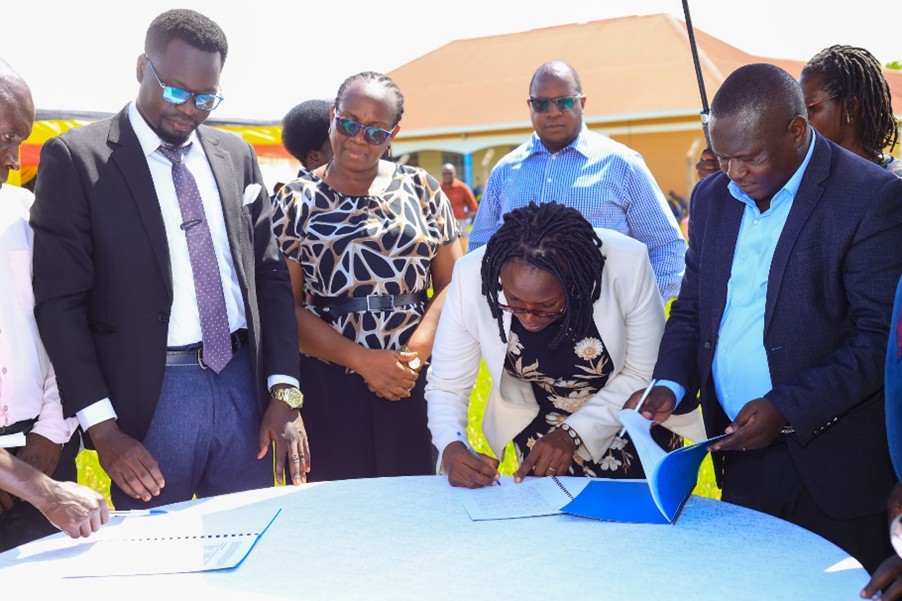
The Hunger Project Country Director and staff sign the handover MOU with Nwoya District officials. (Courtesy)
Today, Oruka has a Health Centre III, Health staff quarters, a community SACCO (Savings and Credit Cooperative Organisation), a community food store, a community hall , a solar powered Water Production facility, demonstration site for improved farming practices as well as other support programmes that provide a base from which residents can continue addressing health, nutrition, livelihoods and financial inclusion.
Oruka's SACCO has grown to more than 500 members, while clean-water interventions have reached about 20,000 of residents. Irene Naikaali Ssentongo, the Country Director of The Hunger Project Uganda, said the handover does not mean abandoning Oruka.
She emphasised that the organisation and its technical team would remain available to offer guidance where necessary as well as continue to strengthen peer learning and support the scaling of approaches that are working across different self-reliant epicenters.
Nwoya Resident District Commissioner Christopher Omara thanked The Hunger Project Uganda staff for their steadfast commitment towards improving the lives of people in Nwoya, saying the investment has strengthened access to essential services in Oruka.
On behalf of the district leadership, Omara pledged to take up the responsibility to safeguard the gains made at Oruka epicenter, with particular attention to the Health Centre III. He said the district would also ensure that the facility is adequately supported and that health workers are able to continue serving the community normally throughout the self-reliance period.
The Hunger Project has worked in Uganda since 1999, using the Epicenter Strategy to mobilise communities around health, food security, women's empowerment, financial inclusion and other locally determined priorities. Oruka has now become the 11th of the 13 epicenters to transition to self-reliance. The facility was funded by partners under The Hunger Project Australia.