
Kadaga urges MPs to fast-track food, nutrition Bill
About 30% of primary learners nationally have no access to school meals, with the share rising to 63% in UPE schools, according to WFP deputy country director Marcus Prior, who urged Parliament to treat school feeding as a national investment rather than a welfare intervention.
Hon. Abeja Suzan Jolly (left), Rebecca Kadaga, Peter Okeyoh and Damali Ssali (right). (Credit: Racheal Nankya)
________________ First Deputy Prime Minister Rebecca Kadaga delivers a speech during the 12th Parliament Orientation on Food and Nutrition Security. (Credit: Racheal Nankya)
First Deputy Prime Minister and Minister for East African Community (EAC) Affairs Rebecca Kadaga has urged Members of Parliament (MPs) to fast-track the passing of the Food and Nutrition Bill.
The former Speaker of Parliament says Uganda should strengthen the legal framework for tackling hunger, malnutrition and food insecurity.
Kadaga adds that there was no need to draft a new Bill because the proposed legislation had already been forwarded to the Executive during the 11th Parliament.
Instead, she urges the 12th Parliament to follow up on the legislation, resubmit it where necessary and engage the Speaker to ensure that it progresses through Parliament.
Kadaga made the call on August 11, 2026, while addressing MPs attending the 12th Parliamentary Orientation on Food and Nutrition Security at Imperial Royale Hotel in Kampala.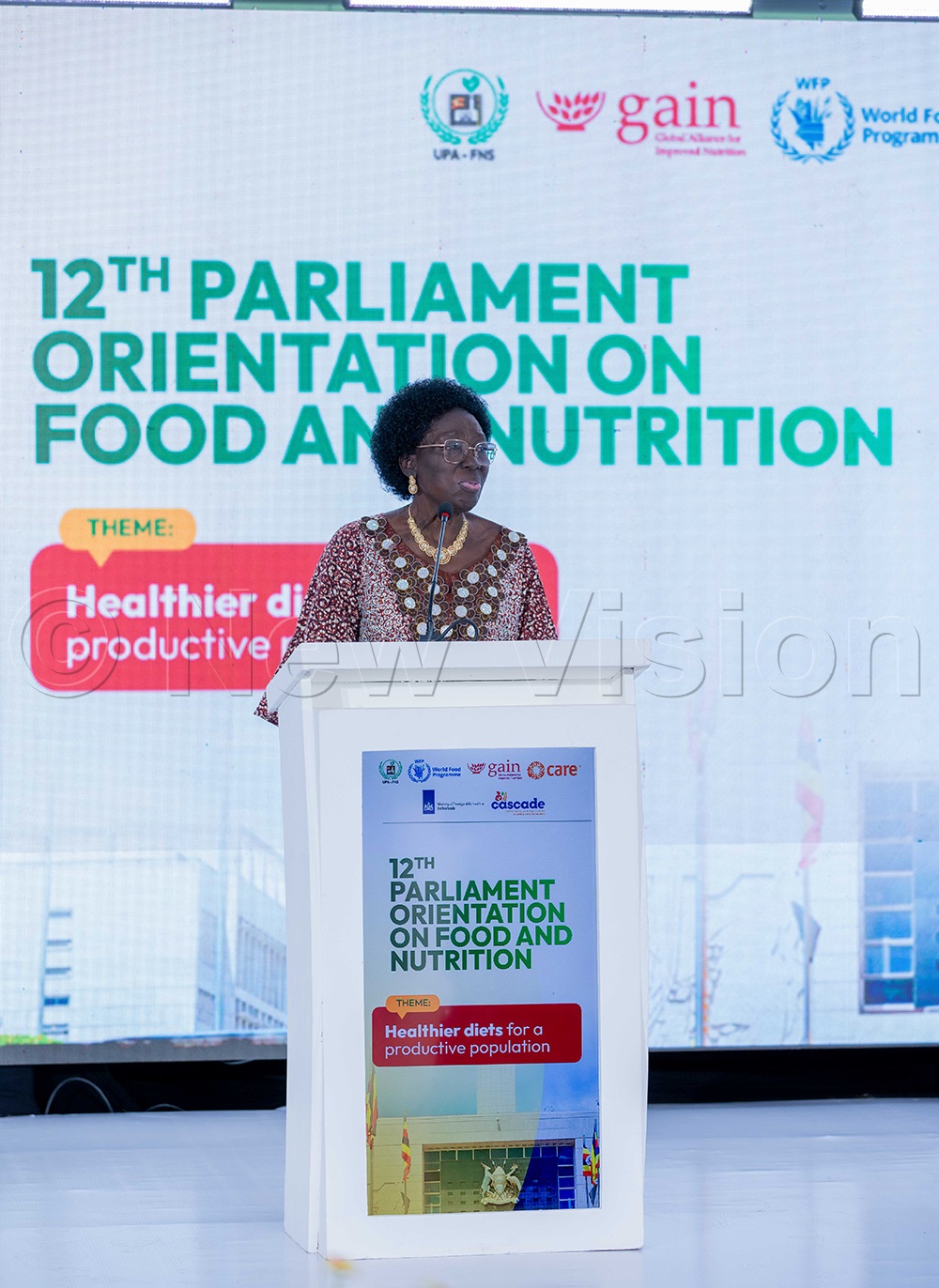
The two-day orientation, running from August 11 to 12, is aimed at strengthening legislators’ understanding of food and nutrition challenges and their role in shaping policies and legislation to improve nutrition outcomes.
Kadaga said the proposed legislation should be treated as an urgent matter because food security requires coordinated action from the national Government, local governments, schools, households and communities.
Historic opportunity
Her call was backed by the World Food Programme (WFP), which described the proposed Food and Nutrition Bill as a historic opportunity to provide a stronger legal foundation for food and nutrition security in Uganda.
WFP deputy country director Marcus Prior, who represented the UN agency at the orientation, said Uganda had made progress in reducing hunger and improving nutrition, but many families and children continued to face food insecurity, malnutrition, climate shocks and economic pressures.
“This gathering comes at a crucial moment,” Prior said.
He said the proposed Bill would clarify institutional responsibilities, strengthen accountability and governance, and provide stronger legal backing for school feeding and other food security initiatives.
Prior also called on Parliament to treat school feeding as a national investment rather than simply a welfare intervention.
He said that despite Uganda’s commitments to improve school meals under the Global School Meals Coalition, significant gaps remained.
“About 30% of primary learners nationally have no access to school meals, and that share rises to 63% in UPE schools,” he said.
According to Prior, school feeding contributes not only to children’s nutrition but also to education, human capital development, local agriculture and economic growth.
He urged Parliament to advocate for the timely approval of the national school feeding policy, increase domestic financing for school feeding programmes and strengthen implementation and accountability.
Practical interventions
Kadaga, meanwhile, challenged MPs to complement national legislation with practical interventions at household and community level.
She urged legislators and local governments to promote household food storage, saying traditional practices could offer lessons for addressing food shortages.
Kadaga recalled that households in her community traditionally maintained three separate food stores, each under the authority of different leaders within the home.
She said the arrangement ensured that families maintained reserve food that could only be accessed under agreed circumstances or when communities faced shortages.
“There was food security. So, I think those are things that can also revive and ensure that in our local governments, in our villages, the homes have those facilities,” Kadaga said.
She called on district councils to develop bylaws and programmes that promote household food security, arguing that local governments were better placed to implement practical interventions within communities.
“As with central government, there are things you can't do on the ground. So, I want to appeal to you to ensure that the best minimums are done so that our people are not left on their own,” she said.
She said she had recently directed the resumption of school gardens and encouraged legislators to promote the initiative in schools and districts.
“The school gardens must be revised. It must be revived to grow things that children can eat, fruits, etcetera,” she said.
She cited a pilot soya feeding programme in schools, where soya is grown and processed into porridge for pupils, as another intervention that could be expanded to other districts following encouraging results.
Food security and PDM
Kadaga also linked food security to value addition under the Parish Development Model, urging communities to participate in the entire agricultural value chain.
She said farmers should not only produce food but also benefit from storage, processing, transportation and marketing.
Using groundnuts as an example, she said the crop creates opportunities for farmers, traders, storage providers and processors, among others.
“Look at the whole chain and ensure that our people properly employ and properly organise themselves,” she said.
Hope Grania Nakazibwe, the Mubende District Woman MP, called for stronger support for nutrition legislation and the implementation of nutrition policies in schools and homes.
She emphasised the role of Parliament, parents, schools and the wider public in promoting healthy eating practices and creating environments where children can access safe, nutritious and diverse foods.
Bernard Bwambale, the national coordinator of the Food Safety Coalition in Uganda, also raised concerns about highly hazardous pesticides and their potential risks to human health.
The orientation was organised by the Uganda Parliamentary Alliance on Food and Nutrition Security (UPA-FNS), in partnership with the World Food Programme, CARE International and the Embassy of the Netherlands in Uganda.
It was coordinated by Participatory Ecological Land Use Management (PELUM) Association Uganda, a regional network of more than 320 civil society organisations operating in 14 countries.
PELUM was represented by its country director, Josephine Akia Luyimbazi, who leads the national secretariat. PELUM operates as a network across 12 African countries.
PELUM Uganda works to improve the livelihoods of smallholder farmers and promote sustainable rural communities through ecological land-use management.