
Is drought index insurance the answer to dying farms?
Experts argue that climate risks undermine productivity and food security. Yet with agricultural insurance, farmers are cushioned against these shocks.
A garden of cassava destroyed by hailstones in Toroma sub-county in Katakwi district. Insurance helps farmers cover such risks.
For more than a decade, Gershom Rutaro, a farmer from Jinja city in eastern Uganda, has planted, cleared and harvested on his land, only to watch drought, erratic rain, and other climate shocks wipe out his efforts season after season.
Each failed harvest has forced him to sell his produce cheaply to clear debts, locking him into what he describes as a vicious cycle of losses.
Rutaro is now considering agricultural insurance to test the waters after years of farming without any safety net. In Kole district in northern Uganda, Vicky Alum tells a different story.
Alum, who has been farming for over eight years, said she once walked the same path as Rutaro, suffering repeated losses that kept her trapped in subsistence farming.
That changed, she said, after subscribing to agricultural insurance three years ago.
“Before I took up agriculture insurance, my farming business was not doing well, but since taking up agriculture insurance in 2023, my children moved to even better schools. I have even bought a heifer from the cash compensation I recently got when disaster struck me. I have realised there are more benefits in insuring my crops and animals,” Alum said.
She added, “I now have nothing to worry about when I am farming. When the crops do well, I gain. When they fail, I have the insurance cover as a shock absorber.” Alum belongs to a farmer group of over 1,000 farmers in northern Uganda. The group is coordinated by Benson Otim, a farmer from the region. Otim said access to agricultural insurance has transformed livelihoods in his farming community.
“The impact is visible. When you compare life before and after insurance, the difference is clear. My farmers are happier; their incomes have improved. I have seen beneficiaries pay school fees for their children and support their families. Entire households are developing,” he said.
“The minimum premium paid by farmers is sh1,260, which is affordable,” he said. According to Otim, some of the farmers have received up to sh3m.
Ibrahim Kaddunabbi Lubega
Food security
Experts argue that climate risks undermine productivity and food security. Yet with agricultural insurance, farmers are cushioned against these shocks.
Ibrahim Kaddunabbi Lubega, the chief executive officer of the Insurance Regulatory Authority (IRA), described recent reports of widespread crop losses as saddening in a country where agriculture underpins the economy.
“Uganda is predominantly an agro-based economy. This loss is not only for farmers but the entire country; everyone shall be affected through rising food prices,” Kaddunabbi said, referring to recent reports of maize gardens scorched by dry spells.
He noted that food constitutes the largest portion of household budgets for many families, meaning any rise in food prices due to shortages directly impacts people’s finances.
Kaddunabbi added that the situation could change if farmers insured their agricultural enterprises. “Insurance serves as a risk management tool that can provide farmers with financial security against losses in production,” he said.
He said embracing agricultural insurance would also enable farmers to access credit from commercial banks, which have traditionally considered them too risky.
Ernest Barutsya Magezi, an insurance actuarial consultant and chief executive officer of Kenbright Uganda, explained that agricultural insurance involves farmers paying a premium to an insurance company in exchange for a guarantee against losses from risks such as floods, drought, pests and diseases, usually for a farming season or year.
Govt scheme
Government intervention has played a central role in expanding access to agricultural insurance. In the 2016/2017 financial year, government introduced the Uganda Agriculture Insurance Scheme (UAIS) to provide farmers with access to subsidised insurance.
The scheme is managed by Agro Consortium, an umbrella organisation of insurance companies offering agricultural insurance covering crop, livestock, aquaculture and apiculture risks.
Under the UAIS, the Government contributes sh5b annually in premium subsidies to make insurance affordable.
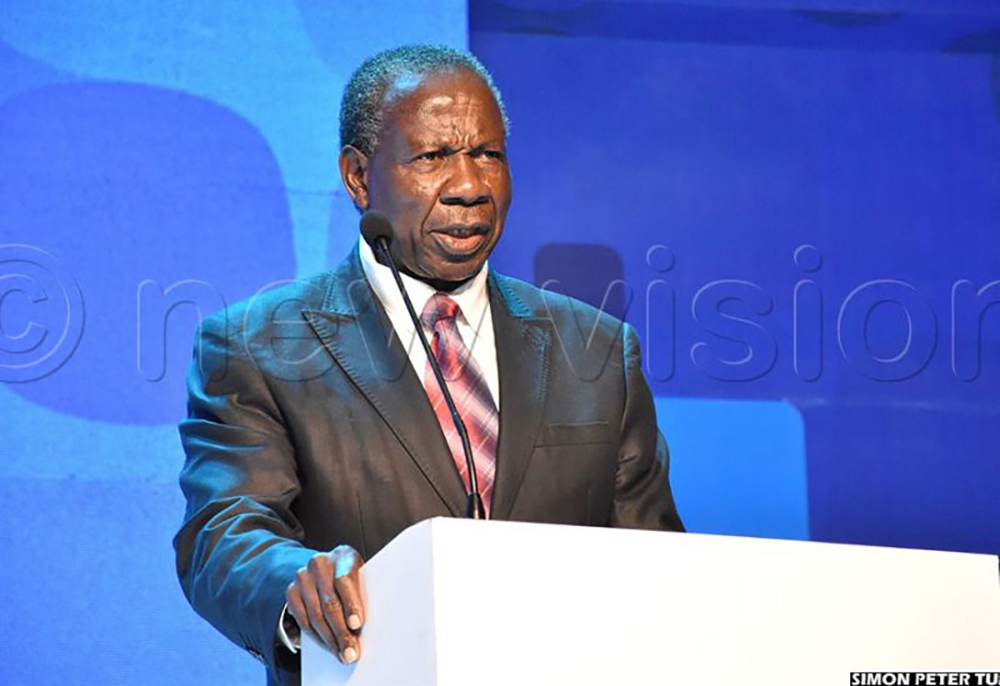
Uganda’s Minister of Finance, Matia Kasaija, has described insurance as a tool for risk management and economic stability.
To ensure their crops or animals, farmers pay 5.5% of the value of the crops they want to cover, except in disaster-prone areas where different arrangements apply according to the Uganda Agriculture Insurance Scheme.
IRA records indicate that uptake has grown steadily. By December 2017, only 45,704 farmers had taken up cover.
By the end of March 2023, the number had cumulatively grown to 687,608 farmers insured under the scheme. Over the same period, claims paid increased from sh2.2 billion in 2017 to sh33.4 billion cumulatively by March 2023.
Kaddunabbi said farmers who have embraced insurance have benefited significantly. However, he noted that demand for agricultural insurance subsidies is now outstripping supply.
The insurance industry, he added, plans to extend agricultural insurance services closer to farmers by licensing at least 12,000 dedicated agricultural insurance agents, working alongside the existing 3,681 agents selling other insurance products.
Calls to expand funding for Uganda’s agricultural insurance scheme have also intensified as climate risks rise.
Despite agriculture contributing about 24.1% to gross domestic product and about 33% of export earnings, experts say insurance adoption remains low, leaving farmers exposed to floods, landslides and pest invasions.
The chairperson of the IRA board, Isaac Nabeta, urged the Government to triple its financial commitment to the UAIS from sh5b to sh15b to enhance farmers’ access to insurance.
Speaking at the fifth Insurance Innovation Awards in Kampala recently, Nabeta said additional funding would significantly impact the sector.
John Makosya, a senior consortium officer at Agro Consortium Uganda, said agricultural insurance penetration remains below 1% of the farming population.
He said increasing the fund would encourage more farmers to take up insurance, especially in disaster-prone areas.
In the 2023/2024 financial year, he said, out of 148,000 farmers who insured their crops, only 37,000 benefited due to depletion of available funds.
“Demand for the subsidy is increasing, which calls for more support,” he said. From Northern Uganda, Otim warns that insurance becomes unaffordable without government support.
“For the last two years, we have not received the government subsidy, yet it is a key pillar of this programme. We appeal to government to reinstate and increase the subsidy because farmers benefit directly,” he says.
Uganda’s Minister of Finance, Matia Kasaija, has described insurance as a tool for risk management and economic stability.

The insurance pays out when a pre-determined drought index shows that crops in a given area are under stress severe enough to cause losses. Under this model, drought conditions are monitored using satellite data.
Farmers’ lifeline
At the centre of this shift is drought index insurance, a product based not on individual farm inspections but on measured weather conditions.
The insurance pays out when a pre-determined drought index shows that crops in a given area are under stress severe enough to cause losses. Under this model, drought conditions are monitored using satellite data.
The scheme partners with EARS, an independent satellite remote sensing company based in the Netherlands.
The EARS drought index is continuously monitored by satellite and represents drought and growing conditions anywhere in Uganda. It indicates declining water availability and resulting crop yield losses, both for current conditions and historical events.
During the growing season, the rainfall evapotranspiration (RE) index tracks drought severity across insured areas.
If the index remains above average, no payout is triggered. When it drops below average, it signals the onset of drought. Once the index reaches a strike level, yield losses are considered imminent, and a payout for that location is triggered.
The exit level marks the maximum payout of 100% of the sum insured in the event of a total loss.
To manage risk, rates and premiums under the rainfall evapotranspiration drought index are aggregated into zones, which can cover a group of farms, a sub-county or an entire district.
Farmers within the same zone pay the same premium rate and receive the same payout rate for the same sum insured.
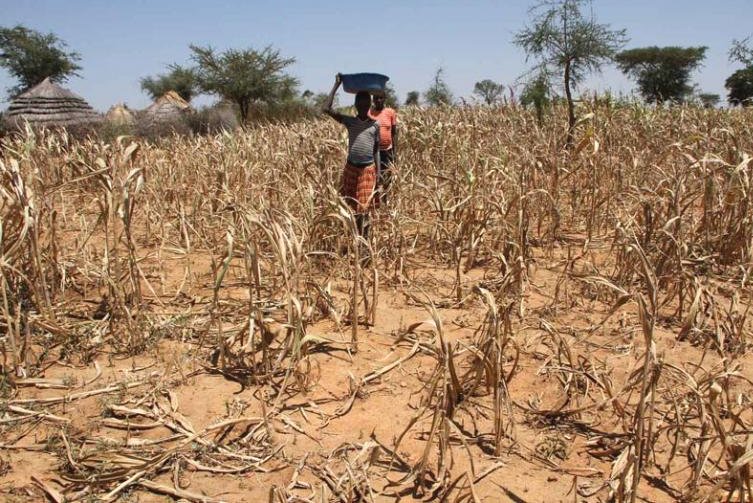
Maize field affected by drought in Uganda.
Enter AI farming
Beyond financing, experts say technology is reshaping how climate risks are managed. Regional initiatives such as the Intergovernmental Authority on Development’s Strengthening Early Warning Systems for Anticipatory Action (SEWAA) project are leveraging artificial intelligence and machine learning to improve weather forecasting and early warnings.
At the launch of SEWAA’s second phase in Entebbe recently, Fetene Teshome, director general of the Ethiopian Meteorological Institute, said AI-driven forecasting models are instrumental in strengthening early warning systems.
Other weather experts say improved forecasting complements insurance by enabling anticipatory action.
Caleb Gumisiriza, the federation’s director of policy, said weather index insurance has helped farmers meet contractual obligations even in poor seasons.
He, however, emphasised the need to build farmer confidence and improve understanding between insurers and farmers.
On his part, Alex Madolo, the head of the agriculture sector at dfcu Bank, said informality remains a major roadblock hindering farmers’ access to finance and insurance.