
Forestry authority undertakes fodder tree planting in Moroto
“We are demonstrating today what the community asked for from the organisation,” Twebaze noted, adding that it’s not only tree planting but the initiative has a far-reaching impact on the people and their livelihood, thus food for animals and improvement of soil cover in degraded areas.
Teams fron national forest authority, partners ,locals and Moroto district prepare to plant fodder trees in Taapac sub county. (Credit: Olandason Wanyama)
MOROTO - Over the past three decades, tree cover on the slopes of Mt Moroto has significantly reduced.
The elders say the mountain could be stripped of its plant cover in the next five years, an issue that could lead to loss of biodiversity, causing severe land degradation.
Jackson Angella, 81, a resident of Rupa, says the weather is fast changing in the sub-region, adding that during his tender age, while looking after animals, the mountain had several active streams flowing to the plains.
He adds that the burden of tree destruction remains a huge challenge as more people engage in charcoal burning for survival and building purposes.
Another elder, John Lokwang, attributes the ever-dwindling rains in the sub-region to illicit human activity on the environment that has led to severe consequences of climate change.
He adds that areas that slope towards the Uganda-Kenya border have had streams dry up because of little or no annual rains. And also, uncontrolled mining has destroyed tree cover, leaving behind gaping holes.
Lokwang added that the worry lies in the future, because most people will be victims of climate change.
“If we do not address the issue at this stage, the future could be hostile to our grandchildren,” he noted, urging the community to find means of restoring the plant fauna and flora.
The move also targets creating awareness about the dangers of deforestation while ensuring that the communities actively participate in preserving trees to reduce soil erosion and loss of fertility for future generations.
At the launch of the Lusina [Leucaena Leucocephala], a fodder tree planting exercise held on May 29, 2026, at Lopelipel Health Centre II in Tapac sub-county, partially home to the 22-million-year-old Mt. Moroto in Moroto district, the in-charge National Forest Authority-NFA Kaabong sector, John Giribo, stressed the need to improve the tree cover of the mountain.
He said unscrupulous people had embarked on the destruction of tree cover on the slopes of the mountain, intending to burn charcoal and for building purposes, among others.
‘Today, we have planted over 200 fodder trees for the beginning in Tapac,” Giribo, however, noted that as NFA, we are committed, and also through partners, the campaign will cover the entire mountain.
He cautiously warned the community not to cut down trees, saying they provide food for animals and also improve soil fertility.
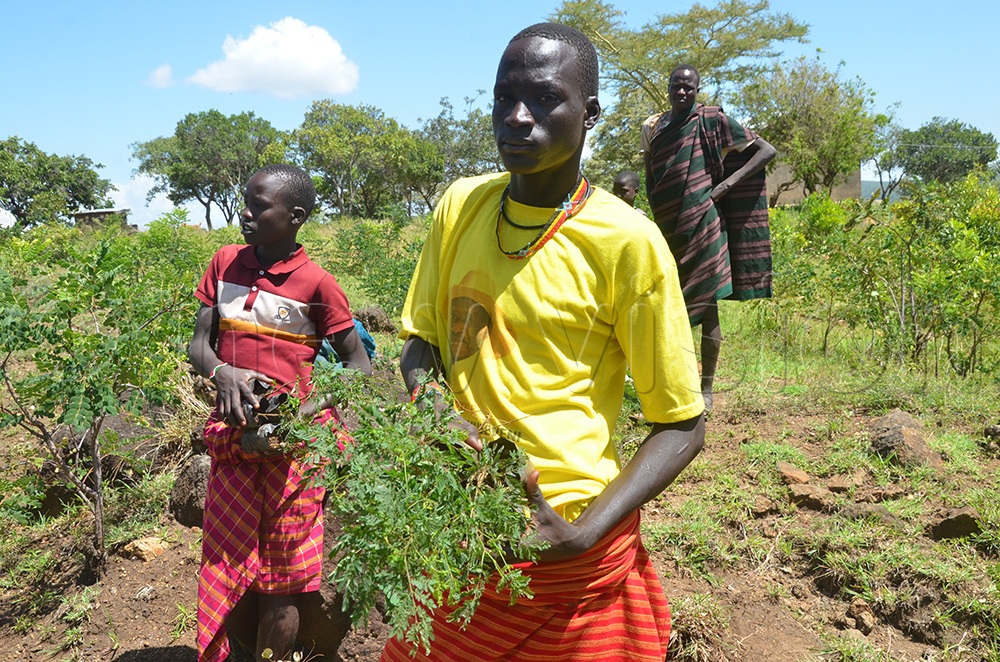
Youth participate in the planting of trees in Tapac sub county, Moroto district. (Credit: Olandason Wanyama)
“As you cut down more trees in the shortest time to fight climate change,” Giribo said, adding that weather changes are real, the reason why we experience prolonged drought and flooding in some parts of the Karamoja sub-region.
He said the exercise stems from the meeting held last year by the community to have more trees planted to fight climate change.
“We are demonstrating today what the community asked for from the organisation,” Twebaze noted, adding that it’s not only tree planting but the initiative has a far-reaching impact on the people and their livelihood, thus food for animals and improvement of soil cover in degraded areas.
He asked the staff at the health centre to ensure the trees do not wither in the future.
“The trees that have been planted will strengthen resilience,” Twebaze said, adding that it will also encourage a culture of environmental conservation among the alpine community.
Background
Leucaena leucocephala grows as a shrub to medium-sized tree up to 10 meters in height.
It's (commonly called river tamarind or ipil-ipil) is a fast-growing, nitrogen-fixing legume used as livestock fodder, soil regeneration, firewood, and agroforestry.
While it offers exceptional protein for ruminant animals and aids in erosion control, its high levels of the toxic amino acid make it unsuitable as a primary diet for humans or non-ruminants.