
ECOTRUST sets firm targets for climate resilience, finance
During the convention held today in Kampala, the Non-Governmental Organisation now seeks to surpass its renowned key ecological zones like Rwenzori and Mt. Elgon, where over 54,000 households have benefited from climate finance through the sale of carbon credits on the voluntary market.
“We want farmers to grow trees because it makes economic sense for them, not simply because they are saving the environment. When environmental services such as carbon storage, watershed protection and climate regulation are properly valued, conservation becomes a profitable and sustainable land-use option,” Nantongo adds.
At the preamble to the launch of the impact report and marking twenty-seven years of anchoring biological diversity conservation and mobilising climate finance in Uganda, the Environmental Conservation Trust of Uganda (ECOTRUST), has set improved targets to achieve private sector-led conservation and climate finance with over 60,000 extra hectares of restored land in sight.
During the convention held today in Kampala, the Non-Governmental Organisation now seeks to surpass its renowned key ecological zones like Rwenzori and Mt. Elgon, where over 54,000 households have benefited from climate finance through the sale of carbon credits on the voluntary market.
“The Impact of these initiatives are far greater than the environmental benefits. Carbon farmers are now taking their kids to schools, while savings and credit cooperatives have been created and capitalised with conservation finance. The impact report will document what the spinoff has been in terms of such investments,” says Pauline Nantongo, the executive director, ECOTRUST.
Beyond trees for global benefits
Primarily, the Rwenzori mountains, Queen Elizabeth, Mt. Elgon, Murchison, and lately, Northern Uganda have been operational grounds where landscape restoration and biodiversity conservation have prevailed.
To date, the intention is to upscale the footprint to more than 16.5 million Ugandans across 33 districts, restoring at least 60,000 extra hectares of degraded land, while creating economic value out of conservation, climate change adaptation and mitigation.
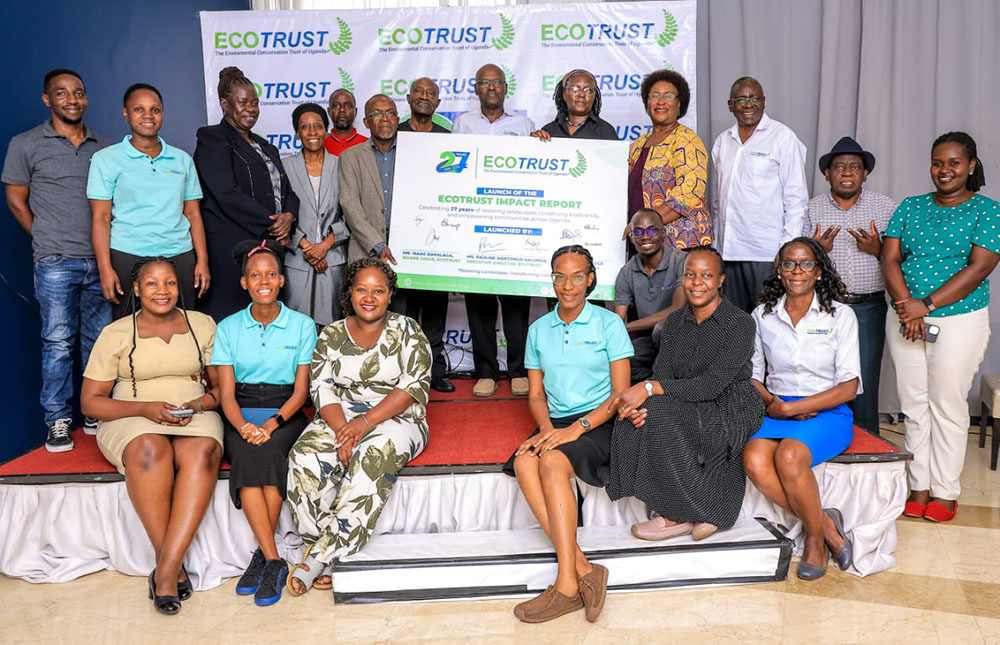
ECOTRUST Board members and staff at the press conference.
“We want farmers to grow trees because it makes economic sense for them, not simply because they are saving the environment. When environmental services such as carbon storage, watershed protection and climate regulation are properly valued, conservation becomes a profitable and sustainable land-use option,” Nantongo adds.
Through its landscape restoration model, ECOTRUST has supported farmers to establish enterprises across major value chains, including timber production, coffee, cocoa, fruit farming, medicinal extracts, honey production, fish farming and fuel wood production.
ECOTRUST’s Board Chairperson, Isaac Kapalaga, has reflected on the organization’s journey since 1999 as deeply fulfilling.
He highlights the successful rollout of programmes in Northern Uganda amidst logistical and operational challenges, commending the expansion into new regions.
“Our commitment remains focused on reaching more communities and ensuring that conservation delivers real social and economic value to ordinary Ugandans,” he notes.
The community-led conservation and restoration initiatives reckon the growing need to meet Uganda’s aspirations of climate change adaptation and mitigation across major sectors, as expressed in the Nationally Determined Contribution.
Still, the efforts resonate with the unmet private finance targets anticipated by the finance ministry, especially with its 2025 deal book of priority projects for investors, suggesting bigger ambitions.