
'Cultural resistance to e-cooking technology still a challenge'
According to Kakeeto, cultural resistance to new cooking technology like Electric Pressure Cookers (EPCs) is still a major hurdle in the uptake of this eco-friendly mode of food preparation.
One of the participants look at the displayed clean cooking items during the clean cooking workshop at Protea hotel Kampala. (Photos by Ronnie Kijjambu)
________________
Deep-rooted cultural beliefs are still hindering the adoption of cheaper electric cooking alternatives to traditional means of cooking, which is a serious concern for bankers, development partners and the government.
According to James Kakeeto, the Stanbic Bank’s Business Development Manager – Renewable Energy, cultural resistance to new cooking technology like Electric Pressure Cookers (EPCs) is still a major hurdle in the uptake of this eco-friendly mode of food preparation.
“How far does the grid go, especially in rural areas? The power grid should move along with that campaign to promote e-cooking,” Kakeeto suggested.
“There is also a need to quantify the market and the willingness and affordability of the electric cooking devices for it to be viable for financial institutions to consider funding the suppliers of these EPCs.”
Kakeeto made this revelation on Thursday (April 03) at Protea Hotel in Kampala, during a workshop organized by Modern Energy Cooking Services in collaboration with ICLEI Africa and the Global Gtreen Growth Institute on electric cooking support and scale programme partners’ progress review.
The workshop was held in partnership with the Government of Uganda through the Ministry of Energy and Mineral Development (MEMD) in partnership with the UK government.
Kakeeto’s remarks were echoed by his fellow banker Virginia Ssemakula, the manager energy, environment and climate change at Equity Bank, who noted that to promote e-cooking devices, there is a need to put the messaging into local languages for these imported devices to appeal to the targeted population especially those who reside in urban slums.
Ssemakula also noted that “We see opportunities for derisking the sector, but it is very vital for the government to put derisking mechanisms in place.”
The Country representative of Global Green Growth Institute, (GGGI), Dr Pablo Martinez speaks during the clean cooking workshop at Protea hotel Kampala. 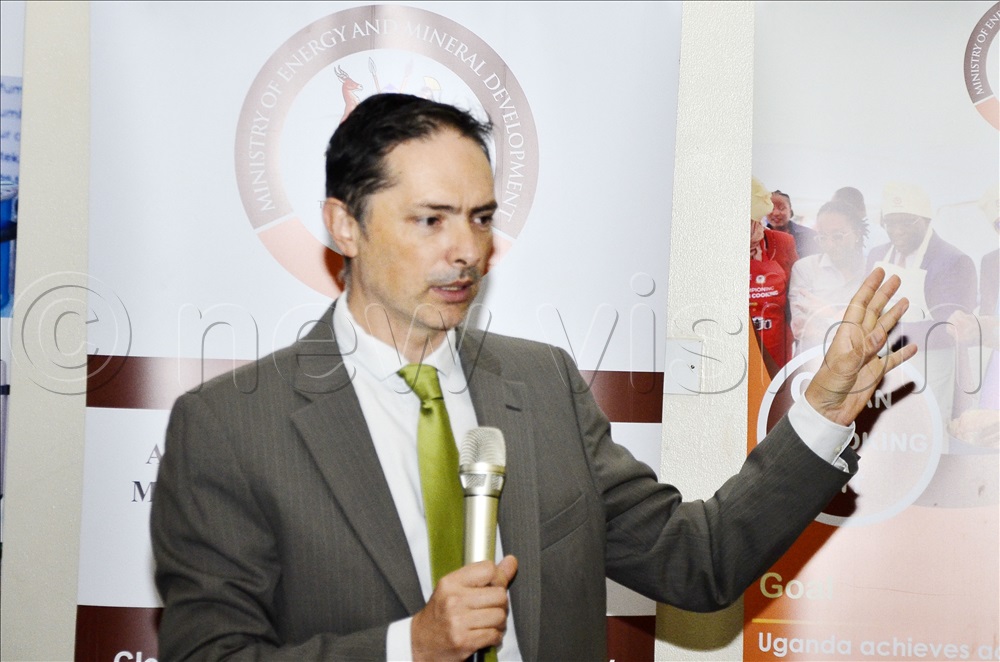
During the workshop, the financial institutions also said they often get feedback that they do not give out loans to promote eco-friendly investments, but their argument is that they are required to follow statutory guidelines and Bank of Uganda regulations.
They, however, suggested that it is important to involve the Ministry of Finance, Planning and Economic Development (MoFPED) in such workshops so that they can weigh in on the matter in order to enable the scale-up of the uptake of EPCs with limited barriers.
Dr Pablo Martinez, the GGGI’s country director for Uganda, said the creation of the Clean Cooking Unit (CCU) at the energy ministry will play a key role in transforming Uganda’s clean cooking sector by improving coordination, facilitating access to finance and investment, and increasing the adoption of clean cooking technologies.
“At GGGI, we are excited to partner with and continue supporting the Government of Uganda in establishing the Clean Cooking Unit (CCU),” he said.
“We extend our sincere gratitude to the UK Government for funding this initiative under the Electric Scale-Up and Support Project,” said Dr Pablo Martinez, GGGI’s Country Director.”
Kampala Capital City Authority’s (KCCA’s) Rhoda Nandawula, said it is true that some women in Central region (Buganda) including herself (previously) have a belief that Matooke (green banana) is better off cooked in the traditional way on either using firewood or charcoal, which she says is an old-fashioned practice which harms the environment through tree cutting.
“Cooking carries risks beyond the kitchen, and traditional methods are time-consuming compared to the use of EPCs,” she noted.
She also pointed out that many teenage girls end up getting raped in forests as they go to collect firewood which leads to school dropout rates, she appealed to MEMD to reach out to local governments to implement the two-year project that promotes e-cooking in both homes and academic institutions in line with Uganda’s vision to transition to clean energy options.
Felix Okurut from the energy ministry who represented the Permanent Secretary, said the move government has taken to boost e-cooking is very critical he said it is aimed at empowering rural women to transition from traditional cooking methods and in so doing reduce cancer rates which he attributes to smoke-infested kitchens that have in recent years spiked cases at the Uganda Cancer Institute.
Lydia Nandawula, the Climate Policy Officer at BHC/FCDO, said at least 70% of their staff have EPCs, which she attributes to the support of this two-year programme.
Her colleague, Benjamin Zeitlyn, the Team leader in charge of Growth, Prosperity and Climate at the British High Commission in Kampala, said on Wednesday at the same venue that this is part of a progress meeting nine months into the delivery of the clean cooking programme.
MEMD says they have been involving cultural leaders from various parts of the country,y including Buganda and Teso, as well as Bugisu, to create awareness and promote the EPCs.
The average cost of EPCs ranges from between sh350,000 to sh416,000 ($94 to $110). Others, especially those supported by off-grid connections, cost as high as sh2m.
Some users have reported that they use one unit of electricity to cook for two and a half days and that they now budget sh15,000 for electricity, which is equivalent to 20 units of power, compared to spending sh50,000 for charcoal and sh30,000 for paraffin in a month.