
Climate walkers near Kampala after 485km trek highlighting environmental crisis
The walkers, participating in the Walk for Water and Environment organised by the Ministry of Water and Environment, have trekked from the semi-arid plains of the Karamoja sub-region in north-eastern Uganda to the greener landscapes of eastern and central Uganda, highlighting the growing impact of climate change on communities.
Goefrey Ayen, the lead walker, sets off after being flagged off at the Nile Bridge in Jinja. (Photo by Leonard Mukooli)
________________
A team of climate change campaigners walking across Uganda to raise awareness about water, environmental and climate issues has covered 485 kilometres of the 560-kilometre journey, demonstrating resilience and endurance as they approach the final leg to Kampala.
The walkers, participating in the Walk for Water and Environment organised by the Ministry of Water and Environment, have trekked from the semi-arid plains of the Karamoja sub-region in north-eastern Uganda to the greener landscapes of eastern and central Uganda, highlighting the growing impact of climate change on communities.
According to Joseph Odong, a senior water officer at the ministry leading the team, the group has already covered 485 kilometres and has only 75 kilometres left to reach Kampala, where they are expected to conclude the journey ahead of schedule.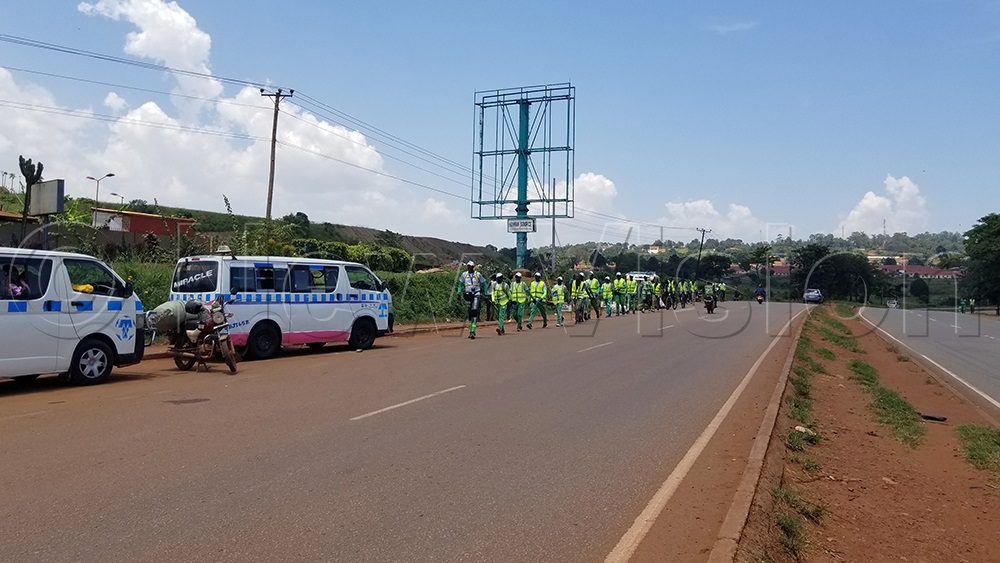
Walkers walking along the Jinja Kampala highway in Jinja City on Monday afternoon, entering the central region. (Photo by Leonard Mukooli)
“So far we have managed to cover 485 kilometres, and we are only left with about 75 kilometres to reach Kampala,” Odong said, noting that the walkers expect to arrive in the capital on March 19.
The journey began in Moroto in the Karamoja sub-region, an area widely known for its harsh climatic conditions, recurrent droughts and limited water sources. From there, the walkers moved southwards through the plains of Teso, passing through Katakwi, Amuria and Soroti before continuing to Ngora, Kumi and Bukedea.
Their journey then took them to the slopes of the Mount Elgon region, entering Mbale city and later crossing through Mbale district before proceeding to Tororo and Busia in the Bukedi sub-region.
The team continued westwards through the Busoga corridor, trekking across Bugiri, Bugweri, Iganga and Mayuge before reaching Jinja, where they were flagged off into the central region for the final stretch to Kampala.
Along the route, the walkers endured varying weather conditions, including scorching sunshine, heavy storms and long hours on the road.
Odong said the difficult conditions mirrored the climate challenges that many Ugandan communities face.
“We had severe weather conditions along the route, including storms and intense sunshine, which affected the way the walkers moved,” he said.
Despite the physical strain, the team continued with awareness activities in different towns and communities, planting trees, engaging local leaders and documenting environmental challenges affecting the country.
The lead walker, Geofrey Ayeni, said the journey has revealed stark contrasts in environmental conditions across regions.
“In Karamoja, the water situation is alarming, and there are serious environmental challenges,” Ayeni said, noting that deforestation caused by charcoal burning has significantly reduced tree cover in the area.
However, he said some districts like Tororo have made progress in environmental restoration, particularly in areas in eastern Uganda where tree-planting initiatives have improved vegetation cover.
Ayeni said the team also observed poor solid waste management in some urban centres, especially in parts of the Busoga sub-region.
“In some towns, we saw reckless garbage dumping on the streets, which shows that waste management is still a major challenge,” he said.
Ayeni further noted that the walk is not only a campaign to raise awareness but also an opportunity to gather firsthand information about environmental challenges affecting communities across the country.
Engi Francis Xavier Rwezahura, deputy branch manager of Water and Sanitation Development Facility – East, said the initiative has highlighted persistent problems, including wetland encroachment and limited access to safe water.
“Encroachment of wetlands is still a major challenge because people want to utilise wetlands for commercial and agricultural purposes,” Rwezahura said.
He added that relocating communities living in wetlands remains difficult due to the shortage of alternative land for resettlement.
Rwezahura also noted that the rapid growth of urban centres has increased demand for water and sanitation services, yet funding constraints continue to limit the expansion of infrastructure.
“In the eastern region alone, we serve over 37 districts, but because of limited funds, we have not been able to extend water and sanitation services to all the emerging towns,” he said.
As the walkers push towards Kampala, the team says the journey has strengthened their resolve to amplify the message on climate change adaptation and environmental conservation.
The final report from the walk will be presented to the government and policymakers in Parliament to support discussions on sustainable solutions to water scarcity, environmental degradation and climate change impacts in Uganda.