
Climate change: Schools like Napak Seed SS turn to smart farming
Emmanuel Owoyesiga, a teacher of agriculture at Napak Seed Secondary School in Karamoja region, demonstrating how they use smart farming on July 16, 2024. (Credit: Eddie Ssejjoba)
_____________________
CONSERVATION
📍 Karamoja
Napak Seed Secondary School in Napak district is engaged in tree planting, smart agriculture/farming and waste management.
Under smart farming, the school has established two acres of land on which students practise irrigation using a solar system for the overhead and drip line irrigation methods to hydrate their garden.
This was revealed on Tuesday (July 16) to a team evaluating the climate change projects of five schools per region as one of the activities of the Green Schools Initiative, which is in its second year of implementation by Vision Group in partnership with the Food and Agricultire Organization of the United Nations (FA0) and funded by the Embassy of Sweden in Uganda.
Debate is one of the tracks of the initiative while the other is innovative projects aimed at mitigating or adapting to climate change.
▪️ Green Schools: Prizes await regional and national winners
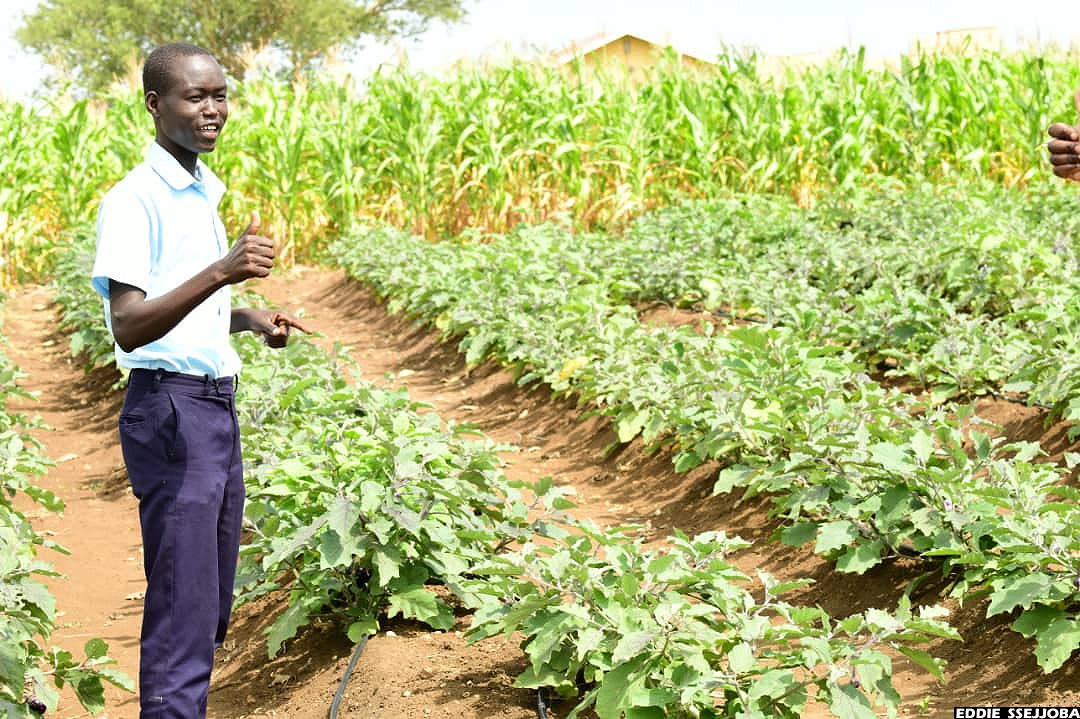


Agriculture teacher Emmanuel Owoyesiga is also the school's Green Schools project coordinator.
He said that with funding from the school administration, the Environment Club members, who comprise Senior One and Senior Two students, plant vegetables such as tomatoes, eggplants, green pepper, spinach and kale (sukuma wiki).
▪️ FAO boss Querido flags off Green Schools evaluation team


Owoyesiga said that instead of using agro-chemical agriculture, they apply various cultural techniques to prevent the spread of pests, and as one way to deal with climate change.
He said since Karamoja is a semi arid region, with less rainfall, they promote the use of cultural techniques that are favourable to the environment.
They plant vegetables, which they feed on as a school community as well as sell part of it to generate money.
The school encourages communities to feed on vegetables instead of red meat.

Having started operating in February 2023, the Napak Seed SS is keen on educating and sensitizing students on smart farming.
Georgina Liko, a Senior Two student at the school, is a member of the Environment Club.
She said the garden has helped the students acquired farming skills, which they in turn export back to their home communities.


Another club member is Barnabas Lokut, who is also in Senior Two.
He pointed out some components of their smart farming as including using solar power, hybrid crop varieties, mulching, strip cropping and row planting.
They prefer the solar system to generators, which he said produce gases that have a negative impact on the environment.
Commenting about the Green Schools project, students said it has sensitized both students and the communities about the importance of the environment.
Elizabeth Amuria, a Senior Two student, said when they started an environment club through their teacher, Sam Okorom, they asked the school to buy for them both shade and fruit trees.
She was given a guava tree, which she planted in the school compound near her class in March last year.
It has produced fruits, which Amuria anticipates will be ready for consumption in the next three weeks.

The trees are growing taller and the students are eager to enjoy the shade they will provide.
Amuria said that due to lack of enough facilities, Senior Five students study under a tree that was spared when constructing the school.


Amuria said the trees are also cooling the atmosphere, which used to be harsh.
So far, they have planted 200 fast-growing guava trees.
When cattle from the communities started eating the young trees, the students and teachers of the school set out to sensitize the communities about the importance of preserving trees.

Teacher Okorom said the school has planted 751 trees. Some died due to the dry weather.
But but this year, he said they procured 1,082 more trees and shared them with the communities after inviting parents and community members to the school and sensitized them on preserving the environment as part of the Green Schools Initiative.

The school also dug a composit manure pit where they dump waste, which is later sorted by students to pick out paper matrials.
They use paper to make modules for learning purposes in the physics class.
The plastic bottles are used in making chairs and classroom dustbins.
Okorom said parents are brought on board and giving trees free of charge so that they can spread the gospel in their respective communities with the aim of mitigating climate change.

He said the project is sustainable both at school and in the communities.
Teachers and students often move in small groups in villages to educate them about tree planting. The teachers also create short videos and photos, which they share on their Whatsapp groups.
They advise parents to pant four trees after cut down one.