
Bukomansimbi farmers decry fake pesticides, call for regional farm store
“Someone buys pesticides expensively, but the pests don't die when they spray them,” he said, before urging the Uganda National Bureau of Standards (UNBS), the Ministry of Agriculture, Animal Industry and Fisheries and other responsible agencies to strengthen controls at the points of entry into Uganda.
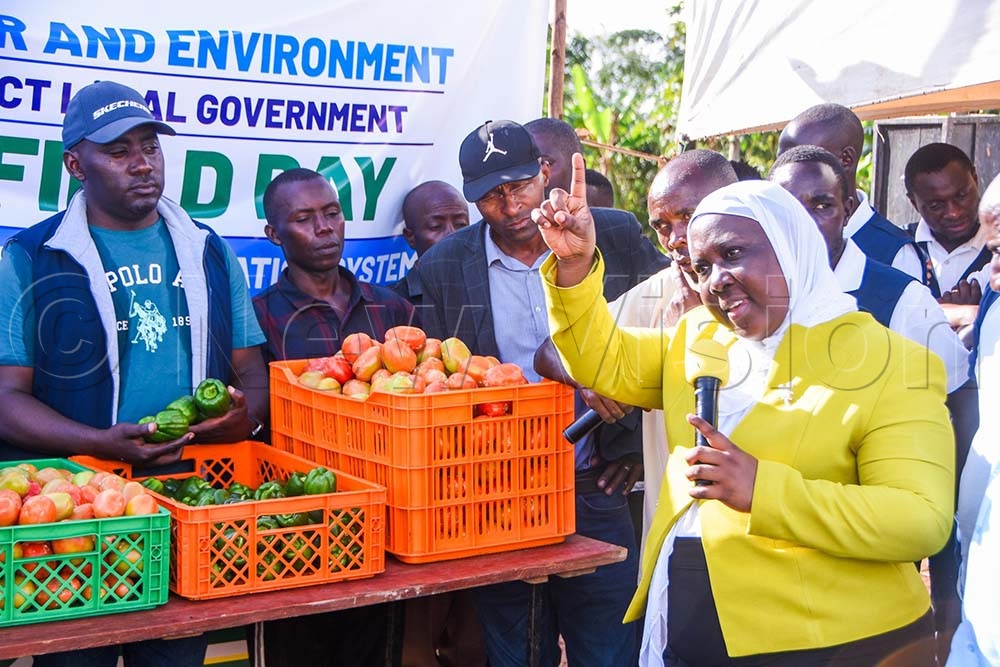
The ministry also launched three solar-powered irrigation projects worth sh2.78b to support farmers in the area. (Credit: Rhyman Agaba)
BUKOMANSIMBI - Farmers in Bukomansimbi district have decried the increased presence of fake agrochemicals on the market and called for the establishment of regional agricultural stores to supply genuine drugs, fertilisers and other farm inputs.
Led by Hassan Mukiibi Sserunjogi, the Bukomansimbi South MP, the farmers said despite being costly, the agrochemicals were fake.
They, therefore, proposed to government to allow the introduction of certified regional agricultural stores that would enable farmers to access genuine farm inputs.
Speaking during an interaction with farmers on Tuesday (October 20) organised by the Ministry of Water and Environment at Kiwenjula village in Butenga sub-county, Bukomansimbi district, Sserunjogi said counterfeit pesticides had become a major challenge for farmers because many could not distinguish genuine products from fake ones.
The ministry also launched three solar-powered irrigation projects worth sh2.78b to support farmers in the area.
He said many of his constituents have spent a lot of money on chemicals, but they have failed to control pests.
“Someone buys pesticides expensively, but the pests don't die when they spray them,” he said, before urging the Uganda National Bureau of Standards (UNBS), the Ministry of Agriculture, Animal Industry and Fisheries and other responsible agencies to strengthen controls at the points of entry into Uganda.
Sserunjogi said the district had partnered with genuine agricultural input suppliers and agricultural officers to conduct spot checks on agro-input shops and guide farmers on the certified dealers.
Sserunjogi cited Bukola Chemical Industries as one of the partners supporting farmers through free agricultural extension services.
He proposed that the Government channels funds through the Ministry of Agriculture to establish regional agricultural stores stocked with approved pesticides, acaricides, fertilisers and farm implements.
Under the proposed arrangement, farmers would purchase inputs directly or obtain them on credit and repay after harvesting. The initiative could also be linked to agricultural processing facilities to enable farmers to settle their debts using proceeds from their produce.
“If the coffee is worth sh5m and a farmer took fertilisers worth sh1m, we shall simply offset that sh1m and pay him the balance of sh4m,” Sserunjogi explained.
The MP also called for tax reductions on irrigation equipment and other agricultural inputs, arguing that high prices prevented smallholder farmers from investing in improved production.
According to Sserunjogi, Bukomansimbi was water-stressed despite having water sources, including Kyoja swamp and Nabajjuzi River. He urged the Government to make irrigation equipment more affordable.
Mukiibi further proposed subsidising fertilisers rather than relying solely on distributing them free of charge, saying lower prices would enable farmers to purchase more inputs and improve their productivity.
Farmers raise concerns
Richard Semakula, a farmer from Kiwenjula village, appealed to the Government to reduce taxes on pesticides and other agricultural inputs to lower production costs.
Semakula also raised concerns about competition from tomatoes imported from Kenya, which he said were cheaper than locally produced ones.
George William Mwesige, another farmer, commended Sserunjogi for supporting agricultural development and urged young people to retain their ancestral land and use it for farming rather than selling it for quick money.
Mwesige welcomed the solar-powered irrigation project, saying it had helped farmers continue producing during dry seasons when unreliable rainfall affected agricultural activities elsewhere.
“I thank Government for this solar-powered irrigation system. It has saved us from drought seasons, which have affected farmers elsewhere, yet we have been earning from our produce throughout the year,” he said.
Irrigation projects
The field day also showcased three water development projects in Lwemiriti, Makomi and Kiwenjula villages, implemented by the Ministry of Water and Environment with funding support from UK Export Finance and constructed by renewable energy company Nexus Green Limited.
Petua Buteme, a project engineer at Nexus Green Ltd, said the company had partnered with the ministry to implement water supply and solar-powered irrigation schemes across the country.
She said the programme covered 687 sites in different constituencies to extend water services to communities and help farmers adapt to climate change and unreliable rainfall.
Alex Kusheesha, the deputy manager of multi-purpose bulk water development at the ministry, who represented the regional manager for central Uganda, said Bukomansimbi was allocated three sites following assessments to establish their technical feasibility.
He said the ministry's approach was demand-driven, requiring district authorities to identify their needs and request intervention before assessments, design and construction.
Kusheesha said Lwemiriti's project cost about sh1b, Makomi's sh780m and Kiwenjula's approximately sh1b. The differences, he explained, depended on construction requirements, distances between water sources and storage facilities, and the number of storage tanks needed.
He said Kiwenjula directly benefits about 25 farmers who invested in the scheme, while other beneficiaries include people providing labour and buyers of agricultural produce, bringing the total to about 50.
Kusheesha added that the ministry planned to extend piped water supply systems to surrounding communities in phases, depending on available funding.
Joseph Luwaga, the deputy resident district commissioner's representative, thanked President Yoweri Museveni for supporting the projects and urged beneficiaries to protect the infrastructure against vandalism.
He said district leaders had alerted security agencies to deal with offenders in accordance with the law.
The field day featured guided farm walks, demonstrations, exhibitions and a plant clinic showcasing post-harvest handling and agricultural produce. Farmer groups, input dealers and financial service providers also shared experiences.
Uganda’s Ministry of Agriculture, Animal Industry and Fisheries (MAAIF) has in recent years taken a strong, zero-tolerance stance against the influx of counterfeit, unregistered, and expired pesticides on the market.
The ministry acknowledges that fake agrochemicals threaten food security, farmer investments, and public health; senior ministry leadership and inspectors have initiated aggressive regulatory and field enforcement actions.
MAAIF has also formed active joint-intelligence and enforcement frameworks alongside the Uganda National Bureau of Standards (UNBS), the Agricultural Police, the Judiciary, and the Directorate of Public Prosecutions to ensure that vendors selling fake chemicals face swift legal prosecution.