
Govt starts registering individuals for land certificates
LAND |
The ministry of lands, housing, and urban development has embarked on the process of registering individuals, families, and communities in an effort to issue them with land certificates of ownership, targeting 13 districts by December this year.
Denis Obbo, the ministry spokesman said that a team of experts was in the field in the districts of Northern Uganda but were spreading to other districts.
In Pader, he said, the team had so far registered 740 families and the number was still growing. According to Obbo, these should be able to get their certificates by December this year.
The ministry is also working on others including Nwoya, Oyam, Soroti, Katakwi, Adjumani, Butalejja, Buliisa, Kisoro, and Kabale.
Other areas listed include Mbarara, Kiruhura, Ibanda, Agago, Apac, and Maracha.
Certificates of customary land ownership help confirm ownership of the land by the occupants and minimize clashes and land grabbing.
The land is often owned by indigenous communities and administered in accordance with their customs with the Land Acr 1998, listing individuals, family, and common ownership as the types of customary land ownership.
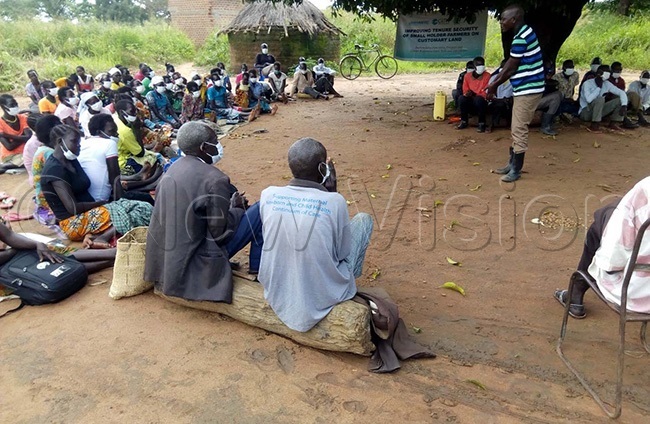
One of the sensitization meetings at Pader in northern Uganda
Obbo said the ministry was targeting at least on average 500 families per district and this is a demand-driven basis where the beneficiaries write applications. The process starts at the village level, to the sub-county and the district land board.
He said other types of land tenure are also considered but going through different processes. The ministry will also move to Karamoja region where they intend to register mainly clans and issue them with certificates of ownership.
The districts to benefit include Amudat, Kaabong, Moroto, and Kotido.
The Permanent Secretary Dorcas Okalany confirmed that by December, the following customary titles shall be ready for issuance to customary landowners.
Other districts in the pipeline include Butaleja, where the ministry, in partnership with Uganda Community Based Association for Women and Children Welfare (UCOBAC) has so far registered 750 Certificate of Customary Ownership(CCO) (customary titles) from Kachonga, Mazzi Masa, and Naweyo sub-counties.
Others are 405 in Pader, 700 from Kabale in the sub counties of Kitumba, Kamuganguzi, Rubaya and Buhara.
In Kisoro 4,000 CCOs have been registered from Muramba and Nyakabande sub-counties, 1,000 CCOs have been registered in Adjumani where the ministry is working in partnership with Makerere University.
In Soroti, the ministry working with GIZ has registered 200 CCOs from the sub-counties of Katine, Asuret, and Tubur, 200 in Katakwi, 650 CCOs in Namutumba, and 340 CCOs in Buliisa. 200 have been registered in Kassanda.
The exercise is intended to ensure people and communities are safe and secure from illegal evictions.
They should also be able to use the certificates or access economic empowerment for both men and women.