
Infrastructure: The visionary push to build the economy
SPONSORED CONTENT
For the last 10 years, infrastructure has received the biggest chunk of the national budget because it has for long been clear to President Yoweri Museveni that if infrastructure is developed, other services will get the spillover effects.
"Strengthening and improving the level of competitiveness of the Ugandan economy continues to remain central to the NRM policy goals and we have thus prioritised infrastructure development to overcome bottlenecks in the economy," he once said.
According to the World Bank senior economist for Uganda, Rachael Ssebude, Uganda needs an efficient transport system that facilitates domestic, regional and international connectivity to support its growth agenda.
The Uganda Manufacturers' Association (UMA) executive director, Daniel Birungi, says transport is one of the key cost pushers for producers and manufacturers, as it adds approximately 25% to the cost of goods.
He said over the years, the association has been pushing for construction, renovation and maintenance of key roads that link their products to major towns and export markets within the region. 
PROGRESS MADE
In 1986, when President Museveni came to power, the total national road network was 7,900km and of the 1,900km that had been tarmacked, only 114km was in fair condition. The condition of the roads network remained a major road block to the country's development agenda.
By 2008, public spending on roads was low, by international standards, and the unit cost also exceptionally high, for reasons including the low volume of work, a lack of competition and weaknesses of the works ministry responsible for procuring and supervising road services.
In 2008, Museveni ordered the creation of the Uganda National Roads Authority (UNRA), to take charge of the roads portfolio and launched the Uganda Road Fund (URF) to address the maintenance backlog.
He also advocated a significant increase in the budget for public spending on national roads, from sh398b to sh3,442b in 2015/16, and, today, the condition of the roads is much better.
"The roads are good from East to West, North to South and North West to South East, which makes the movement of tourists and other human beings easy," he said.
According to URF the country now has approximately 140,000km of roads, categorised as national roads (20,500km) under UNRA. Others are city roads (2,110km) under Kampala Capital City Authority (KCCA), district roads (30,000km) under 121 district local governments, and urban roads (71,500 km) under 14 municipalities, 214 town councils and community access roads.
Of these, the paved stock has grown over the years to 4,971km. Over the last five years, government has focused on paving 2,000km of new roads, aimed at increasing the tarmac foot print from 4,900km to about 6,000km.
It has also directed efforts at reconstruction and rehabilitation of sections of national roads, as well as turning specific sections into dual carriages. Over 800km of roads have been added to the total roads stock over the last four years, with many more in the pipeline.
According to UNRA publicist Allan Ssempebwa, the roads authority has added 814.1km of paved roads to the national stock since 2016. He said the authority is upgrading 23 roads, estimated to cover 1,581.7km from gravel to paved bituminous standards.
"In the first quarter of the current financial year, UNRA's delivery capacity shot up, because we delivered 204km equivalent of roads to the roads stock, which is a 50% achievement against our annual physical performance target of 400km," he said.
According to the works ministry, construction of seven oil roads totalling 550km kicked off in the Albertine region in western Uganda in the 2018/19 financial year, to facilitate oil production.
Museveni said construction of these roads would also boost tourism, a major resource for the economy, raking in approximately $1.5b per annum into the national coffers. Currently, Uganda has a target of completing a large section of its oil roads ahead of the first oil, which is expected to flow in 2023. 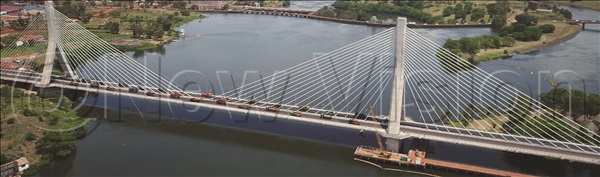
KCCA ROADS
It is estimated that about four million people flock to Kampala city every day for work, from neighbouring districts. Most of these spend hours travelling to and from work due to traffic congestion and limited road networks within the city. Concerned about their plight, President Museveni directed KCCA to address the challenge jointly with Kira, Wakiso, Entebbe, Mukono and Mpigi municipalities, to create quality alternative routes to connect the Greater Kampala and improve productivity.
According to the KCCA director of engineering and technical services, Eng. Andrew Kitaka, works are ongoing for the upgrade of 20 roads in the city, measuring 46.7km. The project is funded by the African Development Bank (AfDB), at a cost of about $240m.
"These will greatly reduce congestion in the city, which is becoming a big mess for those living and operating in Kampala, on a daily basis," he said.
In February 2018, following an agreement between President Museveni and Japanese prime minister Yoshihide Suga, Uganda and Japan signed a sh3.23b grant agreement to fund the detailed design for the construction and equipment of an ultramodern traffic control centre at KCCA.
LAKE PORTS
In March 2018, Museveni received a delegation of GAUFF Engineering and gave them a go-ahead to construct the Bukasa Inland port on Lake Victoria. Museveni said upon its completion, government would reserve Bukasa Port as a port of shipment, Port Bell as a passenger port and Jinja Pier as an industrial port.
He said the location of Bukasa fulfils all the prerequisites for a port to ensure successful operation, and that it would connect to the existing rail and road network.
"The port would serve as a central hub for all flow of goods along the northern and the central transport corridor," he said.
Last year, works minister, Edward Katumba Wamala said plans for the construction of the Bukasa port were in advanced stages. He said it is expected to serve as trio-modal cargo handling facility for road, rail and water transport. The port will sit on 400 hectares on the shores of Lake Victoria.
"Government has finished a significant portion on the rehabilitation of Port Bell, and will soon start the rehabilitation of the Jinja pier to facilitate inland water transport, especially on Lake Victoria," Katumba said.
Uganda's MV Kaawa, Kenya's MV Uhuru and Tanzania's MV Umoja have been improved to provide quick and reliable marine transportation services between Port Bell, Kisumu and Mwanza. Port Bell is Uganda's main link to Kenya and Tanzania through the Kisumu and Mwanza ports. 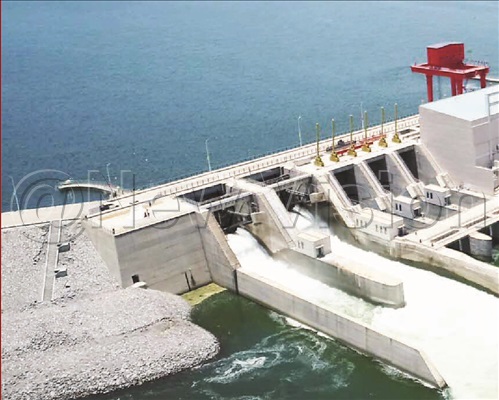
POWER GENERATION
In 2001, President Museveni launched the construction of the $550m Bujagali dam on River Nile after the World Bank approved the project. First proposed in 1994, the dam was not approved for construction, until December 2001 due to concerns raised by environmentalists and some MPs.
Critics said alternative sources of electricity were not seriously analysed and that developing Bujagali would interfere with tourist activities. After feasibility studies, the World Bank, through its private lending arm, the International Finance Corporation (IFC) and the International Development Agency, committed $215m in direct loans and guarantees for the hydro dam.
The dam, consisting fi ve turbines, was commissioned in 2012, with installed capacity of 250MW, and has signifi cantly changed the depiction for Uganda's energy need. In the period pre-dating 1986, power shortages were a part of daily life and created challenges. Power generation at the time stood at 60MW, but over the last 34 years, generation has grown to 1,252.4MW, and this is expected to hit 2035.4MW with the coming on line of the 783MW Karuma dam.
A host of other smaller power dams are expected to raise Uganda's generation capacity over the years. 
REVIVING AIR TRANSPORT
In the past year, many Ugandans have shared their experiences on Uganda Airlines, the revived national carrier. Uganda Airlines took to the skies again last year.
In a speech to Parliament, Museveni said he was reviving the airline to invigorate the services sector. He said annually, Ugandans spent $430m on air travel, describing it as a ‘haemorrhage' that must stop.
In 2018, Uganda ordered four CRJ900 regional jets as part of the plan for the revival of the national carrier. According to the Uganda Civil Aviation Authority publicist, Vianney Luggya, the exponential growth in air traffi c is partly responsible for the current expansion of Entebbe International Airport. He said the first phase of works is expected to be completed by the end of this year.
The construction works on the Kabale International airport in Hoima currently stand at 45% and the airport is expected to be completed by 2023.
Luggya said government is also in the process of constructing and upgrading other regional airports and aerodromes, to match the current and anticipated growth in air transport. 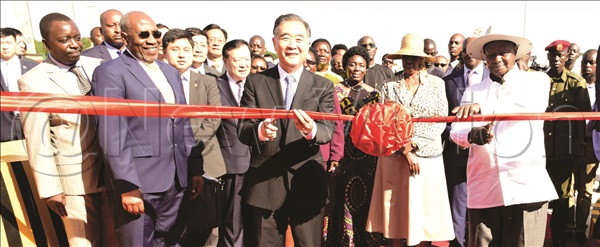
Entebbe Expressway reduces traffic
Still keen on the fast movement of goods and passengers, President Museveni launched the Entebbe Expressway in June 2018. The $476m (1.7 trillion) expressway, a 51km toll road directly links the capital city to the Entebbe International Airport.
The road comprises a 37.23km four lane dual carriageway, connecting the Northern Bypass at Busega, to the existing road at Abayita Ababiri and a 14.13km spur to Munyonyo through Lweza.
According to Museveni, the Government intends to build three more toll roads to help reduce traffi c congestion, as well as earn revenue for government.
"Plans are already in advanced stages to build the Jinja-Kampala express way, Kampala-Bombo and Busega-Mpigi expressways," he said. In 2018, the African Development Bank approved a sovereign loan of $229.5m (sh849b) to fi nance phase one of the Kampala-Jinja Expressway project. Its total project cost is estimated at $1.55b (sh5.735trillion).
The Kampala-Jinja Expressway is the fi rst road project the government is undertaking jointly with the private sector. Museveni said the road is expected to create up to 1,500 jobs during construction and 200 jobs in operation, adding that it is expected to cut the journey time to Jinja by 70 minutes.
He said that project will be carried out in two phases, with the fi rst one being 33km of the Kampala-Jinja mainline commencing at Kampala and terminating at Namagunga and the Kampala Southern Bypass.
"The second phase will be 43.7km of the mainline commencing at Namagunga and terminating at Jinja," he said.