Makerere loses 50 lecturers
Growing up, Julius Mucunguzi always had the desire to teach. So, upon completion of his first degree at Makerere University, he was retained as a lecturer — he was exhilarated.
Growing up, Julius Mucunguzi always had the desire to teach. So, upon completion of his fi rst degree at Makerere University, he was retained as a lecturer — he was exhilarated.
In 2006, however, Mucunguzi got a job with the prestigious Commonwealth Secretariat in London as a communications offi cer. He would miss the classroom, but with the low pay and workload at the university, he had no choice but to bow out.
“It is a question of competitiveness and being able to grow professionally. I think passion is good, but passion without pay
doesn’t feed you,” he says.
He was teaching classes of 80- 800 students and for each hour, he earned sh35,000 before taxes.
“Too much workload, too little time, too little pay,” Mucunguzi observes. As Mucunguzi rushed to catch the next fl ight to London, the
mass communication department was in a dilemma. The students he was supervising had to be allocated to a different supervisor.
In the college of health sciences, one former lecturer who is now working as a doctor in Rwanda tells of how she made a painful decision to leave. She had to teach, attend to patients, supervise students, as well as pursue further studies. “With all the workload, poor pay, I was not still not being promoted,” she laments, “I loved my job, but somehow, I never was recognised. It was demoralising.”
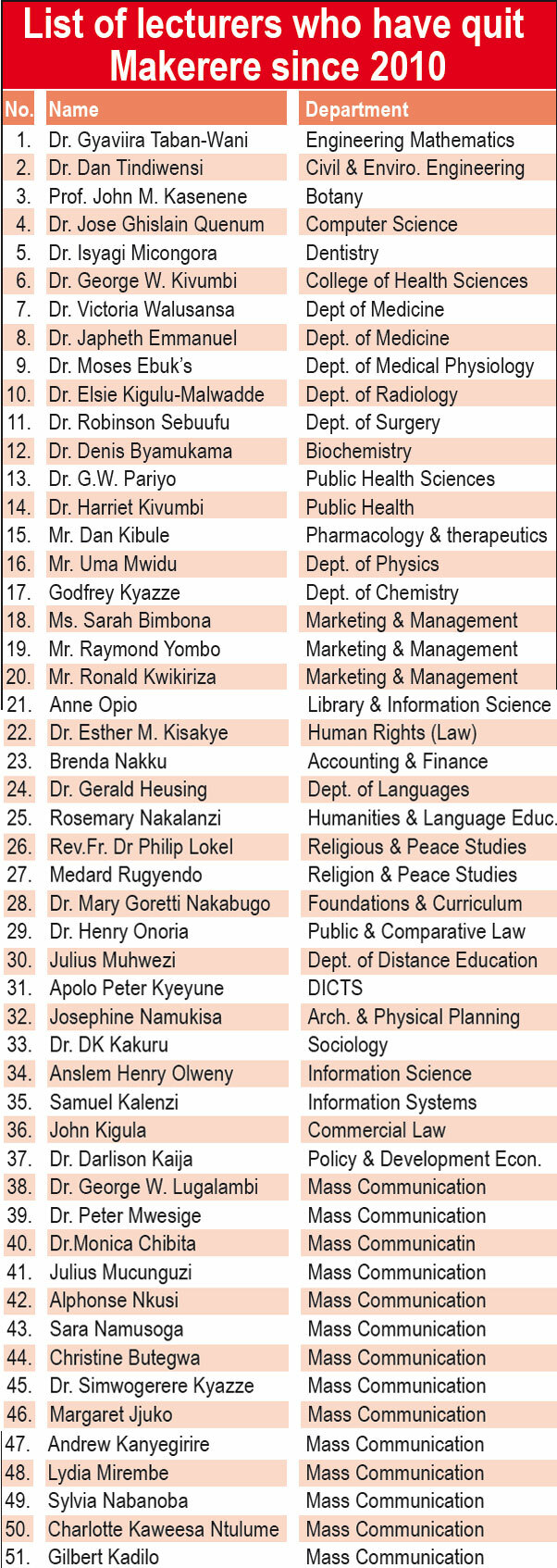
By collecting information from about half the departments in Makerere, Sunday Vision compiled a list of 51 lecturers, who have quit the university since 2010. Some courses, for example the master of journalism and communication, have been closed due to severe staff shortage.
A number of departments have been forced to rely heavily on part-time lecturers.
Aaron Mushengyezi, the head of the journalism and communication programme, says while the university policy is that one must fi le a three-month resignation notice, it is always not easy to shop around for replacements.
“We usually look around for part time staff or ask standby staff to take an extra load,” says Mushengyezi “for an external part-time staff that comes with monetary terms. You have to pay them to come and teach here.”
“Sometimes, if we do not get a replacement immediately, the students doing their dissertation lose a few months,” he discloses.
Many students tell of how they end up retaking papers or having missing marks partly because the lecturers had to switch jobs.
“You do your tests and coursework, but the results go missing. When you try to follow up you are told, your lecturer is in now working in the States. We are retaking papers for nothing and missing out graduation in time!”
laments Alex, a bachelor of commerce student. Another student of economics tells of how she is always told by her part-time lecturer to fi nd her at her consultancy bureau on Lumumba Avenue. “Unlike fulltime lecturers, my supervisor does not have an offi ce at the campus. So, for each chapter that I do, I have to follow her up to her offi ce.”
“She has no time to discuss my work because she is attending to her other business clients,” she says.
In his book Scholars in the Market Place, Prof. Mahmood Mamdani echoes that part-time staff are motivated by monetary
gain, which compromises service delivery. He cites instances where the part-time staff delayed student’s results or were reluctant to mark scripts depending on if they were paid or not.
Mamdani also revealed that increasingly, Makerere is relying on junior staff who can accept low pay, which compromises the quality of education.
However, there are lecturers who have endured the test of time. “I would be in the London School of Humanities by now,” reveals Dr. Tanga Odoi, who says family attachments prevented him from getting a job abroad.
Prof. Augustus Nuwagaba, a senior economist and development expert says: “I do teaching as a passion not for money.
Some of us have stayed because we want to build the image of the university.” Both Odoi and Nuwagaba concur that for brain to stop, there must be a deliberate policy to increase lecturers’ salaries. Currently, a professor earns sh1.8m per month. “Even a driver in Bank of Uganda earns sh4m!” says Nuwagaba.”
Odoi says lecturers earn an equivalent of sh6m in Kenya and sh7.2m in Tanzania per month.
“We have highly specialized lecturers. If you do not pay them well, what do you expect?
Rwanda is in fact taking the lead, taking most of our people,” says Tanga.
Vice-chancellor Prof. Venansius Baryamureeba recently expressed optimism that better remuneration would reduce the brain drain. Currently, Makerere University has 74 professors and 150 associate professors. A university should have at least 60% of its staff as PhD holders, and less than 10% is unacceptable, according to NCHE standards.
“We do not want to continue losing our staff due to low salaries. It is important that the Government provides better pay to staff in universities just like it has done for other statutory agencies,” he said.
The state minister for higher education, Dr. John Muyingo says: “The Government is committed to improving the lecturers’ welfare and the problem is really not grave.”
“The ideal situation for any employer, including the Government, is that you retain all your employees. However, the reality is that staffs, in any institution, are always on the lookout for better terms and greener pastures.”
“In some instances, as it’s in vogue today, the impetus is change of career or advanced studies for career development,” Muyingo commented.