
Reza Pahlavi: Iran's ex-crown prince dreaming of homecoming
The chant of "Pahlavi will come back!" has become a mantra for many of the protesters, while the US-based 65-year-old has urged nightly actions in video messages.
Iranian opposition leader and son of the last shah of Iran Mohammad Reza Pahlavi, Reza Pahlavi holds a press conference in Paris on June 23, 2025. (AFP photos)
________________
PARIS — Reza Pahlavi, who as a boy was groomed to be the next shah of imperial Iran but has spent nearly five decades in exile, has emerged as a rallying figure in the protests shaking the Islamic republic.
The chant of "Pahlavi will come back!" has become a mantra for many of the protesters, while the US-based 65-year-old has urged nightly actions in video messages.
Pahlavi's prominence in the protest movement has surprised some observers.
Pahlavi has during the latest protest wave shown an "ability to turn out Iranians in the streets," said Jason Brodsky, policy director at the US-based group United Against Nuclear Iran.
"There have been clear pro-Pahlavi chants at the protests. Does that mean every Iranian protesting wants a return of the monarchy? No, but there is a nostalgia for the Pahlavi era that has been building for some time," he added.
In an interview with Fox News on Sunday, Pahlavi said he was "prepared to return to Iran at the first possible opportunity".
He has not set foot in his home country since before the Islamic revolution that ousted his father, Mohammad Reza Pahlavi, in 1979 and ended thousands of years of monarchy dating back to Cyrus the Great, the founder of the Achaemenid empire, and beyond.
'Seems a nice person'
Reza Pahlavi was outside Iran at the time of the revolution, after leaving in the summer of 1978, aged 17, for military pilot training in the United States.
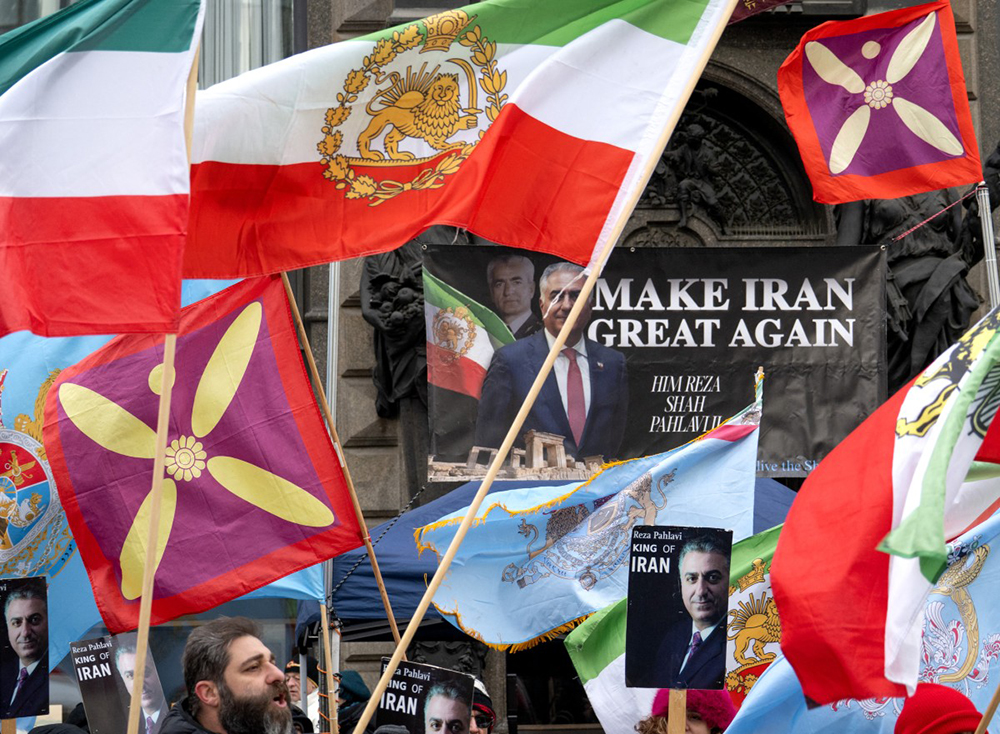
Protesters hold up placards featuring Reza Pahlavi, an Iranian dissident in exile in the United States and son of the last shah of Iran, during a demonstration against the Iranian government at Stephansplatz square in Vienna, Austria on January 11, 2026.
His father died in Egypt in 1980, although his mother, former empress and the shah's third wife Farah, now 87, is still alive.
Clement Therme, a non-resident fellow at the International Institute for Iranian Studies, said Pahlavi had not been tainted by the excesses of the imperial rule because he left in his late teens.
"He is a symbol. His name is well-known," Therme said, describing Pahlavi as the "main popular opposition figure" within and outside of Iran.
Pahlavi has always insisted he does not intend to be crowned king of Iran but is ready to lead a transition towards a free and democratic country.
But he remains a polarising figure -- even within Iran's divided opposition.
While swift to condemn the repression that has marked the history of the Islamic republic, he has never distanced himself from his father's autocratic rule, which was harshly enforced by the dreaded SAVAK secret police.
An attempt to unify the fractious opposition during previous protests in 2023 immediately triggered tensions and ended in acrimony when Pahlavi made a highly publicised visit to Israel that wasn't coordinated with allied groups.
Pro-Pahlavi accounts on social media have for years energetically attacked other opposition figures, with monarchists sparring with supporters of Nobel Peace Prize winner Narges Mohammadi, who is currently in prison in Iran.
"Pahlavi has many supporters in Iran and his popularity has increased in recent days as he is seen as the only nationally known opposition leader with something of a plan to confront the regime," said Arash Azizi, a lecturer at Yale University.
"But his supporters are still a minority in a highly divided country and a highly divided opposition scene. Instead of working to unify the opposition, most of his camp in recent years have helped alienate others and actively oppose them."
He has also yet to win international recognition as an alternative leader for Iran -- even in the current situation.
"I've watched him, and he seems like a nice person, but I'm not sure it would be appropriate at this point to do that (meet him) as president," US President Donald Trump said last week.
'Galvanise a nation'
As well as witnessing the downfall of his father, Reza Pahlavi has endured family tragedy.
In June 2001, his younger sister Leila was found dead in a London hotel room. An inquest later found that the former princess, who for years had reportedly suffered from depression and an eating disorder, had taken a fatal cocktail of prescription drugs and cocaine.
And in January 2011, his younger brother Ali Reza shot himself dead at his home in Boston in a suicide the family said came after he had "struggled for years to overcome his sorrow" over the loss of his homeland, father and sister.
He has one surviving full sibling, his sister Farahnaz, who also lives in the United States but keeps a far lower profile, as does his half-sister Shahnaz whose mother was the shah's first wife Fawzia.
"The end of the regime is near... this is our Berlin Wall moment," he told AFP in June while on a visit to Paris.
"I am stepping in to lead this transition. I don't believe I need a title to play that role. The important thing is to be someone who can galvanise a nation."