
On Ukraine front, married medics face war side by side
The couple navigated their small surgery together and treated the groaning serviceman, following a closely choreographed routine perfected over years of working shoulder-to-shoulder throughout Russia's invasion.
Ukrainian combat medic Anastasia Podobailo, with her colleague and husband Mykola Yasinenko pose for a portrait at a stabilisation point of the 56th brigade, where they serve, in the eastern Donetsk region, on March 15, 2026, amid the Russian invasion of Ukraine. (Photo by Roman PILIPEY / AFP)
___________________
While Ukrainian combat medic Anastasia Podobailo cleaned blood from a wounded soldier's arm and called him "little bun", her colleague and husband Mykola Yasinenko checked the patient's intravenous drip was flowing.
The couple navigated their small surgery together and treated the groaning serviceman, following a closely choreographed routine perfected over years of working shoulder-to-shoulder throughout Russia's invasion.
"We know our strengths, and, well, our not-so-perfect sides," 27-year-old Podobailo told AFP at their military field hospital in the eastern Donetsk region.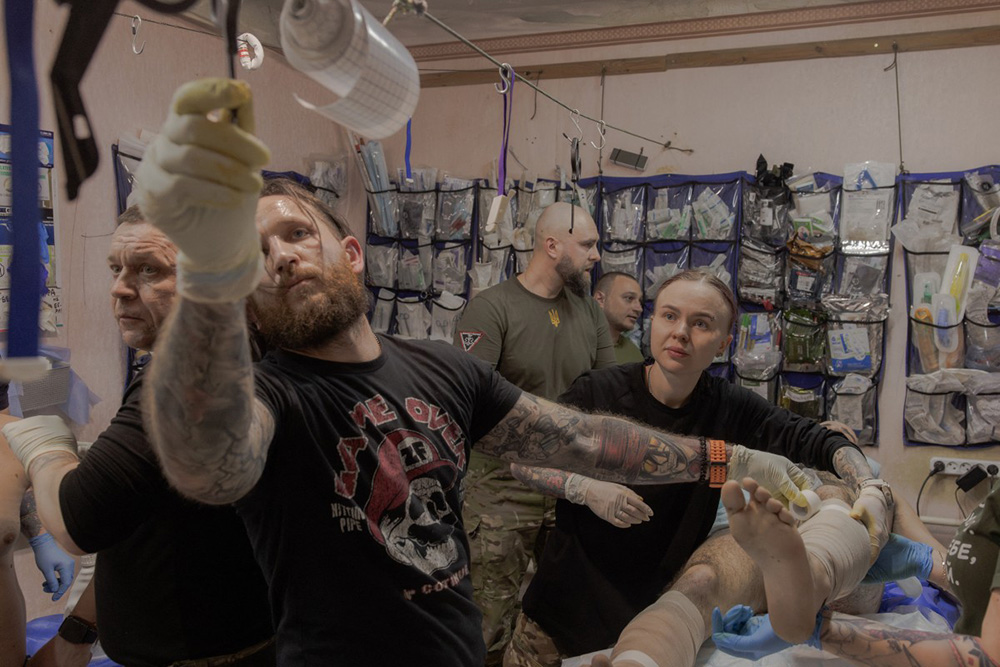
Ukrainian combat medic Anastasia Podobailo (R), with her colleague and husband Mykola Yasinenko (2nd L) and other military medics treat an injured soldier of the Ukrainian army, at a stabilisation point of the 56th brigade, in the eastern Donetsk region, on March 15, 2026, amid the Russian invasion of Ukraine. (Photo by Roman PILIPEY / AFP)
"We've worked together for so long, we hardly need to communicate -- except by looking at each other," added Yasinenko, 31.
The effort to hold back Russian troops has permeated into all areas of life in Ukraine such that family members and couples like Podobailo and Yasinenko are serving together, finding solace from grief and exhaustion.
The pair, working in the 56th brigade, met in 2021, just before the beginning of Russia's full-scale invasion.
Yasinenko, a native of the port city of Mariupol now occupied by Russia, was posted to the base where Podobailo, from northeastern Kharkiv, was stationed.
"We understood who we were choosing right from the start. It's hard to wear a mask at war," Yasinenko said, recounting the early days of their relationship and the beginning of the fighting.
In the high-stakes work environment, their personalities complement each other.
Yasinenko, with tattooed arms, is reserved.
Podobailo, they both agreed, has a more open personality, and her smaller stature and soothing voice make her a calming presence in the surgery, particularly among troops rendered aggressive from shock.
'You keep the pain inside'
At the "stabilisation point" where they serve, the two sleep on bunk beds in a room next to the surgery shared with other colleagues.
Podobailo has crowded her top bunk with fluffy toys and decorated it with posters of capybaras -- her favourite animal and also her military nickname.
Yasinenko sleeps below -- close enough to reach up to his wife.
Together, they spend several days at the stabilisation point before rotating out for break for another several days. They could still be called to respond to Russian attacks, however.
"I constantly keep an eye on the car, on the bags, where I am, what I'm wearing. It has sort of become an obsession," Yasinenko said.
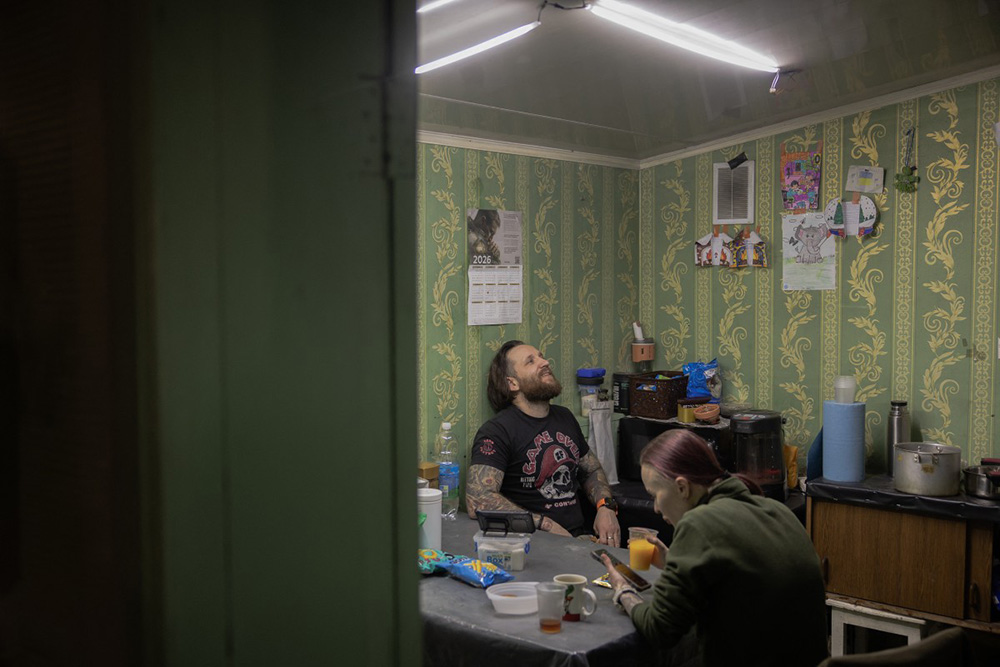
Ukrainian combat medic Anastasia Podobailo (R), with her colleague and husband Mykola Yasinenko rest and eat after treating an injured soldier of the Ukrainian army, at a stabilisation point of the 56th brigade, in the eastern Donetsk region, late on March 15, 2026, amid the Russian invasion of Ukraine. (Photo by Roman PILIPEY / AFP)
Last autumn, they were able to properly unwind and reflect.
Yasinenko, Podobailo and about 40 other medics joined a 10-day "Repower" retreat in Ukraine's western Carpathian Mountains, where AFP first met them.
The retreat was designed to help medics process the immense psychological burden of the work.
"I've had soldiers whose last words were that they wanted another child, that they loved their wives," Podobailo told AFP at the retreat last year.
She said that people she knew had been killed on the front, too.
"You keep the pain inside, you live with it," she said.
There are no official statistics on the number of medics killed in the war, but Ukrainian President Volodymyr Zelensky has said that 55,000 of his soldiers have been killed -- a toll widely believed to be an underestimate.
'As screwed up as you'
One afternoon, Podobailo and Yasinenko joined the group for a concert in an auditorium whose huge bay windows overlooked fog-covered mountains.
One by one the group began a circle dance, with Podobailo and Yasinenko twirling until they collapsed into each other's arms.
"You feel free here and comfortable because everyone is like you," Podobailo said.
"You realise there are people as screwed up as you," said Yasinenko.
Russian forces have battered Podobailo's hometown, occupied Yasinenko's and also captured places important to their relationship.
Karlivka, an eastern Ukrainian village, where they started dating, has been under Russian control for nearly two years.
The village where Podobailo rejected Yasinenko's marriage proposal -- before changing her mind and proposing back to him, with an awkward speech that still makes both giggle -- has also fallen.
"If we ever have children, I'll be able to show them some maps, the town where we met, where we got together and where we took turns proposing to each other," Podobailo said.
"But I won't be able to take them there."
She said it was as if Russian forces had taken some of her own personal history along with the territory they wrested.
"Time erases your memories, no matter how vivid they were, it all fades away," she said.
"I try not to forget."