
World
Oman port and tanker hit as Iran strikes Gulf
On Sunday morning, AFP correspondents heard blasts in Dubai, Doha and Manama as Iran carried out attacks in response to US and Israeli strikes that killed the country's supreme leader and other top officials.
A plume of smoke rises from a reported Iranian strike in the industrial district of Doha on March 1, 2026. (AFP)
By: AFP ., Journalist @New Vision
_____________
MUSCAT — An Oman port and an oil tanker off its coast were attacked Sunday, official media said, marking the first strikes on the sultanate, which mediated US-Iran talks, since Tehran launched a retaliation campaign.
On Sunday morning, AFP correspondents heard blasts in Dubai, Doha and Manama as Iran carried out attacks in response to US and Israeli strikes that killed the country's supreme leader and other top officials.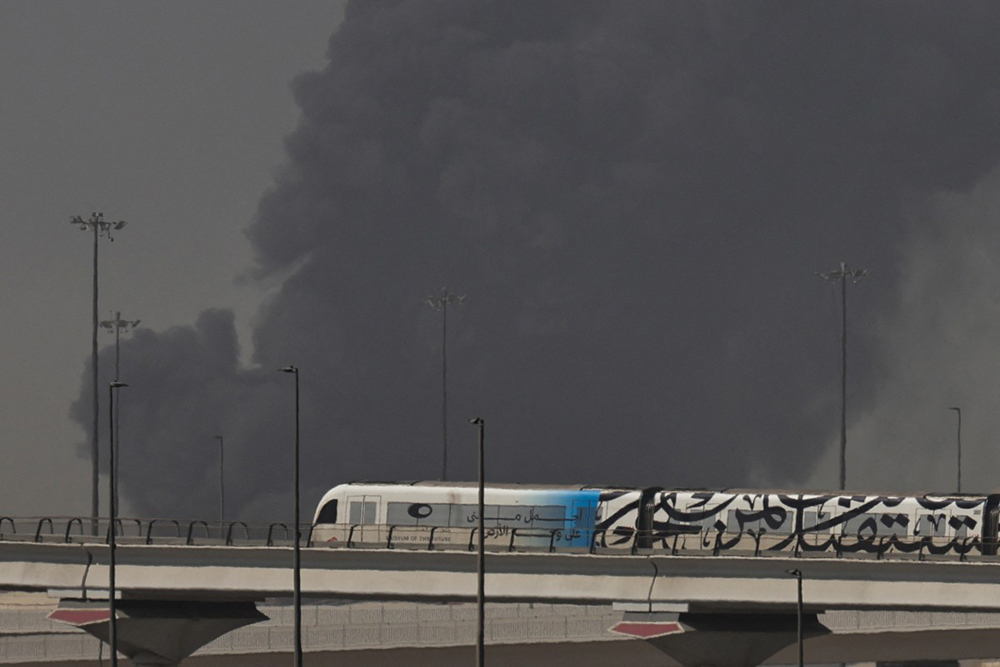
A metro train passes a plume of smoke rising from the port of Jebel Ali following a reported Iranian strike in Dubai on March 1, 2026. (AFP)
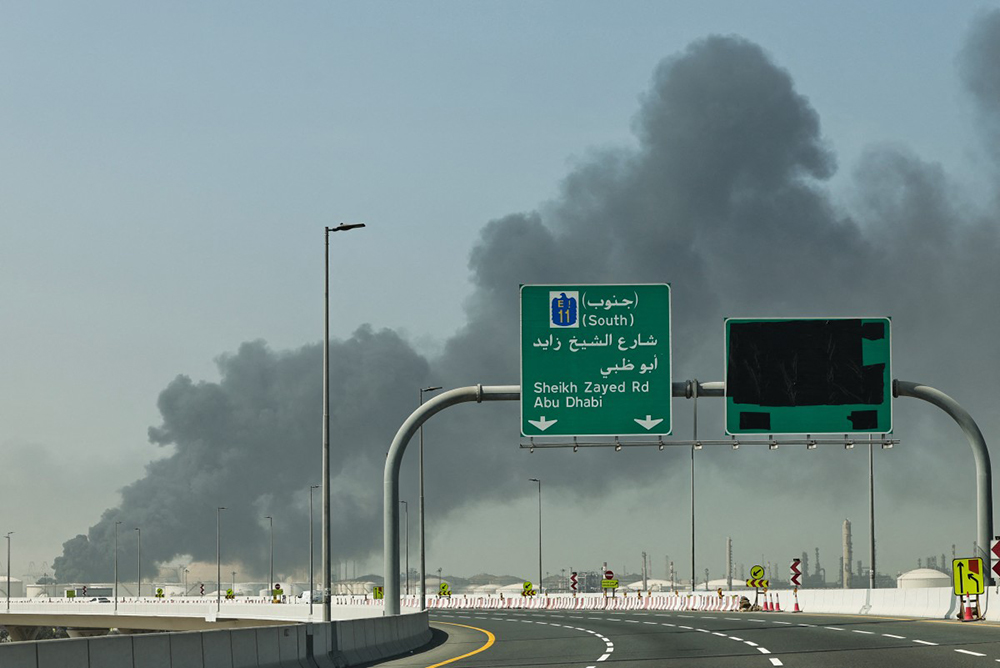
A plume of smoke rises from the port of Jebel Ali following a reported Iranian strike in Dubai on March 1, 2026. (AFP)
Iran's Gulf bombardment has raised fears of a wider conflict and rattled a region long seen as a haven of peace and security in the turbulent Middle East.
"A security source reported that the commercial port of Duqm was targeted by two drones," the Oman News Agency said in a social media post.
"One drone struck a mobile workers' accommodation, injuring one foreign worker, while debris from the other landed near fuel tanks, causing no casualties or material damage," it added.
Shortly after, Oman said an oil tanker was targeted off the coast. Its crew was evacuated, and four of them were injured, the news agency reported.
The second day of strikes comes on the heels of deadly attacks, with two civilians killed in the UAE capital Abu Dhabi as Iran targeted military bases but also civilian infrastructure across the Gulf on Saturday.
The UAE's presidential adviser, Anwar Gargash, lashed out at Tehran, calling the attacks on the Gulf states a miscalculation.
"It isolated Iran at a critical juncture. Your war is not with your neighbours," said Gargash.
"Return to reason, to your surroundings, and deal with your neighbours rationally and responsibly before the circle of isolation and escalation widens."
Earlier Sunday, AFP reporters heard blasts in Dubai, the Bahraini capital Manama and in Qatar, where thick black smoke was seen rising on the clear morning horizon in the south of Doha.
Two people were injured when debris from intercepted drones fell on homes in Dubai, authorities said, and waves of blasts reverberated through Dubai and Doha later in the morning.
And in the UAE capital Abu Dhabi, a woman and child were injured after debris from an intercepted drone collided with a building facade at Etihad Towers, according to the Abu Dhabi Media Office.
An AFP correspondent also saw thick black smoke rising from Dubai's southern Jebel Ali Port on Sunday morning, after authorities said debris from an interceptor had sparked a fire overnight.
The UAE's presidential adviser, Anwar Gargash, lashed out at Tehran, calling the attacks on the Gulf states a miscalculation.
"It isolated Iran at a critical juncture. Your war is not with your neighbours," said Gargash.
"Return to reason, to your surroundings, and deal with your neighbours rationally and responsibly before the circle of isolation and escalation widens."
Earlier Sunday, AFP reporters heard blasts in Dubai, the Bahraini capital Manama and in Qatar, where thick black smoke was seen rising on the clear morning horizon in the south of Doha.
Two people were injured when debris from intercepted drones fell on homes in Dubai, authorities said, and waves of blasts reverberated through Dubai and Doha later in the morning.
And in the UAE capital Abu Dhabi, a woman and child were injured after debris from an intercepted drone collided with a building facade at Etihad Towers, according to the Abu Dhabi Media Office.
An AFP correspondent also saw thick black smoke rising from Dubai's southern Jebel Ali Port on Sunday morning, after authorities said debris from an interceptor had sparked a fire overnight.
Early Sunday, drones also struck the airport in Bahrain's capital, Manama, causing minor damage, authorities said.
Palm, Burj Al Arab
On Saturday, Iran fired 137 missiles and 209 drones at targets across the UAE, the defence ministry said, with fires and smoke seen at landmarks such as The Palm seafront development and Burj Al Arab hotel.
At the airport in Abu Dhabi, at least one person was killed and seven wounded during what authorities called an "incident".
Dubai airport, the world's busiest for international traffic, and Kuwait's airport were also hit.
Earlier on Saturday, falling debris killed a Pakistani civilian in Abu Dhabi, officials said.
In Qatar, host of the region's biggest US military base, officials said Iran had launched 65 missiles and 12 drones towards the Gulf state, most of which were intercepted, but eight people were injured, with one in critical condition.
On the first day of the strikes, Saturday, smoke rose from US bases in Abu Dhabi and Manama, home of the American navy's Fifth Fleet, witnesses said, with US bases also targeted in Kuwait.
The oil-and-gas-rich Arab monarchies, lying just across the Gulf from Iran, are long-term American allies and host a clutch of US military bases.
In Manama, the Iranian attacks saw drones and shrapnel slam into residential buildings, while Saturday's unprecedented barrage also targeted Riyadh and eastern Saudi Arabia.
Palm, Burj Al Arab
On Saturday, Iran fired 137 missiles and 209 drones at targets across the UAE, the defence ministry said, with fires and smoke seen at landmarks such as The Palm seafront development and Burj Al Arab hotel.
At the airport in Abu Dhabi, at least one person was killed and seven wounded during what authorities called an "incident".
Dubai airport, the world's busiest for international traffic, and Kuwait's airport were also hit.
Earlier on Saturday, falling debris killed a Pakistani civilian in Abu Dhabi, officials said.
In Qatar, host of the region's biggest US military base, officials said Iran had launched 65 missiles and 12 drones towards the Gulf state, most of which were intercepted, but eight people were injured, with one in critical condition.
On the first day of the strikes, Saturday, smoke rose from US bases in Abu Dhabi and Manama, home of the American navy's Fifth Fleet, witnesses said, with US bases also targeted in Kuwait.
The oil-and-gas-rich Arab monarchies, lying just across the Gulf from Iran, are long-term American allies and host a clutch of US military bases.
In Manama, the Iranian attacks saw drones and shrapnel slam into residential buildings, while Saturday's unprecedented barrage also targeted Riyadh and eastern Saudi Arabia.