
Hungary prepares to vote as Orban's future hangs in balance
US Vice President JD Vance is set to visit Budapest on Tuesday and hold a rally with Orban.
The National Petition and Fidesz Party posters are seen on the building in Zagyvapalfalva, Hungary on April 1, 2026. (AFP)
______________
BUDAPEST — EU member Hungary will hold a closely watched general election on Sunday, the first since nationalist Prime Minister Viktor Orban's return to power in 2010, where he is not considered the clear favourite.
Surveys from independent pollsters suggest that opposition leader Peter Magyar's conservative TISZA party could be heading for a landslide victory. Pro-government institutions, however, forecast a win for Orban's Fidesz-KDNP coalition.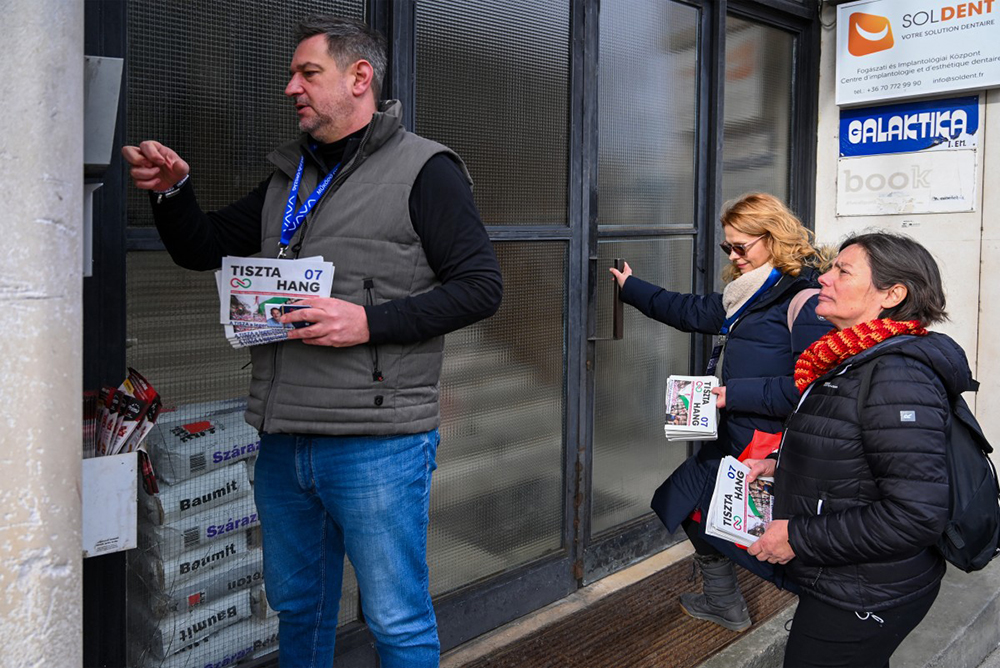
(FILES) Volunteers distribute the opposition TISZA party's newspaper TISZTA Hang (Clean Voice) to households in Budapest on February 14, 2026, two months ahead of the general election. (AFP)
Analysts expect a record turnout of around 75-80 percent.
In the lead up to the April 12 vote, there has been a flurry of accusations and counter-accusations.
Domestic intelligence was accused of trying to sabotage TISZA, leaked phone conversations caused alarm about the foreign minister's close relations with Moscow, and Orban ramped up his rhetoric against Ukraine.
Allegations of Russian interference and mass vote-buying efforts have also surfaced.
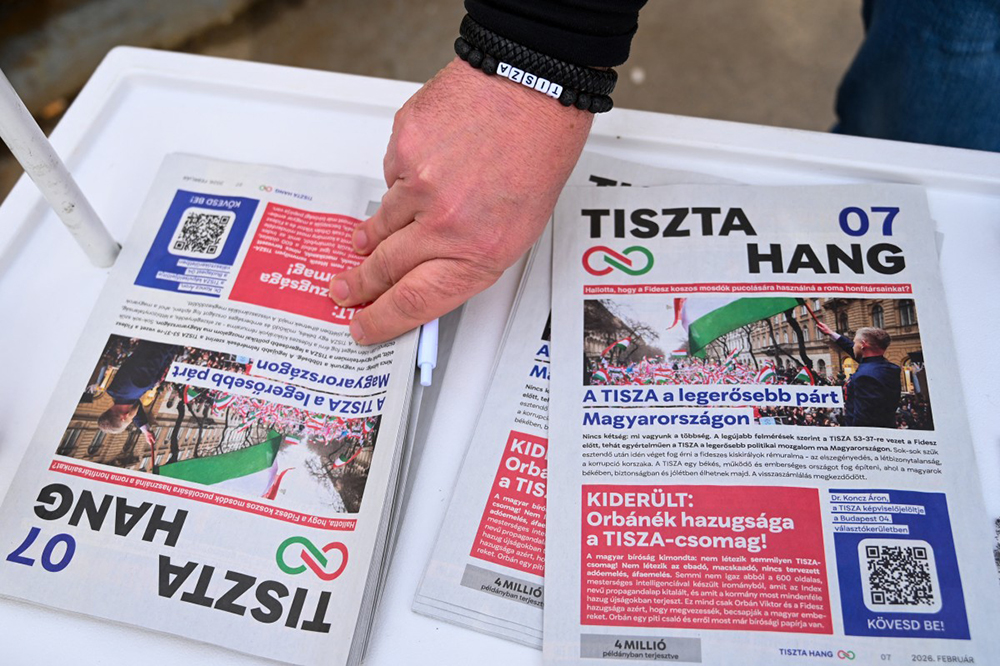
(FILES) The opposition TISZA party's newspaper TISZTA Hang (Clean Voice) is on display at an electoral campaign booth in the streets of Budapest on February 14, 2026, two months ahead of the general election. (AFP)
On Sunday, after Orban called an emergency meeting following Serbia's announcement that they had found explosives near a gas pipeline to Hungary, Magyar suggested it might be a "false flag" operation.
The election is drawing international attention because Orban has a "disproportionate importance" globally, said Jacques Rupnik, a specialist in central and eastern European politics at the Sciences Po university in Paris.
The nationalist, who is close to Russia, China and the United States under President Donald Trump, has regularly paralysed EU foreign policymaking by wielding Hungary's veto power.
His re-election bid has been endorsed by fellow right-wing leaders from around the globe, including Trump.
US Vice President JD Vance is set to visit Budapest on Tuesday and hold a rally with Orban.
For foreign observers, said Rupnik, the main issue is whether Hungary continues to be "lenient" towards Russia under Orban or with the election of Magyar moves "to re-establish relations with the European Union".
Campaign
While Orban's popularity has waned during his latest four-year term amid economic stagnation and high-profile scandals, he is presenting himself as the "safe choice" in a turbulent world.
His messaging has focused on neighbouring Ukraine, accusing Magyar of being puppet of Kyiv and the European Union, which he argues threatens to involve Hungary in the war.
Analysts argue, however, that, unlike previous elections, the governing coalition has not been able to dictate the campaign's priorities.
Instead, they "face a highly effective opposition that forced the complacent ruling party and its leader not only to compete but also to defend themselves", political analyst Peter Farkas Zarug told AFP.
Magyar has pledged a "system change", cracking down on corruption, fixing public services, and rebuilding democratic institutions.
He chose "Now or never" as his campaign slogan, a historic rallying cry of Hungarian revolutionaries.
The 45-year-old former government insider has been criss-crossing Hungary continuously since mid-February, holding four to six rallies a day.
The 62-year-old premier, meanwhile, did just one or two public gatherings per day from mid-March, and was recently met with audible boos from protesters.
Just five parties
On Sunday, Hungarians will vote for local candidates and parties.
Only five parties will be listed -- the fewest since Hungary's democratisation in 1990, after several stood down to bolster the opposition.
In addition to the two big blocs, the far-right Our Homeland party is also anticipated to win seats in the 199-member National Assembly.
Many voters in Budapest told AFP they had already made up their minds.
Mate Dobai, a 35-year-old IT engineer, said he was satisfied with Orban's policies.
"I commend his pro-peace position in Ukraine, because I find the war pointless," he said. "People are dying, and the front line is stagnant."
Andrea Simon, a 57-year-old florist said she planned to vote for TISZA, displeased with Orban's tenure.
"I'm a business owner. Taxes and contributions are increasing month-by-month, and I have hardly any customers, because people are getting poorer even in this affluent town," she said.
Concerns
Orban's critics have accused him of tweaking electoral law and leveraging state resources to help his party's campaign.
A documentary published last month alleged the ruling coalition planned to pressure about 500,000 of Hungary's most impoverished people to vote for them.
NGOs also raised the alarm about the possible manipulation of mail-in ballots by Hungarians living abroad, which are collected by Fidesz-allied parties in Romania and Serbia.
The Organisation for Security and Cooperation in Europe (OSCE) has, for the second time in a row, deployed a full observers' mission for Hungary's general election.
But the OSCE has faced criticism for giving Russian President Vladimir Putin's former interpreter a coordinating role in the mission.