
Belgian museum blocks US firm's access to DRC mining files
The museum, which until 2018 was called the Royal Museum for Central Africa, has disclosed that it turned down a request from a US company suspected of wanting to monetise the data.
This photograph shows drawers in the geological archives of the Royal Museum for Central Africa in Tervuren, near Brussels on February 12, 2026. (Credit: AFP)
BRUSSELS - Belgium's AfricaMuseum is the country's biggest dedicated to the Congo, displaying millions of colonial-era objects and zoological specimens.
But it also holds the archives from the 1960s and 70s of Belgian companies that ceased operations in the former colony, including geological maps.
Now, with a race for rare earths gathering pace across the globe, the institution is grappling with the question of whether it should share them with the mining sector.
The museum, which until 2018 was called the Royal Museum for Central Africa, has disclosed that it turned down a request from a US company suspected of wanting to monetise the data.
"We cannot allow a private company, which may have commercial interests, to get hold of an entire archive collection," AfricaMuseum director Bart Ouvry told AFP.
"That would be against our ethics as a scientific institution," he said on Thursday.
The request from the firm, KoBold Metals, was made about six months ago and involved access to a large quantity of data on the Congolese subsoil in order to digitise it, Ouvry explained.
Belgium is the former colonial power in Congo, which became independent in 1960 and is now called the Democratic Republic of Congo.
According to Ouvry, the museum's geological archive runs to "half a kilometre", and the institution intends to digitise and make it public in the next four to five years, as part of a partnership with the DRC, backed by funding from the European Union.
Private interests controlling the archive is not a matter solely for the museum or the Belgian state, because the DRC authorities are also involved.
"We want to share these archives first with our Congolese partner, which is the national geological service, because ultimately, the question of mining exploration and economic development is the responsibility of the Congolese government," said Ouvry.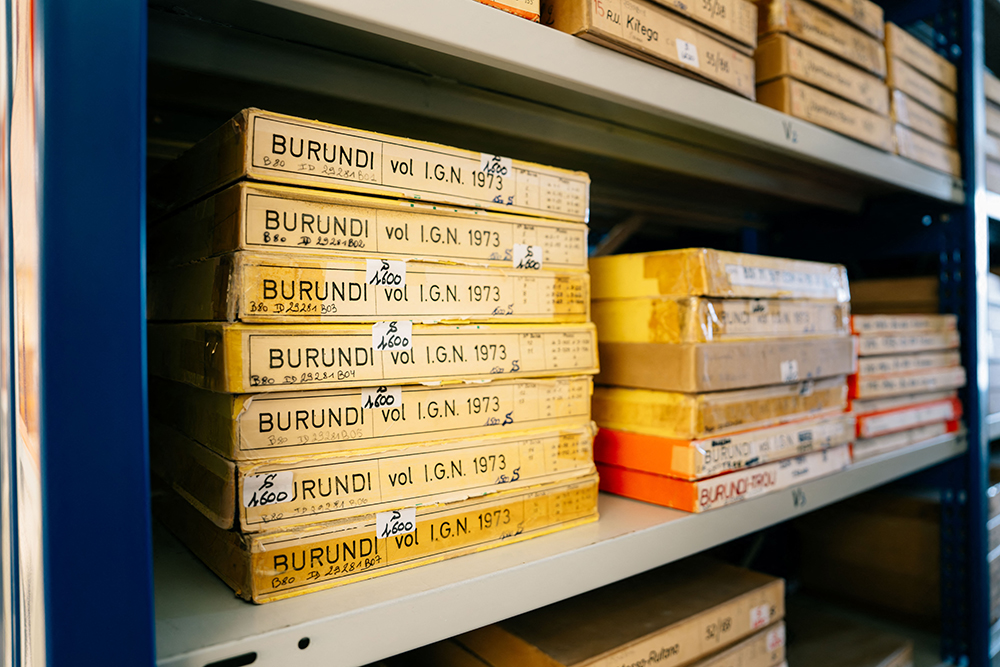
This photograph shows boxes in the geological archives of the Royal Museum for Central Africa in Tervuren, near Brussels on February 12, 2026. (Credit: AFP)
Bezos, Gates and minerals
The Belgian government is singing from the same hymn sheet.
"Belgium cannot grant privileged and exclusive access to a foreign private company with which it has no contractual link, which would affect research and public consultation," said Digital Minister Vanessa Matz, whose brief includes federal scientific institutions.
In the background lies the question of the supply of minerals essential for industry.
The DRC, one of the 15 least-developed countries in the world, has some of the richest land on the planet, notably in copper, cobalt, coltan and lithium, which are used in components for weapons, mobile phones and electric cars.
Last summer, KoBold Metals, a US start-up using artificial intelligence to discover mineral deposits, especially lithium, signed a large-scale exploration agreement with the DRC.
The company, backed by US tech billionaires Jeff Bezos and Bill Gates, also obtained approval from the authorities in the DRC to exploit its valuable mining database.
Asked by AFP on Thursday about an alleged dispute with the AfricaMuseum, the office of Congolese Mines Minister Louis Watum did not respond immediately.
But Watum was quoted as saying in the Financial Times on Wednesday that he wanted to speed up the sharing of Belgian data, and said he had given instructions to that effect to the country's geological service.
"They gave me very positive feedback so there's no need for me to push further," he told the British daily.
At an African mining sector conference in Cape Town on Wednesday, Watum rejected accusations he had "sold off" the DRC's mining potential to the United States under a recent agreement between the two countries.