
As some hijabs come off in Iran, restrictions still in place
Wearing the headscarf in public has been mandatory for women since shortly after the Islamic Revolution of 1979, in what was long seen as an ideological pillar of the clerical leadership.
Iranian women walk along a busy street in Tehran on April 25, 2026. (Photos by AFP) /
________________
PARIS — Images of bareheaded women sipping coffee in cafes in Tehran, in apparent defiance of the Islamic Republic's strict dress rule, have stirred interest outside Iran, but for Elnaz, 32, it is no breakthrough.
"It is not at all a sign of any change in the government in my opinion. Because no achievement has been made regarding women's rights," said Elnaz, a painter in Tehran, who, like other women in the capital and elsewhere contacted by AFP in Paris asked that her full name not be published.
"Under the surface, in reality, no real change has taken place in people's freedom, especially when it comes to women's basic rights," she said.
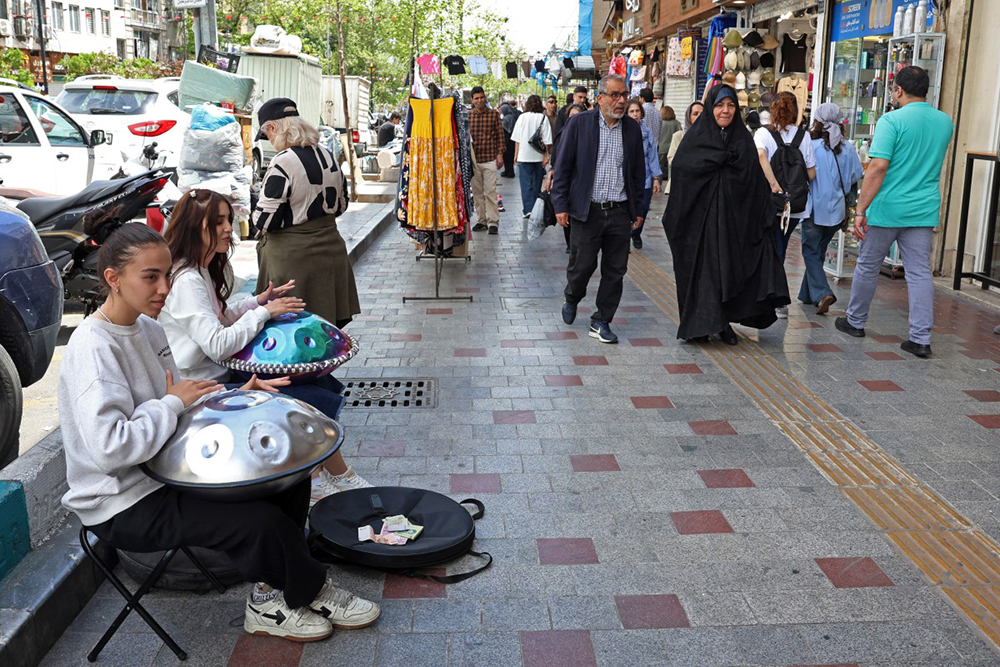
Iranian street musicians perform along a street in Tehran on April 25, 2026.
Wearing the headscarf in public has been mandatory for women since shortly after the Islamic Revolution of 1979, in what was long seen as an ideological pillar of the clerical leadership.
But enforcement of the rule appears to have slackened, at least in parts of Tehran and other cities.
The trend began following the 2022-2023 protests sparked by the death in custody of Mahsa Amini, who had been arrested in Tehran for allegedly ignoring the dress code.
It continued through the June 2025 war with Israel, January protests sparked by the cost of living and now the war against the US and Israel that is on hold with a ceasefire.
There is little sign of the dreaded white patrol vans of the so-called morality police that used to lurk in squares and on street corners to haul in women deemed to have violated the rules.
But the picture remains mixed and the situation evolving, with wearing hijab still a matter of choice for some women. It is not uncommon, even in more liberal areas of Tehran, to see women with and without the headscarf walking together.
Years ago 'only a dream'
"I'm happy for all of them, because until just three years ago this was only a dream," said Zahra, 57, a housewife from Isfahan in central Iran.
"My youth has passed, and I didn't get to have this experience; now I don't wear it anymore, but I wish I could have experienced these days when I was young."
But women can still be summoned by authorities for not wearing hijab, and cafes shut down for failing to enforce the rule, while often women must wear the garment to enter banks, educational establishments and official buildings.
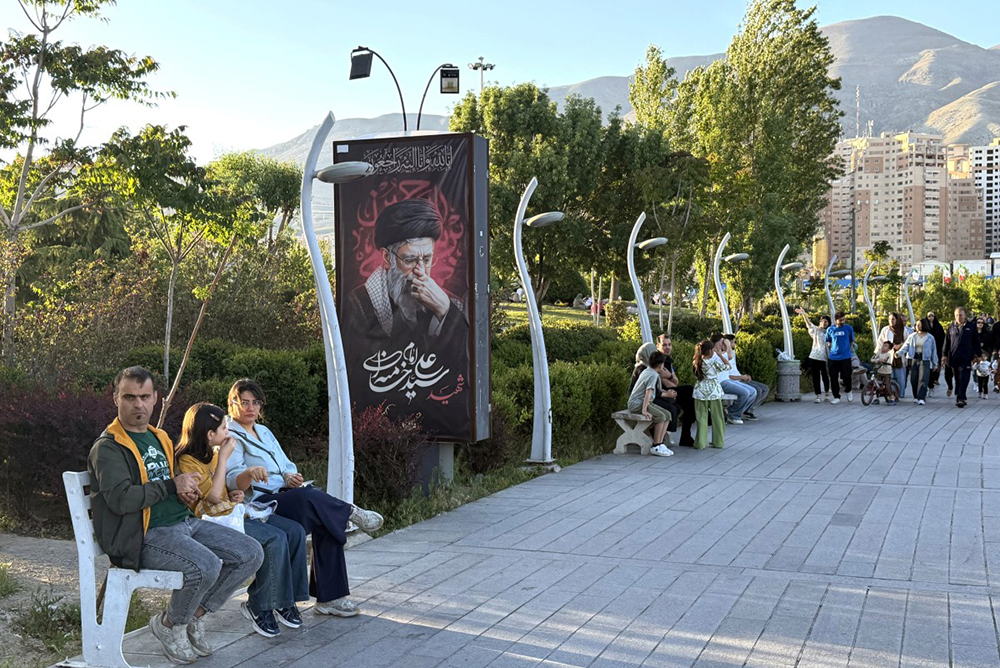
A banner reading “Martyr Ayatollah Ali Khamenei” is displayed along the walkway at Chitgar Lake, an artificial recreational lake and park officially known as the Lake of the Martyrs of the Persian Gulf, in northwestern Tehran on April 26, 2026.
Moreover, the rights of women are still restricted, and they live under a system that has arrested tens of thousands of people following the January protests and thousands more, including women, in the current war, according to rights groups.
"Beautiful photos of cafes and girls are being shared everywhere, but as cafe owners, we've been paying a lot for that," said Negin, 34, who owns a cafe in Tehran.
"We've been treated very harshly over these years, continuing until this day. We've been shut down multiple times, fined and had to pay bribes... What makes me even angrier is when they call this 'freedom', and they say women are being freer," she added.
'More widespread'
Amnesty International said this month that "widespread resistance" to the obligatory hijab "forced authorities to retreat from the violent mass arrests and assaults of previous years".
"However, authorities continued to use existing laws and regulations to enforce compulsory veiling in workplaces, universities and other public sector institutions, leaving women and girls who resisted facing harassment, assault, arbitrary arrest, fines and expulsion from employment and education," it added.
One noticeable change has been state television broadcasting images of Iranian women not wearing hijab -- but only so long as they back the Islamic Republic and denounce Iran's enemies in what critics see as a cynical ploy.
"But I don't see any change in the government system. It's the same as before, aside from those videos of girls going in front of state news cameras without hijab and saying 'my leader, my leader, I will sacrifice myself for him'."
'Don't see any significant change'
The situation is far from uniform across Iran.
Mahsa, a 32-year-old student, said rules and observance are tighter in the major eastern city of Mashhad, home to one of the holiest shrines in Shia Islam.
"Before the 12-day war (against Israel in June), in Mashhad, they wouldn't let us in anywhere without hijab," she said.
"Now they do let people in, but unfortunately, we haven't had the same level of change that people in Tehran have seen over the past three years."
Farnaz, 41 from Isfahan, which is generally seen as one of Iran's more conservative big cities, said she had been summoned to appear in court over hijab observance later this month.
"In Isfahan, for the past few days they've started sealing cafes again over hijab issues. They didn't even wait for the situation with the war to be clarified.
"Here, you're dealing both with the government and with people. Like before in some neighbourhoods, religious people sometimes warn you and harass you. It's not just about the morality police."
"I don't see any significant change," she added.
Maryam, 35, also from Isfahan, said women without hijab would not be served in some banks and shopworkers have to wear it.
"If you are involved in social or economic activity, you are expected to observe hijab."
Zahra, the housewife from Isfahan, said "we paid a very high price to get here", after the crackdown on the Mahsa Amini protests killed hundreds of people according to rights groups.
"Right now, they (the authorities) are just distracted by the war. But after that, who knows what they will do about it," she said.