
Pader, Kitgum ask leaders to fix healthcare, roads, water
“We need the Government to bring back food supplements and build rehabilitation centres with good healthcare so that caring for these children becomes easier,” Abalo said while raising concern that the girls affected by the nodding disease are being sexually abused and abandoned while pregnant.
Pader, Kitgum ask leaders to fix healthcare, roads, water
By Nelson Kiva, Johnisani Ocakacon and Vicente Kaguta
VOTERS’ NEEDS
Kitgum and Pader, like any other districts in Acholi sub-region, suffered the blunt of the Lord’s Resistance Army (LRA) insurgency before the nodding disease syndrome set in. But the sub-region is accelerating to catch up.
The military defeat of the Joseph Kony-led LRA restored peace in not only Acholi sub-region, but also the entire northern Uganda. However, over the past few years, voters said, healthcare-related challenges — such as the nodding disease — have emerged as key concerns that must be fi xed.
Doubled effort to end the health hazard is one of the key voters’ demands in the health sector in Kitgum and Pader districts.
“I have done everything I can to care for my two children suffering from nodding disease, but it breaks my heart watching them suffer without food or medicine. Leaders no longer talk about this problem. The children have been forgotten. We need government support to provide proper healthcare,” Margaret Abalo, a single mother from Angagura sub-county (Pader), said.
Abalo said many victims of the disease have died in bushfires or drowned while their parents were away in the gardens.
“We need the Government to bring back food supplements and build rehabilitation centres with good healthcare so that caring for these children becomes easier,” Abalo said while raising concern that the girls affected by the nodding disease are being sexually abused and abandoned while pregnant.
George Alem, 60, from Cede village in Angagura, said the condition worsens when food runs out.
“These children eat a lot, and when there’s no food, they become restless and aggressive,” he said. Alem said at least four children died last year — three drowned and one was hit by a speeding vehicle.
He added, “These children matter. The Government must act.” Nodding disease is a rare neurological condition that is characterised by episodes of repetitive dropping forward of the head, often accompanied by other seizure-like activity, such as convulsions or staring spells, often in association with progressive neuro-cognitive impairment and physical decline.
The disease, according to the health ministry, has affected thousands of children in the districts across northern Uganda since 2003, when the first case was recorded, and close to 18,000 children are reportedly living with the condition.
Tackling nodding disease
The Government has since committed to the elimination of the dreaded disease by, among other things, reviewing the status and management of children with nodding disease in order to come up with a lasting solution.
Gilbert Olanya, the Kilak South MP, said it is incumbent upon the Government to get to the root cause of the nodding disease and establish rehabilitation and treatment centres across the Acholi sub-region.
“For years, nothing has been done. This problem deserves national attention,” Olanya said. Fred Stephen Okello, the LC3 chairperson of Angagura sub-county, said they have over 800 cases of nodding disease in the area. “Some children are locked indoors or tied to trees while their parents go to the gardens,” he said.
Okello said while the Office of the Prime Minister once supplied food rations and livestock to the affected families, that support has since stopped.
“Now, parents — mostly engaged in subsistence farming — struggle to survive. Health centres are far away, drugs are scarce and transport costs are unaffordable,” Okello said.
Voters say Pader’s lack of a district hospital is also disadvantageous to the provision of health services. They say Pajule Health Centre IV is the only facility offering some improved healthcare.
They want a facility that serves not only Pader, but also parts of Kitgum and Agago districts to be upgraded to a district main hospital.
However, they fault the administrators of the health facility for the bad sanitation and lack of running water, which almost caused its closure recently.
President Yoweri Museveni is set to campaign in Pader and Kitgum districts tomorrow in his re-election efforts.
Other issues that voters in these districts want worked on include health, education, road network and transport, agriculture and food security, water and sanitation, employment, poverty, energy/power, security, land management, business and economic issues, environment, domestic conflicts and leadership.
PEOPLE’S MANIFESTO
The voters’ concerns are also reflected in the New Vision Citizens’ Manifesto and survey conducted between March and May this year, where they highlighted key bottlenecks undermining service delivery in the spheres of healthcare, roads infrastructure, water and sanitation, poverty, unemployment, power connectivity, education, agricultural services, land management, crimes and leadership.
For instance, only about 18.7% of the respondents in Kitgum endorsed the state of health services, while in education — more than 95% believe something should be done to improve the sector’s performance.
Only 11.3% of the respondents in the district approved the state of the roads and transport, as more than 85% said more needed to be done in the spirit of better social services. To ensure a national outlook, the Citizens’ Manifesto and survey involved 6,006 respondents from 58 districts across the 17 sub-regions.
The respondents were randomly sampled from both rural and urban setups. Margaret Lamwaka Odwar, the MP for Chua East Constituency in Kitgum district, said they expect President Museveni and any other presidential candidate coming to Kitgum to speak to how poverty can be reduced not only in Kitgum, but also the entire Acholi sub-region.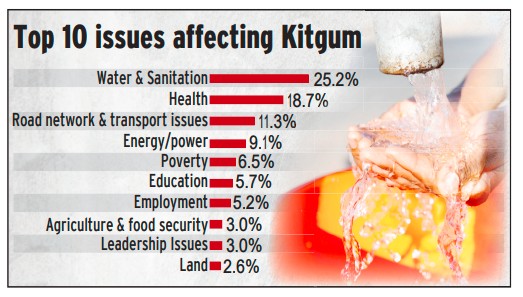
“Poverty has to be reduced because for now, we are second to Karamoja, we are at 59% in terms of poverty. When somebody is poor, obviously, he/she cannot even manage their own health and support their children to school. As much as we have Universal Primary Education and Universal Secondary Education, there are still many things that a parent is supposed to contribute for the welfare of their child,” Lamwaka said.
She said the people also have a lot of land, but they are not making use of it, citing the war that they underwent for about three decades.
“We are expecting the President to come and tell us how he is going to support the locals on mechanisation of agriculture. Agriculture is the backbone of Uganda’s economy, but we want to hear from him about how he is going to look into that,” Lamwaka said.
She added: “We have a very big challenge from our neighbours; the South Sudanese and the Karimojong. They are the people who are affecting us so much with insecurity. They come rape, steal our animals and kill our people.”
“This is something which has been long overdue, and we want the President, this time, to tell us the lasting solution that we, the people of Kitgum will have,” Lamwaka said.
She said the people of the eastern side of Kitgum and eastern side of Acholi, such as Agago, are affected by the animal invasions from Kidepo Valley National Park.
“Fencing of Kidepo national park has not started yet, despite the President’s directive,” Lamwaka said. Other things that she wants the Government to address include compensation of war claimants.
Acelam Alfred Odera, the LC3 chairperson of Orom (Kitgum), said the persistent raids by armed rustlers from the Karamoja sub-region have continued to destabilise communities, disrupt livelihoods and threaten peace in the region.
Odera is urging the Government to strengthen security patrols and enhance co-operation between local defence forces and the Uganda People’s Defence Forces to restore lasting peace.
Odera said the people of Kitgum also want the tarmacking of the Kitgum-Kidepo road, which goes through Orom and connects to Kaabong and Kotido districts.
Emmanuel Lapyem, the LC5 vice-chairperson of Kitgum, who doubles as the district NRM boss, said they expect creation of a new administrative unit called Chua.
According to the 2024 National Population and Housing Census, Pader and Kitgum have a combined population of about 480,000 people. A 2001 parliamentary legislation upgraded Aruu and Agago counties to form Pader district, carving them out of Kitgum district.
The district is surrounded by Lamwo to the northwest, Kitgum (northeast), Agago (east), Otuke (southeast), Lira (south,) Oyam (southwest) and Gulu (west). At the time Uganda secured its independence in 1962, Kitgum was part of Acholi district. In 1974, under the provincial administration, the then Acholi district was divided into two districts: West Acholi and East Acholi.
The latter became Kitgum district in 1980. The majority of the population in both administrative units draw their livelihood from agriculture, which is majorly on substance basis.
In both districts, authorities are undertaking ambitious interventions in line with the national priorities to secure prosperity for their people. “Villages in Pader will soon be connected to the electricity national grid, though our current focus is on improving water systems in urban centres,” Col Fearless Obwoya Oyat, the Pader LC5 chairperson, said.
Oyat said several roads in the district are for rehabilitation. “We’re implementing phased roadworks to improve access to public facilities. The long-awaited Puranga-Kitgum road has been included in the 2025/2026 budget, with feasibility studies already completed.”
The Pader district water officer, Patrick Olanya, said safe water coverage stands at over 90% though gaps remain.
What people say
Agnes Obina, resident of Odeng A Parish: Leaders should provide clean water and upgrade roads so that children access schools.
Alfonse Odongkara: Leaders should address the issue of nodding disease in the community and build rehabilitation centres for the affected.
Geoffrey Okello, resident of Kitgum Cell: I ask voters to choose leaders who can listen to the challenges and address them in the community.
Jimmy Lanyang, resident of Oader: I urge leaders to work on the road network so that people can access health centres, hospitals and markets for their products.
Monica Alanyo, LC3 Councillor of Pader: I ask the leaders to lobby for electricity in areas that are not connected so that people grow their businesses and help to fight poverty in homes.
Expert's view
Henry Kasacca, a political commentator, said what the people of northern Uganda are interested in hearing now from any presidential contestants is how to consolidate the peace ushered in with the defeat of Joseph Kony.
“Secondly, poverty is a big issue in Acholi and needs redress, on top of issues such as compensating war claimants and resettling the returnees,” Kasacca said.
He added: “The President has focused his campaign on economic emancipation and must continue with it in Acholi to ensure people have income to overcome poverty.”
How Vision Group was done
The survey was conducted between March and May, this year, covering a sample size of 6,006 Ugandans countrywide. The respondents were each asked: “In your opinion, which issues are affecting this community?”
To ensure national representation, the research team sampled eligible Ugandan voters from across 58 districts. Only citizens possessing a valid national ID, and aged 18 and above were sampled.
The survey covered all 17 sub-regions of Uganda. The respondents were randomly sampled from both rural and urban areas.