
Heavy security inspired confidence in voters — UHRC chief Wangadya
Wangadya said UHRC observers across the country consistently reported that voters appeared calm and willing to engage with the security personnel.
Hon. Mariam Wangadya (Extreme Right) the Chairperson of the Uganda Human Rights Commission (UHRC) issuing the commissions observers’ report on the recently concluded voting and declaration of elections results process as commissioners Shifrah Lukwago (extreme Left) and Crispin Kaheru (Centre) look on. This was at the commissions head offices at Nakasero Kampala on January 18, 2026. (Photos by Lawrence Mulondo.)
________________
Heavy deployment of security forces across Kampala city and other parts of the country during the January 15, 2026, General Election painted a picture that blended tension with reassurance.
From the early hours of the morning, soldiers in full combat, military police and heavily armed Police officers were visible on major roads, junctions and near polling and tallying centres.
Armoured personnel carriers rolled slowly through the streets, while foot patrols monitored crowds forming to cast their votes. For many Ugandans, it was an unmistakable sign that the state was taking no chances with security during the election period.
According to Uganda Human Rights Commission (UHRC) chairperson Mariam Wangadya, this heavy security deployment did not scare voters away, as some critics have argued. Instead, she says it inspired confidence among the electorate and reassured them that the voting process would take place in a secure environment.
Speaking to journalists today, January 18, in Kampala city, while releasing the commission’s election observation findings, Wangadya said UHRC observers across the country consistently reported that voters appeared calm and willing to engage with the security personnel.
She said people do not usually approach those who intimidate them, yet at several polling stations, voters freely walked up to Police officers, asking for directions and assistance.
“At the polling station where I voted, I personally saw voters approaching policemen and women, showing them their national identity cards, and asking where to vote from,” Wangadya said.
“You cannot do that if you are intimidated. On the contrary, people felt safe,” she added.
She recounted how security officers even stepped in to help vulnerable voters. At one polling station in Nakawa East, where she cast her vote, Wangadya said a visibly unwell young woman had been forced to sit on the grass due to delays caused by technical failures of voting equipment. A Police officer offered her a bottle of water, while others helped manage the queues.
Hon. Mariam Wangadya (Second from Right) the Chairperson of the Uganda Human Rights Commission (UHRC) issuing the commissions observers’ report on the recently concluded voting and declaration of elections results process as commissioners Shifrah Lukwago (extreme Left) and Crispin Kaheru (second from Left) and Simeo Muwanga Nsubuga (Extreme Right) follow on. This was at the commissions head offices at Nakasero on January 18, 2026.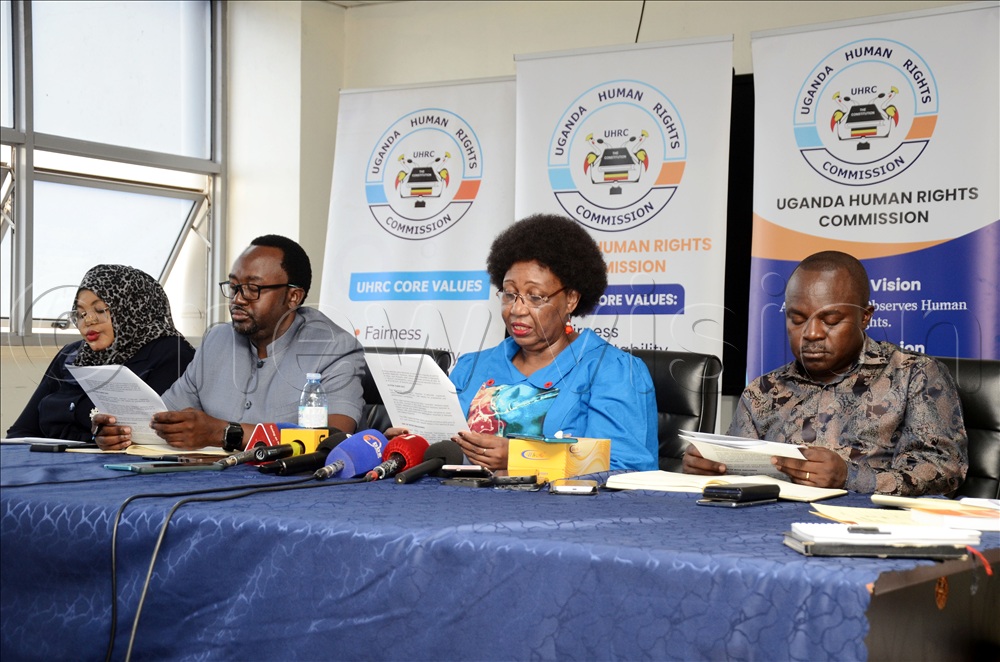
In Wangadya’s view, such actions contradicted claims that security forces were deployed to frighten voters.
Unacceptable events
However, the UHRC chairperson was clear that not all security-related incidents during the election period were acceptable. She strongly condemned acts of violence and intimidation reported during the tallying process, particularly at the Kololo tally center in Kampala.
Wangadya described scenes where groups of goons invaded tally centres, attacked Electoral Commission (EC) officials, and attempted to interfere with the transportation and handling of ballot materials.
She said such acts were criminal and posed a serious threat to the integrity of the electoral process.
“I was watching what happened in Kololo,” she said. “You had goons attacking EC officials as they were carrying sensitive electoral materials. This is criminality. It is wrong, and it must be confronted.”
She added that the chaos at Kololo significantly contributed to the delay in declaring results. According to her, candidates who emerged victorious should have been declared much earlier, but the prevailing insecurity slowed the process. Despite this, Wangadya commended EC officials stationed at the Kololo tally centre for standing firm in the face of intimidation.
“They resisted bullying and intimidation and declared the results as they were; that courage deserves recognition,” she said.
She called for the arrest and prosecution of all individuals involved in attacking election officials, warning that failure to act would entrench a culture of impunity. She stressed that elections cannot be free or credible if criminal elements are allowed to disrupt tallying and threaten officials without consequences.
No reason to doubt the election results
On broader questions about the credibility of the election results, Wangadya said she had no reason to doubt the authenticity of the figures declared by the chairperson of the Electoral Commission.
She explained that voting followed established procedures, with polling officials verifying voters against the register, showing ballot papers to agents before counting, and publicly displaying results at polling stations.
“Documents do not lie,” she said, adding that any candidate who doubts the results has a constitutional right to challenge them in court.
Low voter turnout
Wangadya rejected the argument that heavy deployment of security discouraged participation. She noted that a turnout of just over 50% was not unusually low by historical standards and said the early morning queues she observed suggested strong enthusiasm among voters.
If some voters left polling stations without voting, she said, it was more likely due to delays caused by technical and procedural challenges rather than fear of soldiers or police officers.
She pointed out that some polling stations started voting late because of failures in biometric kits, forcing voters to wait for hours.
She emphasised that no voter was deliberately disenfranchised, including herself. Although she arrived at her polling station shortly after 7:00am, she only managed to vote around 10:00am due to delays, but she was still able to cast her ballot freely.
Internet shutdown
On the controversial internet shutdown during the election period, Wangadya acknowledged that businesses suffered losses but said the suspension had been justified by authorities on grounds of public interest and national security.
She advised affected business owners to seek compensation through the courts if they wished.
Wangadya said the UHRC will push for reforms aimed at improving future elections, including better voter education, comprehensive testing of electoral technologies, and accountability for all acts of violence and intimidation.
In her assessment, the presence of soldiers and police officers on the streets, though striking, largely achieved its intended purpose.
“In our observation, the deployment of security inspired confidence among the people. We were assured of safety. The problem was not the presence of security but the criminal acts by those who sought to undermine the process,” she said.