
Kabale bishop rallies Christians to support Ebola containment efforts
Bishop Rubaramira urged members of the public to strictly observe the standard operating procedures and guidelines issued by the Ministry of Health to prevent the spread of Ebola, which continues to pose a threat to communities across the country.
Christians in Kabale Diocese pose for a group photo after the mass on Wednesday, June 3, 2026. (Credit: Ahimbisibwe Nelson)
___________________
Christians in Kabale Diocese joined the rest of the country in commemorating Uganda Martyrs Day with prayers, reflection and renewed calls for public vigilance against the Ebola outbreak that has disrupted religious and social activities across Uganda.
The call was made by the Bishop of Kabale Diocese, Rt Rev. Callist Rubaramira, during a Uganda Martyrs Day Mass held at Our Lady of Good Shepherd Rushoroza Cathedral Parish in the Southern Division of Kabale Municipality.
Bishop Rubaramira urged members of the public to strictly observe the standard operating procedures and guidelines issued by the Ministry of Health to prevent the spread of Ebola, which continues to pose a threat to communities across the country. He emphasised the need for vigilance and collective responsibility, noting that the disease remains highly contagious and dangerous.
Bishop Rubaramira urged members of the public to strictly observe the standard operating procedures and guidelines issued by the Ministry of Health to prevent the spread of Ebola, which continues to pose a threat to communities across the country. (Credit: Ahimbisibwe Nelson)
The Bishop encouraged the public to maintain proper hygiene practices, including regular handwashing with clean water and soap, frequent use of hand sanitisers, and immediate reporting to health facilities whenever symptoms associated with Ebola are detected.
He also called upon communities to cooperate with health authorities and support government efforts aimed at containing the outbreak.
The impact of the Ebola outbreak was evident during this year’s Uganda Martyrs Day celebrations, which were significantly scaled down compared to previous years.
Authorities limited large gatherings at Namugongo as part of measures to reduce the risk of transmission and protect public health. As a result, many Christians marked the day in their dioceses, parishes and homes rather than undertaking the traditional pilgrimage to the national shrine.
Despite the restrictions, the significance of Uganda Martyrs Day remained undiminished as Christians reflected on the extraordinary sacrifice of the 45 young converts who died for their faith between 1885 and 1887.
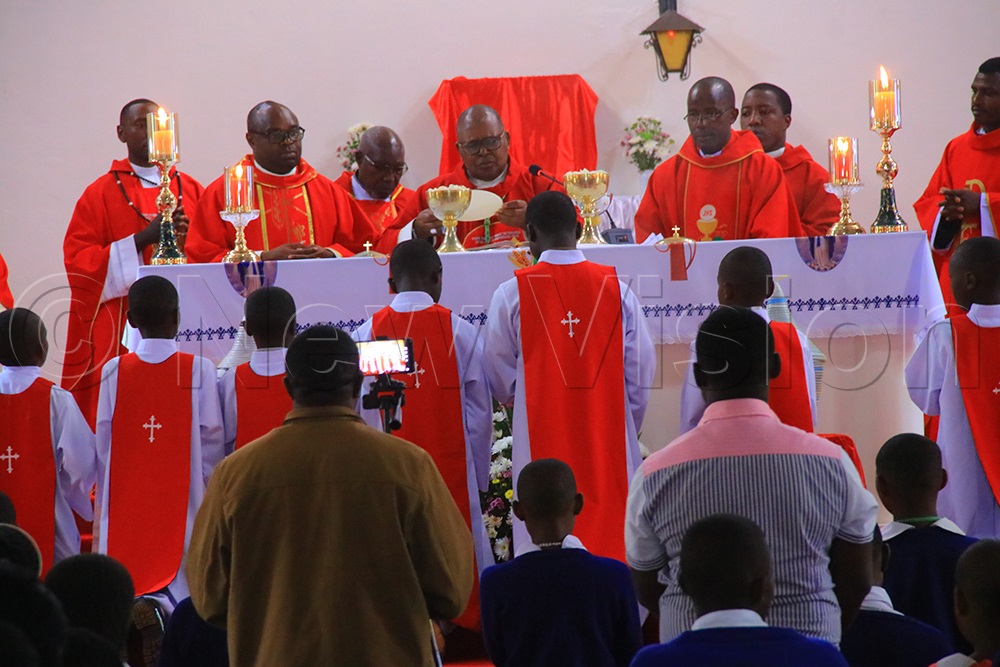
Christians in Kabale Diocese during Mass on Wednesday, June 3, 2026. (Credit: Ahimbisibwe Nelson)
During the same Mass, the parish priest of Rushoroza Cathedral, Rev. Fr Austin Christmas, called upon Christians to emulate the faith, courage, resilience and commitment demonstrated by the Uganda Martyrs. He encouraged believers to remain steadfast in their faith while facing the challenges of modern life and to continue promoting peace, unity and love within their communities.
The annual commemoration honours the Uganda Martyrs, a group of 22 Catholic and 23 Anglican converts who were executed during the reign of Kabaka Mwanga II of Buganda. The young men were killed after refusing to renounce Christianity and rejecting demands that conflicted with their religious beliefs.
Their persecution began in 1885 as Christianity continued to spread within the Buganda Kingdom. Concerned by the growing influence of the new faith among members of his royal court, Kabaka Mwanga II launched a campaign against Christian converts.
One of the most notable figures among the martyrs was Charles Lwanga, who emerged as a leader of the Christian pages. He encouraged fellow believers to remain faithful despite the threat of death. His courage and leadership continue to inspire Christians around the world.
The most remembered event in the history of the Uganda Martyrs occurred on June 3, 1886, when a large group of converts was marched to Namugongo and burnt alive. Among those executed was Kizito, the youngest of the martyrs, whose unwavering faith has become a symbol of courage for young Christians.
Several Catholic martyrs, including Lukka Baanabakintu, James Buuzabalyawo, Gyaviira Musoke, Ambrosius Kibuuka, Anatoli Kiriggwajjo, Mukasa Kiriwawanvu, Achileo Kiwanuka, Adolphus Mukasa Ludigo, Mugagga Lubowa, Bruno Sserunkuuma and Mbaga Tuzinde, died alongside their companions at Namugongo.
The Anglican martyrs who perished at Namugongo included Nuwa Walukagga, Alexander Kadoko, Frederick Kizza, Robert Munyagabyangu, Danieri Nakabandwa, Kiwanuka Giyaza, Mukasa Lwakisiga, Mubi Azaalwa, Kwabafu, Kifamunnyanja and Muwanga Njigiya. Other martyrs were speared, beheaded or subjected to brutal punishment in different parts of Buganda.
Although the executions were intended to suppress Christianity, they instead strengthened the faith and accelerated its spread throughout Uganda. The courage displayed by the martyrs inspired many people to embrace Christianity, contributing to the growth of the Church across the country.
Today, Namugongo remains one of Africa’s most important Christian pilgrimage destinations, attracting millions of believers every year. The shrine stands as a symbol of faith, sacrifice, perseverance and devotion.
As Christians marked this year’s Uganda Martyrs Day under the shadow of an Ebola outbreak, church leaders emphasised that the martyrs’ legacy remains relevant. Their example of courage, discipline and commitment continues to inspire believers to remain faithful in times of uncertainty while supporting efforts to protect lives and safeguard communities.